



- Atal Bhujal Yojana was launched on 25 December 2019 for sustainable groundwater management.
- The scheme covered 8,203 Gram Panchayats in 229 blocks across 80 districts in 7 states.
- It focused on water budgeting, Water Security Plans, groundwater monitoring and efficient water use.
- Atal Bhujal Yojana (Atal Jal)
- Phone: 011-24320293
- Email: [email protected]
Summary of the Scheme | |
|---|---|
| Name of Scheme | Atal Bhujal Yojana (Atal Jal) |
| Launch Year | 2019 |
| Benefits | Community-led groundwater management across 8,203 Gram Panchayats, including water budgeting, Water Security Plans, groundwater monitoring and support for efficient water-use practices. |
| Beneficiary | Communities, farmers and groundwater users in selected water-stressed Gram Panchayats across 7 states. |
| Nodal Agency | Department of Water Resources, River Development & Ganga Rejuvenation, Ministry of Jal Shakti |
| Subscription | Subscribe here to get Update Regarding Scheme |
| Mode of Apply | No individual application. The scheme was implemented through selected Gram Panchayats and community-level groundwater management processes. |
Scheme Introduction: A Brief Overview
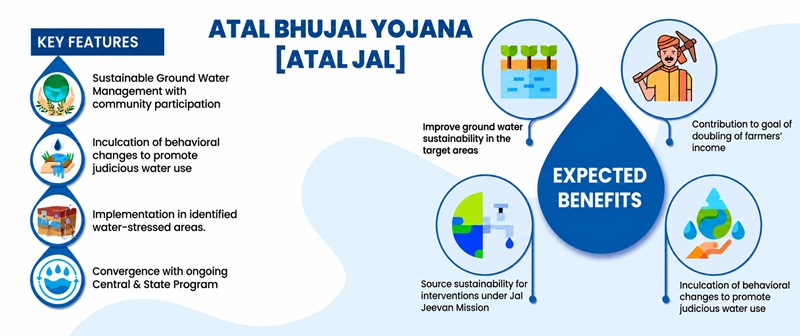
Groundwater is an important source of water for agriculture, drinking water and rural livelihoods, but excessive extraction has placed pressure on groundwater resources in many parts of the country. To address this challenge through community participation, the Government of India introduced the Atal Bhujal Yojana (Atal Jal). The scheme was launched on 25 December 2019 and became operational from 1 April 2020 as a Central Sector Scheme for sustainable groundwater management in selected water-stressed areas. Under the pilot, community-led groundwater management was taken up across 8,203 Gram Panchayats in 229 blocks and 80 districts across 7 states. The programme focused on water budgeting, Water Security Plans, groundwater monitoring, efficient water-use practices and convergence with existing government schemes rather than providing a universal cash benefit to individual applicants.
The scheme was implemented by the Department of Water Resources, River Development & Ganga Rejuvenation (DoWR, RD & GR), Ministry of Jal Shakti. Atal Jal followed a community-led and demand-side approach in which Gram Panchayats and local communities used groundwater data to prepare water budgets and Water Security Plans. These plans identified measures such as micro-irrigation, crop diversification, rainwater harvesting and groundwater recharge, with interventions implemented through convergence with ongoing Central and State Government schemes.
The programme had a total outlay of ₹6,000 crore, divided into ₹1,400 crore for Institutional Strengthening & Capacity Building and ₹4,600 crore for the Incentive Component. The incentive component was linked to predefined results, including public disclosure of groundwater data, preparation of Water Security Plans, financing of approved plans, adoption of efficient water-use practices and improvement in groundwater conditions.
Atal Bhujal Yojana was not a conventional individual subsidy or direct-benefit scheme with a standard online application. However, farmers in participating areas received assistance for certain efficient water-use practices through the programme's convergence and incentive framework. The Government reported that 9,78,709 direct beneficiaries received assistance or subsidies for such practices between October 2021 and December 2024.
The Atal Bhujal Yojana pilot was implemented from 1 April 2020 to 15 October 2025. It is therefore not currently open for fresh individual applications. The Government's latest assessment reported that, during assessments conducted from 2023 to 2025, 180 out of 229 participating blocks showed improvement in groundwater levels.
Readers interested in schemes related to irrigation and water conservation can also explore the Bihar Mukhyamantri Niji Nalkup Yojana on GovtSchemes.in, which provides financial assistance to eligible farmers for private tube wells and motor pumps in Bihar. The scheme is separate from Atal Bhujal Yojana and has its own eligibility and application process.
Scheme Benefits
- Atal Bhujal Yojana has a total financial outlay of ₹60,000 crore for five years. This includes ₹30,000 crore in World Bank assistance and an equal ₹30,000 crore contribution from the Government of India.
- Around ₹14,000 crore is allocated for institutional strengthening and capacity building. This covers training, community mobilization and equipment such as digital groundwater-level recorders, rain gauges and water-quality testing kits.
- The scheme has an incentive component of ₹46,000 crore. Financial incentives are linked to the achievement of specified groundwater-management targets by participating states and Gram Panchayats.
- The scheme supports measures to reduce groundwater demand, including drip and sprinkler irrigation, reuse of treated or recycled water, underground pipelines and suitable crop diversification.
- It also supports groundwater recharge and water conservation through structures such as check dams, percolation ponds, contour trenches, sub-surface dykes and farm ponds.
- State groundwater-quality laboratories can be strengthened and upgraded to help them obtain NABL accreditation for testing and calibration.
Conditions
- The participating Gram Panchayat must establish or strengthen a Village Water and Sanitation Committee (VWSC) to support participatory groundwater management.
- Water budgeting should be carried out regularly, preferably season-wise or at least once every year.
- The Water Security Plan should be reviewed and updated annually according to changes in local water requirements and planned interventions.
- Social audits should be conducted to obtain community feedback and promote transparency in scheme-related activities.
- Proper financial and implementation records must be maintained. Gram Panchayats are required to submit audited financial statements and utilization certificates for the funds received.
How Atal Bhujal Yojana Works
Atal Bhujal Yojana followed a community-led planning process in which groundwater information was combined with local knowledge and water-use requirements. The approach focused mainly on managing demand for groundwater while also supporting suitable conservation and recharge measures.
- Groundwater levels, rainfall and water-use information were collected and made available to local communities.
- Communities used this information to understand the balance between available groundwater and local demand.
- Gram Panchayats prepared Water Budgets and community-led Water Security Plans based on local conditions.
- The plans identified measures for reducing groundwater demand and improving water availability.
- Approved activities were implemented through convergence with relevant Central and State Government schemes.
- Groundwater levels and implementation progress were monitored regularly to assess changes and improve local planning.
- State-level performance was assessed against the prescribed Disbursement Linked Indicators for the incentive component.
This approach connected groundwater monitoring, community planning and government-funded interventions instead of treating groundwater conservation as a stand-alone activity.
The Water Security Plan (WSP) was the main local planning document under Atal Jal. It was prepared at the Gram Panchayat level with community participation and was designed around the actual groundwater situation and water requirements of the area.
- The plan was prepared using groundwater, rainfall and water-use information available for the Gram Panchayat.
- It identified the major causes of groundwater stress and areas where water demand could be reduced.
- Demand-side measures could include drip or sprinkler irrigation, crop diversification, mulching and other efficient water-use practices.
- Supply-side measures could include ponds, check dams, recharge shafts, recharge pits, rainwater harvesting and other suitable conservation works.
- The proposed activities were taken forward through convergence with relevant government schemes and departments.
- Water Security Plans were updated annually to reflect changes in groundwater conditions and local water requirements.
The Government reported that community-led Water Security Plans had been prepared and updated annually by all 8,203 participating Gram Panchayats.
States and Areas Covered
Atal Bhujal Yojana was implemented as a pilot programme in selected groundwater-stressed areas rather than across the entire country. The programme covered 8,203 priority water-stressed Gram Panchayats in 229 blocks across 80 districts of seven states.
- Gujarat – 6 districts, 36 blocks and 1,873 Gram Panchayats
- Haryana – 14 districts, 36 blocks and 1,647 Gram Panchayats
- Karnataka – 14 districts, 41 blocks and 1,199 Gram Panchayats
- Madhya Pradesh – 6 districts, 9 blocks and 670 Gram Panchayats
- Maharashtra – 13 districts, 43 blocks and 1,133 Gram Panchayats
- Rajasthan – 17 districts, 38 blocks and 1,132 Gram Panchayats
- Uttar Pradesh – 10 districts, 26 blocks and 549 Gram Panchayats
The participating areas were selected with consideration to groundwater depletion and stress, institutional readiness, existing water-management systems, previous experience in groundwater conservation and the willingness of the concerned areas to participate. Final selection of Gram Panchayats was carried out by the respective State Governments.
Eligibility Requirements
Atal Bhujal Yojana was not open for individual applications. The programme was implemented in selected water-stressed areas, where Gram Panchayats and local communities participated in groundwater planning and management. The main eligibility and participation conditions were as follows:
- The Gram Panchayat must be located in one of the 7 participating states: Gujarat, Haryana, Karnataka, Madhya Pradesh, Maharashtra, Rajasthan or Uttar Pradesh.
- The Gram Panchayat must fall within the selected 80 districts and 229 blocks covered under the programme.
- The programme covered 8,203 selected water-stressed Gram Panchayats identified under the programme framework.
- Gram Panchayats and their communities were expected to participate in groundwater management activities such as water budgeting and preparation of Water Security Plans.
- Local communities, farmers and groundwater users in participating Gram Panchayats could take part in activities related to groundwater conservation and efficient water use.
- Community institutions involved in groundwater management were expected to support participatory planning, monitoring and implementation.
- Women were given a defined role in community decision-making, with a minimum 33% participation requirement in relevant decision-making arrangements.
- Individual citizens could not apply separately for Atal Bhujal Yojana benefits through a nationwide online application form.
- Assistance for eligible water-efficient practices, where available through the programme, was linked to participating areas and implemented through convergence with relevant government schemes.
As the Atal Bhujal Yojana pilot ended on 15 October 2025, fresh individual applications are not currently being accepted under the completed programme. The scheme's final coverage and participation figures were 7 states, 80 districts, 229 blocks and 8,203 Gram Panchayats.
Required Documents
Atal Bhujal Yojana did not have a standard document checklist for individual applicants because the programme was not designed as an individual application or direct cash-benefit scheme. Participation was organised through selected Gram Panchayats and community-level groundwater management processes.
- No individual application form was required for participation in the scheme.
- No standard Aadhaar, income certificate or bank account document was required for a general Atal Jal application.
- Gram Panchayats and community institutions used groundwater, rainfall, water-use and other local resource data for water budgeting and preparation of Water Security Plans.
- Records and supporting information required for programme activities were maintained through the relevant Gram Panchayat, district and state-level implementation arrangements.
- Farmers receiving assistance for specific water-efficient practices through convergence had to meet the requirements of the respective government scheme through which the assistance was provided.
Since the Atal Bhujal Yojana pilot was completed on 15 October 2025, there is no current nationwide document submission or individual application process under the scheme.
Steps to Apply
Atal Bhujal Yojana was implemented through selected Gram Panchayats and community-level groundwater management institutions, so individuals were not required to submit a separate application form to receive benefits under the scheme. The participation process worked through the selected local bodies and their Water Security Plans rather than through an individual online registration system.
- First, the Gram Panchayat had to fall within the areas selected for Atal Bhujal Yojana. The pilot covered 8,203 Gram Panchayats across 229 blocks in 80 districts of Gujarat, Haryana, Karnataka, Madhya Pradesh, Maharashtra, Rajasthan and Uttar Pradesh.
- Local communities participated in collecting and using groundwater-related information, including data on groundwater levels, rainfall and water use. This information supported local water planning.
- The Gram Panchayat prepared a community-led Water Budget to understand the availability of water and the demand for it within the local area.
- Based on the water budget, the community prepared a Water Security Plan identifying suitable measures for groundwater conservation, recharge and efficient water use. Water Security Plans were updated annually during the programme.
- The approved measures were taken up by the concerned State Government through convergence with relevant Central and State Government schemes. These could include water-efficient irrigation, crop diversification and groundwater recharge or conservation works.
- Atal Bhujal Yojana did not provide a separate online application route through which an individual could claim a fixed cash benefit. The Government has specifically stated that incentive amounts under the scheme were released to participating States based on achievement of the prescribed Disbursement Linked Indicators.
- Farmers who received assistance for eligible water-efficient practices had to participate through the applicable local implementation and convergence arrangement. The requirements for receiving such assistance depended on the particular government scheme or intervention through which it was provided.
- The Atal Bhujal Yojana pilot was implemented from 1 April 2020 to 15 October 2025. Therefore, fresh individual applications are not currently being accepted under the completed pilot programme.
For information about the completed programme, its coverage, implementation records and groundwater-management activities, readers can refer to the official Department of Water Resources, River Development & Ganga Rejuvenation, Ministry of Jal Shakti. The latest Government assessment confirms that the programme was implemented as a fixed-duration pilot and is no longer an ongoing individual-benefit application scheme.
Role of Gram Panchayats and Local Communities
Gram Panchayats and local communities were central to the implementation model of Atal Jal. Instead of relying only on departmental planning, the scheme involved local communities in understanding groundwater conditions and deciding suitable measures for their areas.
- Gram Panchayats participated in groundwater data collection, monitoring and public disclosure.
- Local communities took part in preparing Water Budgets and Water Security Plans.
- Communities helped identify suitable demand-side and supply-side measures based on local groundwater conditions.
- Gram Panchayats supported awareness and capacity-building activities related to sustainable groundwater use.
- Local participation helped encourage efficient irrigation, crop diversification and other water-saving practices.
- Community-level monitoring helped track changes in groundwater conditions and the implementation of planned activities.
- District Implementation Partners, including NGOs, were engaged to support community participation and implementation.
The community-led model was intended to make groundwater management a shared local responsibility rather than relying entirely on government departments for planning and implementation.
Relevant Links
- Department of Water Resources, River Development & Ganga Rejuvenation
- Atal Bhujal Yojana (Atal Jal) Official Portal
- Atal Bhujal Yojana – Programme Details and Guidelines
- Atal Bhujal Yojana – Latest Government Status
Contact Information
For scheme-specific queries relating to Atal Bhujal Yojana, the official Department of Water Resources directory lists the Atal Jal office under the Ministry of Jal Shakti. As the pilot programme has been completed, this contact is more appropriate than providing an individual application helpline.
Atal Bhujal Yojana (Atal Jal) Department of Water Resources, River Development & Ganga Rejuvenation
- Phone: 011-24320293
- Email: [email protected]
- Address: Atal Bhujal Yojana, 6th Floor, MDSS (MTNL) Building, CGO Complex, Pragati Vihar, New Delhi - 110003
Frequently Asked Questions
Atal Bhujal Yojana, also known as Atal Jal, is a Government of India programme focused on sustainable groundwater management through community participation.
The scheme was launched on 25 December 2019 and became operational from 1 April 2020.
The main objective is to improve groundwater management through water budgeting, Water Security Plans, groundwater monitoring and efficient water-use practices.
The scheme covered Gujarat, Haryana, Karnataka, Madhya Pradesh, Maharashtra, Rajasthan and Uttar Pradesh.
The programme covered 8,203 selected Gram Panchayats across 229 blocks and 80 districts.
No. It was not a conventional individual subsidy or direct-benefit scheme. It was implemented through selected Gram Panchayats and community-level groundwater management processes.
A Water Security Plan is a Gram Panchayat-level plan prepared with community participation to identify measures for groundwater conservation, recharge and efficient water use.
The programme supports activities such as drip and sprinkler irrigation, crop diversification, mulching, rainwater harvesting, groundwater recharge and water-conservation measures.
No. The pilot programme ended on 15 October 2025, so fresh individual applications are not currently being accepted under the completed programme.
The scheme was implemented by the Department of Water Resources, River Development & Ganga Rejuvenation, Ministry of Jal Shakti, through central, state, district and Gram Panchayat-level arrangements.
Do you have any question regarding schemes, submit it in scheme forum and get answers:
Feel free to click on the link and join the discussion!
This forum is a great place to:
- Ask questions: If you have any questions or need clarification on any aspect of the topic.
- Share your insights: Contribute your own knowledge and experiences.
- Connect with others: Engage with the community and learn from others.
I encourage you to actively participate in the forum and make the most of this valuable resource.


Add new comment