


- The scheme was originally launched as Deendayal Vikas Yojana on 25 September 1991.
- It was renamed Baba Saheb Ambedkar Rozgar Protsahan Yojana on 14 November 2019.
- Eligible rural residents of Uttar Pradesh aged 18 to 65 years can apply.
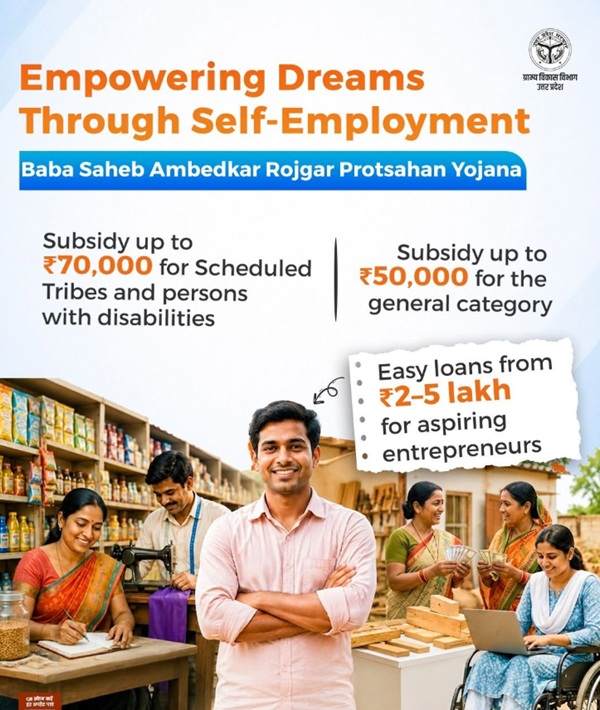
- SC/ST and Divyang applicants can receive a 35% subsidy up to ₹70,000, while General category applicants can receive 25% up to ₹50,000.
- Rural Development Department (Gram Vikas Vibhag), Government of Uttar Pradesh Phone: 18001805999
Summary of the Scheme | |
|---|---|
| Name of Scheme | Baba Saheb Ambedkar Rojgar Protsahan Yojana |
| Launch Year | 1991 (Originally launched as Deendayal Vikas Yojana) |
| Benefits | Government subsidy up to ₹70,000 for self-employment projects. |
| Beneficiary | Unemployed rural residents of Uttar Pradesh aged 18–65 years with annual family income up to ₹2 lakh. |
| Nodal Agency | Rural Development Department, Uttar Pradesh |
| Subscription | Subscribe here to get Update Regarding Scheme |
| Mode of Apply | Offline through the Block Development Office (Vikas Khand) |
Scheme Introduction: A Brief Overview
Starting a business or setting up a small enterprise can be difficult for rural unemployed people who have the skills and willingness to work but lack the money needed to establish their own ventures. To address this challenge and create sustainable employment opportunities in rural areas, the Government of Uttar Pradesh runs the Baba Saheb Ambedkar Rojgar Protsahan Yojana. The scheme provides bank-loan-linked financial assistance with a government subsidy to eligible rural residents who want to start their own businesses, service enterprises or small industries. Under the scheme, the maximum project cost is ₹2 lakh for business activities and ₹5 lakh for service and industrial activities. Eligible General-category beneficiaries can receive a subsidy of 25% of the loan disbursed, up to ₹50,000, while SC/ST beneficiaries and persons with disabilities (Divyang) can receive 35%, up to ₹70,000.
Originally launched on 25 September 1991 as the Deendayal Vikas Yojana, the scheme was later renamed the Ambedkar Special Employment Scheme. On 14 November 2019, the Uttar Pradesh Government renamed it the Baba Saheb Ambedkar Employment Promotion Scheme and introduced revised implementation guidelines. The scheme is implemented by the Rural Development Department (Gram Vikas Vibhag), Government of Uttar Pradesh, with the District Development Officer (DDO) serving as the nodal officer at the district level.
The Baba Saheb Ambedkar Employment Promotion Scheme aims to create permanent employment opportunities in rural areas of Uttar Pradesh. It encourages unemployed people to start their own businesses or income-generating activities using local resources and skills. The scheme covers both agricultural and non-agricultural activities and provides support through bank loans, government subsidies, training and marketing assistance. Its main goals are to reduce unemployment in villages, increase family income and reduce the need for people to move to cities in search of work. If applicants need training for their proposed business, it can be arranged through institutions such as the Uttar Pradesh Skill Development Mission (UPSDM), Deen Dayal Upadhyaya Grameen Kaushalya Yojana (DDU-GKY) and Rural Self Employment Training Institutes (RSETIs).
The scheme is open to unemployed people who live in rural areas of Uttar Pradesh, are between 18 and 65 years old and have an annual family income of up to ₹2 lakh from all sources. People from all castes, communities and religions can apply. However, preference is given to Scheduled Caste (SC), Scheduled Tribe (ST), persons with disabilities (Divyang), abandoned women and widows. The scheme also provides at least 23% reservation for SC/ST beneficiaries and 5% horizontal reservation for persons with disabilities. Applicants who have received training under State or Central Government skill development programmes are also given preference during selection. However, people who have already taken loans under certain other self-employment schemes, such as the Pradhan Mantri Mudra Yojana or Prime Minister's Rozgar Yojana, cannot apply under the scheme.
Eligible applicants can get the application form from their respective Block Development Office (Vikas Khand) and submit it before the deadline announced by the district administration. They can submit the form in person or send it by registered post. Applicants should collect an acknowledgement receipt after submitting the application. The government guidelines issued in 2019 also mention online applications through the Rural Development Department's website, but a working online application link could not be verified. The selection process includes an initial screening at the block level, followed by an interview conducted by the District-Level Selection and Implementation Committee. For application dates, eligibility details or help with the application process, applicants can contact their Block Development Officer (BDO), Assistant Development Officer (ADO) or District Development Officer (DDO).
The Government of Uttar Pradesh also operates other schemes to promote self-employment and entrepreneurship. Readers interested in starting a rural enterprise can explore the Uttar Pradesh Mukhyamantri Gramodyog Rojgar Yojana, which provides bank loans and interest subsidy for eligible rural entrepreneurs. Similarly, the Chief Minister Yuva Udhyami Vikas Abhiyan (CM-YUVA) supports eligible youth in establishing new micro-enterprises, while the Uttar Pradesh Mukhyamantri Yuva Swarojgar Yojana provides financial assistance to educated unemployed youth for setting up industrial and service-sector enterprises. These schemes offer different eligibility conditions and financial benefits, so applicants should check their respective guidelines before applying.
Scheme Benefits
The Baba Saheb Ambedkar Employment Promotion Scheme provides financial support to eligible rural residents who want to start their own businesses or enterprises. The major benefits offered under the scheme are as follows:
- Eligible beneficiaries can receive a government subsidy of up to ₹70,000 to establish their own self-employment activities.
- General-category beneficiaries can receive a subsidy of 25% of the loan disbursed, subject to a maximum of ₹50,000.
- SC/ST beneficiaries and persons with disabilities (Divyang) can receive a subsidy of 35% of the loan disbursed, subject to a maximum of ₹70,000.
- Beneficiaries can establish business projects costing up to ₹2 lakh and service or industrial projects costing up to ₹5 lakh.
- The scheme supports both agricultural and non-agricultural activities that can generate sustainable income in rural areas.
- Eligible applicants can receive assistance for setting up small businesses, service enterprises and industries based on local resources and market requirements.
- Beneficiaries can receive project-based skill training through institutions such as the Uttar Pradesh Skill Development Mission (UPSDM), DDU-GKY and Rural Self Employment Training Institutes (RSETIs), wherever required.
- The scheme provides support for production and marketing of rural products and services to help beneficiaries reach markets and earn better returns.
- For eligible loans exceeding ₹2.50 lakh, the beneficiary's margin money contribution is 7.5% for general-category applicants and 5% for SC/ST and Divyang applicants.
- Beneficiaries receive a one-year moratorium before the bank starts loan recovery, as prescribed under the scheme guidelines.
- The scheme provides at least 23% reservation for SC/ST beneficiaries and 5% horizontal reservation for persons with disabilities.
- Women, widows, abandoned women and individuals trained under State or Central Government skill development programmes receive priority during beneficiary selection.
Financial Assistance and Subsidy
Under the Baba Saheb Ambedkar Rojgar Protsahan Yojana, eligible applicants can get a bank loan along with a government subsidy to start their own business, service or industrial unit in rural areas of Uttar Pradesh. The amount of subsidy depends on the applicant's category and the loan amount disbursed by the bank.
The financial assistance available under the scheme is explained below:
| Category | Subsidy Rate | Maximum Subsidy |
|---|---|---|
| SC/ST and Divyang applicants | 35% of the loan disbursed | ₹70,000 |
| General category applicants | 25% of the loan disbursed | ₹50,000 |
The subsidy is calculated on the loan amount disbursed by the bank. Applicants receive the applicable percentage or the maximum subsidy limit, whichever is lower.
Maximum Project Cost
The maximum project cost allowed under the scheme depends on the type of activity:
- Business activities: Up to ₹2 lakh.
- Service and industrial activities: Up to ₹5 lakh.
Beneficiary Contribution (Margin Money)
Applicants taking a loan of more than ₹2.5 lakh are required to contribute a part of the project cost as margin money. The required contribution is:
- General category: 7.5% of the unit cost.
- SC/ST and Divyang applicants: 5% of the unit cost.
The subsidy is transferred to the beneficiary's bank account through Direct Benefit Transfer (DBT) after the bank sanctions the loan and the required government funds are made available. The subsidy is adjusted after the concerned officer verifies that the project assets have been created.
Eligibility Requirements
To receive financial assistance under the Baba Saheb Ambedkar Rojgar Protsahan Yojana, applicants must fulfil the following eligibility conditions prescribed by the Uttar Pradesh Government:
- The applicant must be a resident of a rural area of Uttar Pradesh.
- The applicant must be at least 18 years old and not more than 65 years old.
- The annual income of the applicant's family from all sources must not exceed ₹2 lakh.
- The applicant must be unemployed and willing to start their own business, service enterprise or industrial unit.
- People belonging to any caste, class or religion can apply for the scheme.
- Priority is given to applicants belonging to Scheduled Castes (SC), Scheduled Tribes (ST), persons with disabilities (Divyang), abandoned women and widows.
- Applicants who have received training under State or Central Government skill development programmes, such as UPSDM and DDU-GKY, are also given priority during selection.
- Only individual applications are accepted; applications submitted by groups are not eligible.
- Applicants who have already received loans under other self-employment schemes, such as the Pradhan Mantri Mudra Yojana or Prime Minister's Rozgar Yojana, are not eligible under the scheme guidelines.
Required Documents
Applicants need to submit an application along with the necessary supporting documents to establish their eligibility for the Baba Saheb Ambedkar Rojgar Protsahan Yojana. The official guidelines do not provide a fixed statewide list of required documents. However, applicants may be asked to provide the following documents by their respective Block Development Office:
- Aadhaar card or other valid identity proof.
- Proof of age to confirm that the applicant is between 18 and 65 years old.
- Rural residence certificate or other proof of residence in Uttar Pradesh.
- Family income certificate showing an annual income of not more than ₹2 lakh.
- Caste certificate for applicants claiming SC/ST category benefits.
- Disability certificate for applicants claiming benefits under the Divyang category.
- Training certificate, if the applicant has received training under a State or Central Government skill development programme.
- Bank account details or a copy of the bank passbook.
- Details of the proposed business, service or industrial project.
- Recent passport-size photographs.
Note: This is a suggested list for applicants' guidance, not an officially prescribed document checklist. Before applying, contact your Block Development Office (Vikas Khand) to confirm the exact documents required and obtain the prescribed application form.
Loan Repayment and Subsidy Rules
The financial assistance under the Baba Saheb Ambedkar Rojgar Protsahan Yojana is linked to a bank loan. Therefore, beneficiaries must use the loan for the approved project and follow the repayment conditions prescribed by the bank.
The main loan and subsidy conditions are as follows:
- A one-year moratorium is provided before the bank begins loan recovery under the scheme guidelines.
- The maximum period allowed for completing the project is three years.
- The bank charges interest on the bank-financed portion of the loan. The beneficiary's contribution and government subsidy are not treated as bank-loan amounts for this purpose.
- The subsidy is adjusted after the concerned District Development Officer or authorised officer verifies the creation of assets under the approved project.
- Beneficiaries must repay the bank loan according to the repayment schedule fixed by the bank after the applicable moratorium.
- Under the scheme guidelines, a beneficiary should not be declared a defaulter once 80% of the loan has been repaid.
When Can the Subsidy Be Withheld or Withdrawn?
Receiving a bank loan does not automatically make an applicant eligible to retain the government subsidy. The beneficiary must use the loan properly and complete the approved project. The subsidy may not be released or may be withdrawn in situations such as:
- The beneficiary uses the loan for a purpose other than the approved project.
- The beneficiary fails to create the required assets.
- The project is not completed and the beneficiary wilfully defaults on the loan.
- The bank declares the beneficiary's loan account as a defaulter.
- The business or industrial unit stops production or service activities or closes down.
Beneficiaries should therefore use the loan only for the approved purpose, establish the proposed unit and follow the bank's repayment schedule to remain eligible for the subsidy.
Selection Process
The selection of beneficiaries under the Baba Saheb Ambedkar Rojgar Protsahan Yojana is carried out at the block and district levels. Applicants are assessed on their eligibility, skills, training, experience and proposed business activity.
The selection process generally involves the following steps:
- Applicants submit their completed application forms to the concerned Block Development Office within the prescribed period. Applications are entered into a register according to their date of receipt.
- The Block Application Screening Committee examines the applications. If the number of applications exceeds the available target, applicants are shortlisted for further assessment. The committee may call up to four times the number of applicants against the available target for interviews.
- Applicants are assessed on factors such as educational qualifications, professional skills, training received under government programmes, work experience and age-based seniority.
- Shortlisted applicants are called for an interview before the District Level Selection and Implementation Committee, which is chaired by the District Magistrate (DM). The interview date and venue are communicated to applicants through the concerned Block Development Office.
- The selection results are announced within one working day after the interview. The selected applicants and waiting list are displayed on the district website and at the offices of the District Development Officer and Block Development Officer.
- After selection, the Block Development Office forwards the applicants' loan files to the concerned bank for further processing and loan disbursement.
Selection Process at a Glance
Selection does not automatically guarantee the release of a loan. The bank must also process and sanction the loan according to the applicable rules.
Steps to Apply
If you want to start your own business, service enterprise or small industry under the Baba Saheb Ambedkar Rojgar Protsahan Yojana, you need to submit an application through your local development block. The scheme's 2019 guidelines also provide for online applications, but a working online application facility could not be verified. Therefore, applicants can follow the block-level application process explained below:
- Get the Application Form: Visit your local Block Development Office (Vikas Khand) and contact the concerned Assistant Development Officer (ADO) to obtain the prescribed application form for the scheme.
- Fill in the Application Form: Enter your personal details, residential information, family income and other required information. Also provide details of the business, service or industrial unit you want to establish.
- Attach the Required Documents: Attach the supporting documents requested by the concerned block office, such as age proof, rural residence proof, income certificate, bank details and relevant caste or disability certificates, wherever applicable.
- Submit the Application: Submit the completed application form at your Block Development Office before the last date mentioned in the district notification. You can submit it personally or send it through registered post.
- Collect the Application Receipt: After submitting the form, obtain an acknowledgement receipt from the block office. Make sure it contains the date of submission, issuing officer's name, designation and official seal. Keep this receipt safe for future reference.
- Application Screening: The block-level Application Screening Committee examines the submitted applications. Applicants are assessed on factors such as educational qualifications, professional skills, training, work experience and age. Applications are generally processed on a first-come, first-served basis.
- Attend the Selection Interview: Shortlisted applicants are called for an interview conducted by the District-Level Selection and Implementation Committee, chaired by the District Magistrate (DM). The block office informs applicants about the interview date and venue.
- Check the Selection Result: The district administration publishes the list of selected applicants and a waiting list on the district administration's official website and at the concerned DDO and BDO offices. According to the scheme guidelines, the selected list is announced within one working day of the interview.
- Complete the Bank Loan Process: After selection, the Block Development Officer forwards your loan application to the concerned bank. The bank processes the loan and releases the first instalment according to the prescribed timeline and applicable conditions. The government subsidy is transferred through DBT after the loan is sanctioned and the required funds are received.
Note: This is a suggested list for applicants' guidance, not an officially prescribed document checklist. Before applying, contact your Block Development Office (Vikas Khand) to confirm the exact documents required and obtain the prescribed application form.
Relevant Links
- Rural Development Department, Government of Uttar Pradesh – Official Website
- Baba Saheb Ambedkar Rojgar Protsahan Yojana Guidelines (PDF)
Contact Information
For information about the Baba Saheb Ambedkar Employment Promotion Scheme, application forms, eligibility and district-wise selection dates, applicants can contact the Rural Development Department through the concerned district and block-level offices.
Department: Rural Development Department (Gram Vikas Vibhag), Government of Uttar Pradesh
- Phone: 18001805999
- Address: Commissioner, Rural Development, Uttar Pradesh, Lucknow (exact postal address not independently verified).
- District-level contact: District Development Officer (DDO), Vikas Bhawan, concerned district headquarters.
- Block-level contact: Block Development Officer (BDO) / Assistant Development Officer (ADO), concerned Development Block.
Applicants should contact their respective Block Development Office or District Development Officer for the latest application dates, prescribed forms and assistance under the scheme.
Frequently Asked Questions
The Baba Saheb Ambedkar Employment Promotion Scheme is a Uttar Pradesh Government scheme that provides bank loan-linked subsidies and other support to unemployed rural residents who want to start their own business, service or industrial unit.
Unemployed individuals who are permanent residents of rural areas of Uttar Pradesh, aged between 18 and 65 years, and have an annual family income of up to ₹2 lakh can apply.
SC/ST and Divyang applicants can receive a subsidy of 35% of the loan amount disbursed, up to ₹70,000. General category applicants can receive 25% of the loan amount disbursed, up to ₹50,000.
No. People from all castes, communities and religions can apply if they meet the eligibility conditions. However, the scheme provides a minimum 23% reservation for SC/ST beneficiaries and 5% horizontal reservation for persons with disabilities.
The maximum project cost is ₹2 lakh for business activities and ₹5 lakh for service and industrial activities.
The scheme supports agricultural and non-agricultural income-generating activities. Applicants can propose projects based on local resources, their skills and market demand, subject to the scheme guidelines and approval process.
Eligible applicants can collect the application form from their respective Block Development Office (Vikas Khand) and submit it before the district-announced deadline. Applications can be submitted personally or through registered post.
The 2019 government guidelines provide for online applications through the Rural Development Department's website. However, a working online application link could not be verified. Applicants can contact their Block Development Office for the current application procedure.
Beneficiaries are selected through a block-level screening process followed by an interview conducted by the District-Level Selection and Implementation Committee, which is chaired by the District Magistrate.
Yes. The financial assistance is linked to a bank loan. The subsidy is provided after the bank sanctions and disburses the loan, subject to the scheme conditions.
The scheme guidelines provide a one-year moratorium before loan recovery begins. The maximum project completion period is three years. Beneficiaries must repay the loan according to the bank's repayment schedule.
No. Applicants who have already obtained loans under certain other self-employment schemes, including the Pradhan Mantri Mudra Yojana and Prime Minister's Rozgar Yojana, are excluded under the scheme guidelines.
Application dates are announced district-wise. Applicants should contact their Block Development Office or District Development Officer (DDO) to confirm the latest application deadline in their area.
Selected beneficiary lists are displayed on the respective district administration website and at the offices of the District Development Officer and Block Development Officer.
Do you have any question regarding schemes, submit it in scheme forum and get answers:
Feel free to click on the link and join the discussion!
This forum is a great place to:
- Ask questions: If you have any questions or need clarification on any aspect of the topic.
- Share your insights: Contribute your own knowledge and experiences.
- Connect with others: Engage with the community and learn from others.
I encourage you to actively participate in the forum and make the most of this valuable resource.
| Caste | Person Type | Scheme Type | Govt |
|---|---|---|---|


Matching schemes for sector: Subsidy
| Sno | CM | Scheme | Govt |
|---|---|---|---|
| 1 | 
|
Uttar Pradesh Mukhyamantri Krishak Samriddhi Yojana | Uttar Pradesh |
| 2 |
|
Uttar Pradesh Vishwakarma Shram Samman Yojana | Uttar Pradesh |
| 3 |
|
Uttar Pradesh Agri Junction Yojana | Uttar Pradesh |
| 4 |
|
Uttar Pradesh One District One Product (ODOP) Financing Assistance Scheme | Uttar Pradesh |
| 5 |
|
Uttar Pradesh One District One Cuisine (ODOC) Financing Assistance Scheme | Uttar Pradesh |
| 6 |
|
Uttar Pradesh Mini Nandini Krishak Samridhi Yojana | Uttar Pradesh |
Matching schemes for sector: Subsidy
| Sno | CM | Scheme | Govt |
|---|---|---|---|
| 1 | 
|
PMFME Scheme | CENTRAL GOVT |
| 2 |
|
SHREYAS Scheme | CENTRAL GOVT |
| 3 |
|
PAHAL (Pratyaksh Hansrakshit Labh) Scheme | CENTRAL GOVT |
| 4 |
|
Housing Loan Interest Subsidy Scheme | CENTRAL GOVT |
| 5 |
|
National Livestock Mission | CENTRAL GOVT |
| 6 |
|
Sub-Mission on Agricultural Mechanization (SMAM) | CENTRAL GOVT |
Add new comment