



- Provide 125 days of guaranteed wage employment to rural households
- Unemployment allowance if work is not provided within 15 days
- Weekly or fortnight wage payment system
- Biometric attendance and geo-tagging of worksites
Summary of the Scheme | |
|---|---|
| Name of Scheme | Viksit Bharat G RAM G Yojana |
| Launch Date | 1 July 2026 |
| Benefits | 125 days guaranteed wage employment |
| Beneficiary | Rural households Adult Members |
| Nodal Agency | Ministry of Rural Development, Government of India |
| Subscription | Subscribe here to get Update Regarding Scheme |
| Mode of Apply | Through Gram Panchayat, CSC, or Online. |
Scheme Introduction: A Brief Overview
The Government of India has officially introduced the Viksit Bharat – Guarantee for Rozgar and Ajeevika Mission (Gramin) Act, 2025, popularly known as the VB-G RAM G Scheme 2025, as a modern replacement for the Mahatma Gandhi National Rural Employment Guarantee Act (MGNREGA). The new rural employment framework received Presidential assent in December 2025 and will be implemented nationwide from 1 July 2026 as part of the Government's long-term vision of Viksit Bharat @2047.
The Viksit Bharat G RAM G Yojana is one of the largest rural employment and infrastructure reform programmes introduced in India. The scheme has been designed to strengthen rural livelihoods, create sustainable village infrastructure, improve climate resilience, modernise Panchayat-level planning and provide guaranteed wage employment opportunities to rural households across the country.
Under the VB-G RAM G Act 2025, eligible rural households whose adult members are willing to undertake unskilled manual work will receive a legal guarantee of 125 days of wage employment every financial year. This is 25 days more than the earlier MGNREGA guarantee of 100 days. The scheme also provides an unemployment allowance if work is not provided within 15 days of submitting the demand for employment.
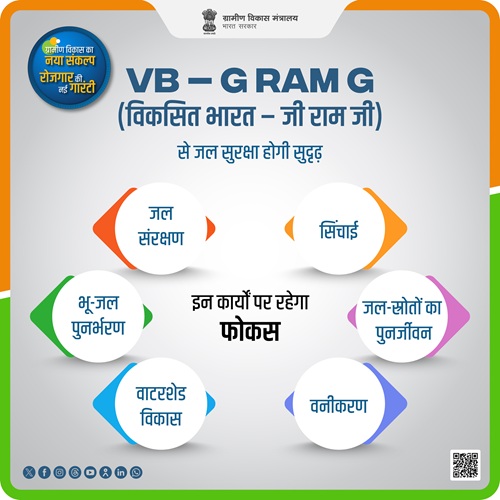
Unlike MGNREGA, which mainly focused on employment generation, the new Viksit Bharat G RAM G Mission links rural employment with durable infrastructure creation and long-term village development. The Government will use the scheme to develop water conservation systems, irrigation infrastructure, village roads, storage centres, rural markets, Anganwadi buildings, disaster management infrastructure and climate-resilient public assets.
The scheme introduces a new decentralised planning model through Viksit Gram Panchayat Plans. Villages will prepare infrastructure and development plans according to local requirements, while the Government will integrate these plans with the PM Gati Shakti National Master Plan and the Viksit Bharat National Rural Infrastructure Stack for better coordination and monitoring.
The Government has also added advanced digital governance systems under the scheme to improve transparency and reduce corruption. The new framework includes biometric attendance, geo-tagging of worksites, GPS-based monitoring, AI-enabled fraud detection systems, real-time dashboards, digital wage payments and mandatory social audits. These reforms are aimed at solving the major implementation issues that existed under the previous MGNREGA framework.
The Viksit Bharat G RAM G Yojana focuses on four major rural development sectors, including water security works, core rural infrastructure, livelihood-related infrastructure and climate resilience projects for extreme weather events. Through this approach, the Government aims to transform rural employment into a long-term development mission instead of only a temporary wage employment programme.
The scheme also supports farmers by allowing state governments to pause public works for up to 60 days during peak sowing and harvesting seasons. This provision has been introduced to ensure labour availability for agricultural activities and to prevent labour shortages during important farming periods.
According to the Ministry of Rural Development, the VB-G RAM G Act 2025 will help improve rural incomes, create productive assets, strengthen Panchayati Raj Institutions, improve accountability and support sustainable economic growth in villages across India.
Key Features of the Viksit Bharat G RAM G Act 2025
- 125 days of guaranteed wage employment for rural households
- Unemployment allowance if work is not provided within 15 days
- Weekly or fortnightly wage payment system
- Biometric attendance and geo-tagging of worksites
- AI-enabled monitoring and fraud detection systems
- Real-time MIS dashboards and digital transparency tools
- PM Gati Shakti integrated planning system
- Climate-resilient and infrastructure-focused development works
- Mandatory social audits and grievance redressal mechanisms
- Stronger role of Gram Panchayats and Gram Sabhas
Why VB-G RAM G Replaces MGNREGA
MGNREGA was introduced in 2005 to provide guaranteed wage employment to rural households. While it improved rural employment and transparency over time, the Government identified several long-term issues such as irregularities in work, misuse of funds, weak infrastructure outcomes, limited planning integration and gaps in monitoring systems.
According to the Government, rural India has changed significantly over the last two decades due to rising incomes, digital penetration, improved connectivity and diversification of livelihoods. The earlier MGNREGA structure was no longer fully aligned with modern rural development needs.
The new VB-G RAM G Act modernises rural employment by combining wage security with long-term infrastructure creation, climate resilience, digital governance and stronger local planning systems.
VB-G RAM G vs MGNREGA: Major Differences
| Feature | MGNREGA | VB-G RAM G Act 2025 |
|---|---|---|
| Employment Guarantee | 100 days | 125 days |
| Main Objective | Wage employment generation | Employment plus rural infrastructure development |
| Planning System | Limited local planning | Structured Viksit Gram Panchayat Plans |
| Monitoring | Traditional monitoring systems | AI-based monitoring and digital governance |
| Transparency | Basic digital systems | Real-time dashboards and geo-tagging |
| Infrastructure Creation | Limited durable assets | Focus on productive and climate-resilient assets |
| Agriculture Support | No formal labour protection system | 60-day seasonal work pause for farming support |
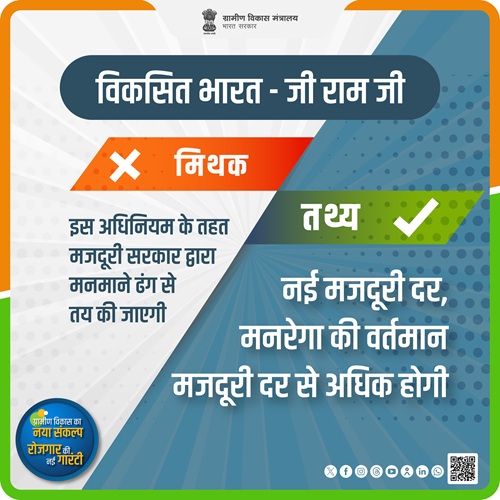
| Funding Model | Demand-based funding | Normative and predictable allocation system |
Why VB-G RAM G Is Better Than MGNREGA
- Employment guarantee has increased from 100 days to 125 days
- Focus on durable and productive infrastructure creation
- Better transparency through AI-based monitoring systems
- Improved accountability and a stronger social audit system
- Digital wage payments and biometric attendance
- Improved planning through Viksit Gram Panchayat Plans
- Strong climate resilience and disaster management focus
- Better support for agriculture and irrigation systems
- Stronger integration with national development projects
- Improved worker protection and unemployment allowance system
Four Major Priority Areas Under the Scheme
- Water security and irrigation-related works
- Core rural infrastructure development
- Livelihood-related infrastructure
- Special works for climate change and extreme weather events

Benefits of the Viksit Bharat G RAM G Scheme
The Viksit Bharat G RAM G Yojana has been introduced to improve rural employment, strengthen village infrastructure and support long-term rural development across India. The scheme not only increases the employment guarantee for rural households but also focuses on creating productive public assets that directly benefit farmers, labourers and village communities.
- Rural households can receive wages for 125 days instead of 100 days under the earlier MGNREGA framework.
- Workers receive an unemployment allowance if employment is not provided within 15 days of application.
- Villages will benefit from better roads, irrigation systems, water conservation structures and public infrastructure.
- Water conservation and groundwater recharge projects can improve agricultural productivity and reduce water shortages.
- Climate-resilient infrastructure can help villages deal with floods, droughts and extreme weather conditions.
- Real-time monitoring systems and AI-based audits may reduce corruption and fake work.
- Better village-level planning can create more predictable and organised employment opportunities.
- Rural markets, storage centres and livelihood infrastructure can support local economic growth and reduce migration.
- Stronger social audit systems and grievance redressal mechanisms improve accountability and worker protection.
- Panchayats and Gram Sabhas receive a larger role in planning and monitoring village development projects.
Benefits for Farmers and Labourers Under VB-G RAM G Scheme
| Benefits for Farmers | Benefits for Labourers and Rural Workers |
|---|---|
| Better labour availability during sowing and harvesting seasons | Higher annual earning opportunities through a 125-day employment guarantee |
| Improved irrigation and groundwater recharge systems | Predictable work opportunities through village-level planning |
| Better village roads and market connectivity | Timely digital wage payments directly into bank accounts |
| Reduced post-harvest losses through storage infrastructure | Legal unemployment allowance protection |
| Climate-focused infrastructure for crop protection | Better village infrastructure and public facilities |
| Prevention of artificial wage inflation during peak agricultural periods | Safer, transparent and digitally monitored work systems |
Types of Works Allowed Under VB-G RAM G Scheme
- Canal construction and irrigation works
- Check dams and pond rejuvenation
- Rural roads and drainage systems
- Anganwadi centres and Panchayat Bhawans
- Rural haats and storage centres
- Flood shelters and cyclone shelters
- Forest and soil conservation works
- Livelihood infrastructure for SHGs and farmers
- Water harvesting and groundwater recharge works
- Disaster mitigation and climate resilience projects
Eligibility Requirements
- Applicant must belong to a rural household
- Adult members should be willing to undertake unskilled manual work
- Applicant should be at least 18 years old
- Registration with the Gram Panchayat is required
- Applicant must possess valid identification documents
Required Documents
- Photograph of the applicant
- Name, age and gender details of all applicants from the household.
- Name of village, Gram Panchayat and Block.
- Proof of identity such as Aadhaar Card, Ration Card, Voter ID Card or PAN Card.
- Details regarding SC / ST / Indira Awaas Yojana (IAY) / Land Reform (LR) beneficiary status, if applicable.
- Specimen signature or thumb impression of the applicant.
- Mobile number and bank account details.
- Existing MGNREGA Job Card, if available.
- As mentioned in the scheme guidelines.
Steps to Apply
The Government has not yet released the official nationwide application process for the Viksit Bharat G RAM G Scheme. However, since the new scheme will replace MGNREGA from 1 July 2026, the application and registration process is expected to follow a structure similar to that used for MGNREGA Job Cards. Rural households may apply for the Gramin Rozgar Guarantee Card through Gram Panchayats, CSC Centres, and digital platforms such as the UMANG App or Portal.
1. Offline Application Through Gram Panchayat
- Visit your local Gram Panchayat office during official working hours
- Request the Gramin Rozgar Guarantee Card application form from the designated staff member
- Provide accurate household details: members' names, ages, Aadhaar numbers, mobile contact, and bank account information
- Attach photocopies of required documents: Aadhaar Card, residence proof, bank account details, and recent photographs
- Submit the completed application directly to the Gram Panchayat officials
- Gram Panchayat conducts household verification through a ward member or Programme Officer if required
- Approved households receive the Gramin Rozgar Guarantee Card within 15 days from the application date
- Card contains a unique registration number, household member details, biometric information, and key guarantees
2. Application Through CSC Centres
CSC operators provide digital assistance, enabling online registration for technologically comfortable populations.
- Locate the nearest Common Service Centre (CSC) in your village or block using the CSC e-Governance portal
- Visit the CSC with original identity documents and supporting papers
- Provide the CSC operator with your Aadhaar Card, mobile number, bank account details, and household member information
- CSC operator fills the online registration form on your behalf, ensuring accuracy
- Biometric data (fingerprints or iris scan) gets captured and uploaded through the digital system
- Receive an acknowledgement receipt with the application reference number for future tracking
- CSC transmits the completed application digitally to your Gram Panchayat and District Rural Development office
- Officials conduct verification and household confirmation procedures
- Approved Gramin Rozgar Guarantee Card either gets delivered through CSC or collected directly from the Gram Panchayat
3. Online Application Through UMANG App or Portal
- Download the UMANG App or visit the official UMANG Portal.
- Log in using your mobile number and OTP verification.
- Search for the VB-G RAM G Scheme or Rural Employment Services section.
- Fill in personal, household and bank account details.
- Upload required documents such as Aadhaar Card and photographs.
- Submit the application online and note the application reference number.
- Applicants may be able to track their application status online after submission.
Transparency and Accountability Features
- Biometric authentication for attendance and payments
- GPS and geo-tagging-based monitoring
- AI-supported monitoring and transparency systems
- Real-time MIS monitoring dashboards
- Weekly public disclosure of works and payments
- Social audits every six months
- Grievance redressal and Ombudsperson system
- Stronger Centre and State-level monitoring authorities.
Funding Pattern Under the Scheme
- 60:40 Centre-State cost sharing for most states
- 90:10 funding support for the North Eastern and Himalayan states
- 100% Central funding for Union Territories without a legislature
- Normative allocation system for predictable budgeting.
- Additional support during disaster situations.
Relevant Links
- Viksit Bharat G RAM G Yojana Notification
- Viksit Bharat G RAM G Yojana Gazette
- Viksit Bharat G RAM G Yojana Official Portal
- Worker Attendance Mobile Application
- VB G RAM G Online Complaint
- VB G RAM G Worker Attendance Dashboard
- UMANG Portal
- CSC Centre Locator
Contact Information
Frequently Asked Questions
VB-G RAM G stands for Viksit Bharat – Guarantee for Rozgar and Ajeevika Mission (Gramin).
The Government of India introduced the Act in 2025. The scheme will be implemented nationwide from 1 July 2026.
Yes, the Viksit Bharat G RAM G Act 2025 has been introduced as a replacement and upgraded framework for the existing MGNREGA scheme.
Eligible rural households can receive up to 125 days of guaranteed wage employment in a financial year.
Rural households whose adult members are willing to undertake unskilled manual work may become eligible under the scheme.
VB-G RAM G increases the employment guarantee from 100 days to 125 days and focuses more on durable infrastructure, digital monitoring, climate resilience and village development planning.
The scheme may include water conservation works, irrigation projects, rural roads, storage centres, climate resilience infrastructure, flood protection and livelihood-related infrastructure projects.
The official application process is yet to be announced. However, applications are expected to be accepted through Gram Panchayats, CSC Centres and online platforms similar to MGNREGA registration systems.
Gram Panchayats will play an important role in planning, implementation, monitoring and social audits under the scheme.
The scheme framework includes biometric attendance and geo-tagging systems for better transparency and monitoring.
Yes, the scheme focuses on digital and transparent wage payment systems along with biometric attendance and geo-tagging.
Worker attendance is recorded digitally through the official NREGA Mobile Monitoring System (NMMS) Application. The scheme uses biometric authentication and geo-tagging to ensure that only genuine workers present at the worksite are marked as attending.
Workers can download it online through their Mobile Play Store or its link available at VB GM RAM G official portal.

Do you have any question regarding schemes, submit it in scheme forum and get answers:
Feel free to click on the link and join the discussion!
This forum is a great place to:
- Ask questions: If you have any questions or need clarification on any aspect of the topic.
- Share your insights: Contribute your own knowledge and experiences.
- Connect with others: Engage with the community and learn from others.
I encourage you to actively participate in the forum and make the most of this valuable resource.
| ব্যক্তির প্রকার | প্রকল্পের ধরন | সরকার |
|---|---|---|


সেক্টরের জন্য ম্যাচিং প্রকল্প: চাকরি
| Sno | CM | Scheme | সরকার |
|---|---|---|---|
| 1 | 
|
Agnipath Scheme | কেন্দ্র সরকার |
| 2 |
|
পিএম এমপ্লয়মেন্ট লিংকড ইনসেনটিভ স্কিম A: ফার্স্ট টাইমার | কেন্দ্র সরকার |
| 3 |
|
পিএম এমপ্লয়মেন্ট লিংকড ইনসেনটিভ স্কিম B: উৎপাদনে কর্মসংস্থান সৃষ্টি | কেন্দ্র সরকার |
| 4 |
|
PM Employment Linked Incentive Scheme C: Support to Employers | কেন্দ্র সরকার |
| 5 |
|
Bima Sakhi Yojana | কেন্দ্র সরকার |
Comments
Road
Kera
Vb ram j
Mettu mare venam പ്രായം അയവർ വേണ്ട
কোনো বি জব দিন
কোনো বি জব দিন
நான் ஒரு மாற்றுத்திறனாளி எனக்கு 125 நாள் அட்டை வேண்டும் என்று பல
எனக்கு 125 நாள் அட்டை வேண்டும்
21
Manish regar
নতুন কমেন্ট যুক্ত করুন