



- The scheme helps eligible Micro and Small Enterprises access institutional credit.
- Eligible credit facilities of up to ₹10 crore can be covered under CGS-I, subject to applicable conditions.
- Women-led MSEs can receive guarantee coverage of up to 90%.
- The Annual Guarantee Fee starts from 0.37% per year for eligible credit facilities up to ₹10 lakh.
- Credit Guarantee Fund Trust for Micro and Small Enterprises (CGTMSE)
- Phone: 1800 222 659 (Toll Free)
- Other Contact Numbers: 022-6722 1553, 022-6753 1313, 022-6722 1483
- Email: [email protected] for queries and suggestions
Summary of the Scheme | |
|---|---|
| Name of Scheme | Credit Guarantee Scheme for Micro and Small Enterprises (CGTMSE) |
| Launch Year | 2000 |
| Benefits | Credit guarantee support for eligible credit facilities up to ₹10 crore, with guarantee coverage of up to 90% |
| Beneficiary | Eligible new and existing Micro and Small Enterprises (MSEs) |
| Nodal Agency | Ministry of Micro, Small and Medium Enterprises |
| Mode of Apply | Through eligible Member Lending Institutions (MLIs) |
Scheme Introduction: A Brief Overview
Access to formal credit can be difficult for small businesses when they do not have sufficient assets to offer as collateral. The Credit Guarantee Scheme for Micro and Small Enterprises addresses this challenge by providing guarantee support for eligible credit facilities extended to Micro and Small Enterprises (MSEs) without requiring collateral security or third-party guarantees. From 1 April 2025, eligible credit support of up to ₹10 crore can be covered under the scheme, while the extent of guarantee coverage can reach up to 90% for eligible categories. The scheme is available to eligible new and existing MSEs and is intended to improve their access to institutional finance for starting, operating and expanding their businesses.
The scheme is implemented by the Ministry of Micro, Small and Medium Enterprises through the Credit Guarantee Fund Trust for Micro and Small Enterprises (CGTMSE). The Trust was jointly established by the Ministry of MSME, Government of India, and the Small Industries Development Bank of India (SIDBI) in 2000. CGTMSE itself does not sanction or disburse loans to entrepreneurs. Instead, it provides guarantee cover to eligible Member Lending Institutions (MLIs) against qualifying credit facilities extended to MSEs.
Under Credit Guarantee Scheme for Micro and Small Enterprises, the guarantee coverage depends on the type of business, location and loan amount. Women-led MSEs can get coverage of up to 90%. The Annual Guarantee Fee (AGF) starts from 0.37% per year and varies with the loan amount. This fee is separate from the loan interest, which is decided by the lender.
Entrepreneurs do not apply directly to CGTMSE for a loan. They first approach an eligible Member Lending Institution (MLI), such as a participating bank. The lender checks the business and loan proposal. If the loan meets the CGTMSE conditions, the lender applies for the guarantee cover. CGTMSE coverage does not guarantee loan approval.
The scheme mainly covers eligible Micro and Small Enterprises (MSEs). Eligible borrowers need the required Udyam Registration, while qualifying Informal Micro Enterprises can use the Udyam Assist Platform. The scheme can cover eligible term loans, working capital and other permitted credit facilities. A hybrid security option is also available, where collateral may be taken for part of the loan and the eligible unsecured portion can receive CGTMSE cover.
Before applying, entrepreneurs should keep basic documents such as Udyam Registration details, PAN, KYC documents, business records, financial statements and bank statements ready. The exact documents depend on the lender and the type and amount of credit required.
For clarification regarding guarantee coverage, applicable fees, eligibility or other scheme provisions, applicants should first contact their lending institution. Detailed scheme guidelines and the latest CGTMSE circulars are also available through the Ministry of MSME's Credit Guarantee Scheme page.
Entrepreneurs looking for other business credit options can also read about the Pradhan Mantri MUDRA Yojana (PMMY), which provides collateral-free institutional credit to eligible micro enterprises. Traditional artisans and craftspeople may also explore the PM Vishwakarma Scheme for credit, skill training and other business support.
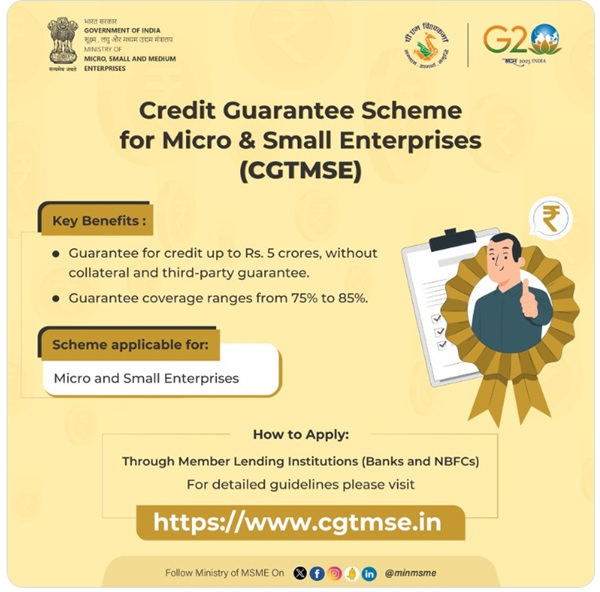
Scheme Benefits
The CGTMSE Scheme provides guarantee support that can make it easier for eligible Micro and Small Enterprises to access institutional credit. Its key benefits include:
- Eligible credit facilities of up to ₹10 crore under CGS-I can be covered, subject to the applicable scheme conditions.
- Eligible MSEs can access credit without the need for conventional collateral security or a third-party guarantee, subject to the scheme and lender's terms.
- Women-led MSEs can receive guarantee coverage of up to 90% of the eligible credit facility.
- Eligible micro enterprises can receive up to 85% guarantee coverage for credit facilities up to ₹5 lakh.
- Certain special categories, including SC/ST entrepreneurs, persons with disabilities, Agniveers, transgender entrepreneurs and ZED-certified MSEs, can receive enhanced guarantee coverage under applicable conditions.
- Eligible MSEs in the North Eastern Region, Jammu & Kashmir and Ladakh can receive enhanced guarantee coverage under the applicable provisions.
- The Annual Guarantee Fee starts from 0.37% per year for eligible credit facilities up to ₹10 lakh, with the applicable fee varying according to the credit amount.
- Eligible new and existing MSEs can use the guarantee support for permitted credit facilities, subject to the scheme guidelines.
- The scheme covers eligible businesses engaged in manufacturing, services and trading, including retail and wholesale trade, subject to applicable conditions.
- Eligible Informal Micro Enterprises registered through the Udyam Assist Platform can receive special guarantee support for credit facilities up to ₹20 lakh.
- The hybrid security facility allows eligible unsecured credit to receive CGTMSE coverage even when the lender takes collateral for another portion of the same credit facility.
CGTMSE guarantee support reduces the lender's credit risk, which can make institutional credit more accessible to eligible MSEs. However, the guarantee does not remove the borrower's responsibility to repay the loan, and the lender continues to decide the loan amount, interest rate and other credit terms.
How Does Credit Guarantee Scheme for Micro and Small Enterprises (CGTMSE) Work?
CGTMSE helps eligible Micro and Small Enterprises get institutional credit by providing a guarantee to the lender. The main points to understand are:
- Guarantee coverage: Coverage depends on the business type, location and loan amount. Women-led MSEs can get up to 90% coverage.
- Annual Guarantee Fee: The AGF starts from 0.37% per year and varies with the credit amount. It is separate from the loan interest.
- Loan interest: The interest rate is decided by the lending institution, not CGTMSE.
- Apply through a lender: Entrepreneurs do not apply directly to CGTMSE. They approach an eligible Member Lending Institution (MLI).
- Lender checks the proposal: The lender checks the business, documents, repayment capacity and other loan requirements.
- Guarantee application: If the loan meets CGTMSE conditions, the lender applies for the guarantee cover.
- Loan approval: CGTMSE coverage does not guarantee loan approval. The lender takes the final lending decision.
- Eligible enterprises: The scheme mainly covers eligible Micro and Small Enterprises (MSEs), subject to the applicable guidelines.
- Udyam Registration: Eligible borrowers need the required Udyam Registration. Qualifying Informal Micro Enterprises can use the Udyam Assist Platform.
- Types of credit: Eligible term loans, working capital and other permitted credit facilities can be covered.
- Hybrid security: The lender may take collateral for part of the credit facility, while the eligible unsecured portion can receive CGTMSE coverage.
Eligibility Requirements
To get credit under CGTMSE, the applicant and loan facility must meet the applicable scheme conditions. The main requirements are:
- The applicant must be an eligible Micro or Small Enterprise (MSE).
- Both new and existing MSEs can apply.
- The enterprise should have the required Udyam Registration. Eligible Informal Micro Enterprises can use the Udyam Assist Platform.
- Businesses in eligible manufacturing, services and trading activities can be covered, subject to scheme conditions.
- The loan must be obtained from an eligible CGTMSE Member Lending Institution (MLI).
- Eligible term loans, working capital and other permitted credit facilities can be covered.
- Medium Enterprises are not covered under the regular CGTMSE framework.
- Self-Help Groups (SHGs) and Joint Liability Groups (JLGs) are not covered under the regular scheme.
- The lender checks the business, repayment capacity and other loan requirements before sanctioning the credit.
- CGTMSE coverage does not guarantee loan approval. The final decision is taken by the lender.
- Under the hybrid security model, collateral may be taken for part of the loan while the eligible unsecured portion can receive CGTMSE coverage.
The exact eligibility may vary depending on the business, borrower category and type of credit facility. Applicants should confirm the applicable conditions with the lender before applying.
Required Documents
The documents required for a Credit Guarantee Scheme for Micro and Small Enterprises (CGTMSE)-backed loan may vary depending on the lender, type of business and amount of credit requested. Applicants should generally keep the following documents ready:
- Udyam Registration Certificate or applicable Udyam Assist details.
- PAN card of the business and the proprietor, partners or directors, as applicable.
- Aadhaar or other valid KYC documents of the proprietor, partners or directors.
- Business registration and address proof, such as a shop and establishment certificate, partnership deed, certificate of incorporation or other applicable documents.
- GST registration and relevant GST returns, where applicable.
- Income Tax Returns and financial statements of the business, particularly for existing enterprises.
- Recent business bank account statements, as requested by the lender.
- Project report or business plan explaining the proposed business activity and financing requirement.
- Estimated project cost, quotations and invoices for machinery, equipment or other assets, where applicable.
- Details of existing loans and other outstanding credit facilities, if any.
- Recent photographs of the applicant or authorised representatives, where required by the lender.
- Duly completed loan application form and any additional documents requested by the Member Lending Institution.
The final document list is decided by the lending institution based on the applicant's business structure, credit requirement and loan type. Additional documents may be requested during the lender's credit assessment.
Steps to Apply
Getting credit under Credit Guarantee Scheme for Micro and Small Enterprises (CGTMSE) starts with the lending institution rather than with a separate application to the Trust. Once the business and loan proposal are assessed by an eligible Member Lending Institution, the lender handles the CGTMSE guarantee process on behalf of the borrower.
- First, keep your business registration and loan-related documents ready, including the applicable Udyam Registration details, KYC documents, financial records and business or project information. The exact documents depend on the type of enterprise and credit facility.
- Next, identify a CGTMSE Member Lending Institution. You can check the official CGTMSE list of Member Lending Institutions to see participating lenders. Eligible institutions include participating banks and other financial institutions covered under the applicable CGTMSE framework.
- Approach the selected bank or financial institution with your loan proposal. Clearly tell the lender that you want the eligible credit facility to be considered under Credit Guarantee Scheme for Micro and Small Enterprises (CGTMSE) coverage. The lender will assess your business, repayment capacity, project viability and other applicable lending conditions.
- If the lender approves the credit facility, it sanctions and disburses the loan according to its own lending process. CGTMSE does not independently approve the borrower's loan; its role is to provide guarantee cover to the eligible lending institution.
- After sanction or disbursement, the Member Lending Institution submits the guarantee application through the CGTMSE system. The borrower does not have to submit a separate guarantee application to CGTMSE.
- CGTMSE processes the guarantee request under the applicable scheme conditions. Once the required guarantee fee is received, the guarantee cover is issued to the lending institution.
- After the guarantee is issued, the borrower continues to repay the loan according to the repayment schedule agreed with the lender. The applicable Annual Guarantee Fee may be recovered from the borrower by the lending institution as per its terms.
For the current process and participating lenders, the CGTMSE official website provides the relevant Member Lending Institution information and scheme details. If you are unsure whether a particular bank or financial institution is covered, confirm its CGTMSE membership before submitting the loan proposal.
It is also important to remember that Credit Guarantee Scheme for Micro and Small Enterprises (CGTMSE) coverage does not mean automatic loan approval. The Member Lending Institution remains responsible for evaluating the proposal and deciding whether to sanction the credit facility.
Relevant Links
- Ministry of MSME – Credit Guarantee Scheme Guidelines
- Credit Guarantee Scheme for Micro and Small Enterprises (CGTMSE) Official Website
- Credit Guarantee Scheme for Micro and Small Enterprises (CGTMSE) – Eligible Borrowers
- Credit Guarantee Scheme for Micro and Small Enterprises (CGTMSE) – Credit Facilities and Parameters
- Credit Guarantee Scheme for Micro and Small Enterprises (CGTMSE) Annual Guarantee Fee Circular
- Credit Guarantee Scheme for Micro and Small Enterprises (CGTMSE) – Member Lending Institutions
- Udyam Registration Portal
Contact Information
For questions specifically related to CGTMSE guarantee coverage, scheme provisions, Member Lending Institutions or other operational matters, applicants can contact the Credit Guarantee Fund Trust for Micro and Small Enterprises (CGTMSE).
Credit Guarantee Fund Trust for Micro and Small Enterprises (CGTMSE)
- Phone: 1800 222 659 (Toll Free)
- Other Contact Numbers: 022-6722 1553, 022-6753 1313, 022-6722 1483
- Email: [email protected] for queries and suggestions
- Address: 1st Floor, SIDBI, Swavalamban Bhavan, C-11, G-Block, BKC, Bandra (East), Mumbai – 400051
- Office Hours: 10:00 AM to 6:00 PM
Frequently Asked Questions
CGTMSE is a credit guarantee scheme that helps eligible Micro and Small Enterprises access institutional credit without relying on traditional collateral or third-party guarantees, subject to scheme conditions.
Eligible new and existing Micro and Small Enterprises can seek credit under the scheme, subject to the applicable eligibility conditions.
Under CGS-I, eligible credit facilities of up to ₹10 crore can be covered, subject to the applicable scheme conditions.
Yes. Eligible women-led MSEs can receive guarantee coverage of up to 90%.
No. Entrepreneurs need to approach an eligible CGTMSE Member Lending Institution, such as a participating bank or other eligible lender.
No. The lender independently evaluates the business, repayment capacity and other lending requirements before deciding whether to approve the loan.
The Annual Guarantee Fee currently starts from 0.37% per year for eligible credit facilities up to ₹10 lakh. The applicable fee varies according to the credit amount.
No. The guarantee fee is separate from the loan interest. The interest rate is decided by the lending institution.
Eligible term loans, working capital facilities and other permitted credit facilities can be covered, subject to the applicable CGTMSE guidelines.
Yes. Udyam Registration is required for eligible borrowers under the current framework. Qualifying Informal Micro Enterprises can use the Udyam Assist Platform under applicable provisions.
Do you have any question regarding schemes, submit it in scheme forum and get answers:
Feel free to click on the link and join the discussion!
This forum is a great place to:
- Ask questions: If you have any questions or need clarification on any aspect of the topic.
- Share your insights: Contribute your own knowledge and experiences.
- Connect with others: Engage with the community and learn from others.
I encourage you to actively participate in the forum and make the most of this valuable resource.


Add new comment