


Scheme Introduction: A Brief Overview
The EPFO Amnesty Scheme 2026, officially called Amnesty, 2026, is a one-time opportunity for certain establishments that manage their employees' Provident Fund through a PF Trust. The scheme helps such establishments regularise the status of their PF Trust if they have been operating the Trust without the required formal exemption under EPF law. In simple terms, it gives eligible establishments a chance to correct and regularise their past exemption-related issues under the conditions set by EPFO.
The scheme has been introduced by the Employees' Provident Fund Organisation (EPFO) under the Ministry of Labour & Employment, Government of India. Its main purpose is to provide a structured route for retrospective regularisation of eligible PF Trusts. After regularisation, an establishment may choose to comply as an exempted or un-exempted establishment, subject to the applicable provisions.
Amnesty, 2026 also provides relief from certain requirements under the Code on Social Security, 2020. These include the minimum employee headcount, corpus-size requirement and three-year prior compliance rule. The scheme also provides specified relief from certain pending and past assessment proceedings, subject to the conditions laid down under the scheme.
It is important to note that this is not a direct financial assistance scheme for individual EPF members. The primary applicants are eligible establishments and PF Trusts. The scheme focuses on resolving the historical exemption status of qualifying Trusts while following the required contribution, audit and other compliance conditions.
Establishments dealing with other EPFO compliance matters should separately check the applicable EPFO provisions and campaigns because Amnesty, 2026 has a specific purpose related to PF Trust exemption and regularisation.
Categories Under Amnesty, 2026
The scheme provides different routes for eligible establishments depending on how they intend to comply after retrospective regularisation.
Category | What It Means |
|---|---|
Category I | Establishments seeking retrospective regularisation and complying or opting to comply prospectively as an un-exempted establishment. |
Category II | Establishments seeking retrospective regularisation while continuing as an exempted establishment under the applicable framework. |
The applicable category should be identified carefully before submitting the application because the compliance route after regularisation depends on the category selected by the establishment.
Scheme Benefits
Amnesty, 2026 is designed to resolve long-pending exemption and compliance issues of eligible PF Trusts. Instead of providing direct financial assistance, the scheme gives establishments a route to regularise their Trust status and obtain specified statutory relief. The main benefits are as follows:
- Eligible establishments can seek retrospective regularisation of their PF Trust's exemption status from the date of establishment up to the applicable cut-off date, subject to the conditions of Amnesty, 2026.
- The scheme provides relaxation from the specified minimum employee headcount and minimum corpus requirement prescribed for exemption under the Code on Social Security, 2020.
- The requirement relating to prior compliance for three years is deemed to have been fulfilled for eligible establishments covered under the scheme.
- Subject to the prescribed conditions, certain pending assessments relating to statutory dues, damages and interest may be withdrawn and abated. This relief is linked to the applicable requirements concerning contributions and interest credited to members' accounts.
- Certain assessment orders that have already been finalised may be treated as void ab initio under the scheme, where the specific conditions of Amnesty, 2026 are fulfilled.
- After retrospective regularisation, eligible establishments can follow the applicable route for continuing as an exempted or un-exempted establishment, subject to the relevant statutory requirements.
The relief available under Amnesty, 2026 is conditional and should not be considered a blanket waiver of all past EPF liabilities. Establishments must fulfil the applicable requirements relating to contributions, interest, audit, records and other compliance conditions to receive the relevant relief.
Eligibility Requirements
Amnesty, 2026 is meant for a specific group of establishments that manage provident fund benefits through a PF Trust. Before starting the application process, the establishment should make sure that it meets the conditions below.
- The applicant should be an establishment operating a Provident Fund Trust for its employees.
- The PF Trust should be recognised under the Income Tax Act, 1961.
- The Trust should not have the required formal exemption order under the Employees' Provident Funds and Miscellaneous Provisions Act, 1952 or the applicable provision of the Code on Social Security, 2020.
- The establishment should be seeking retrospective regularisation of the PF Trust's exemption status under Amnesty, 2026.
- The establishment must be able to provide the records and information required by EPFO for examining the Trust's exemption and compliance history.
- The establishment must fulfil the applicable conditions relating to PF contributions and interest credited to members' accounts where it seeks relief from eligible pending or past proceedings.
- The PF Trust's financial accounts should meet the prescribed audit requirement, including audit by a Chartered Accountant.
Amnesty, 2026 is not intended for individual EPF members who want to withdraw their PF balance, transfer an EPF account or update their UAN. Employees with such requirements need to use the regular EPFO services applicable to their case.
What Requirements Are Relaxed Under the Scheme?
Amnesty, 2026 provides relief from certain requirements that may otherwise affect the exemption status of an eligible PF Trust. The scheme also provides relief in specified pending and past proceedings, subject to the prescribed conditions.
- Minimum employee requirement: The specified minimum employee requirement under the Code on Social Security, 2020 is relaxed for eligible establishments covered by the scheme.
- Corpus requirement: The specified corpus-size requirement is waived for eligible establishments covered under Amnesty, 2026.
- Three-year compliance requirement: The requirement relating to prior compliance for three years is deemed satisfied for eligible establishments covered by the scheme.
- Pending assessments: Certain pending assessments relating to EPF dues, damages and interest may be withdrawn and abated when the prescribed conditions are fulfilled.
- Member contribution and interest condition: The relief from pending proceedings is subject to the applicable requirements concerning contributions and interest credited to members' accounts.
- Past finalised orders: Certain assessment orders that have already been finalised may be treated as void ab initio where the specific conditions of Amnesty, 2026 are fulfilled.
These relaxations and relief measures are available only to establishments that meet the conditions of Amnesty, 2026. They should not be treated as a general waiver of all EPF contributions, interest, damages or other statutory compliance requirements.
Important Compliance Conditions
Regularisation under the Amnesty Scheme does not mean that every historical PF liability is automatically cancelled. Eligible establishments must continue to fulfil the conditions prescribed under the scheme.
- Member contributions and interest must meet the applicable requirements for the relief available under the scheme.
- Financial accounts of the PF Trust must be audited by a Chartered Accountant.
- If EPFO authorities direct a special or compliance audit, the establishment must complete it within the prescribed period.
- Any deficiency in contributions or interest payable to members must be addressed as required.
- The establishment must provide the information and records required by EPFO during scrutiny or verification.
- The PF Trust must continue to comply with applicable statutory requirements after regularisation.
Required Documents and Information
Applicants should keep the records needed to establish the history and compliance position of their PF Trust ready before submitting the application. The exact documents may vary depending on the establishment's circumstances and EPFO's requirements.
- Establishment and EPF registration details.
- Provident Fund Trust details.
- Proof of recognition of the PF Trust under the Income Tax Act, 1961.
- Available records relating to the Trust's exemption status.
- Audited financial accounts of the PF Trust.
- Contribution and interest records maintained for members.
- Employee and PF Trust records required for verification.
- Relevant records relating to PF Trust operations and investments, where applicable.
- Details of any pending EPFO assessment or compliance proceedings.
- Any additional documents or information requested by the jurisdictional EPFO Regional Office.
Employers should follow the detailed procedure and document requirements issued by EPFO rather than relying only on a general checklist, as additional records may be required depending on the Trust's history.
Steps to Apply
If you are an employer and want to use the EPFO Amnesty Scheme 2026 for your PF Trust, follow these steps in order. You do not need to understand the entire EPF process beforehand; start by checking your Trust's status and then proceed as directed below.
- First, check your PF Trust status: Confirm whether your organisation has a Provident Fund Trust that is recognised under the Income Tax Act, 1961 but does not have the required formal exemption under EPF law. If your organisation does not operate such a PF Trust, Amnesty, 2026 may not apply to you.
- Collect your PF Trust records: Keep the Trust's registration and exemption-related papers, employee details, records of PF contributions, interest credited to members and other relevant financial records together. These documents will be needed when EPFO examines your application.
- Get the Trust accounts audited: Arrange for the financial accounts of your PF Trust to be audited by a Chartered Accountant. Keep the audited accounts and related documents ready for submission.
- Decide your future PF status: Before submitting the application, determine whether your establishment intends to continue as an exempted establishment or comply as an un-exempted establishment after the Trust's status is regularised.
- Contact your EPFO Regional Office: Identify the EPFO Regional Office that has jurisdiction over your establishment and contact the office for the Amnesty, 2026 application procedure. You can also communicate your willingness to avail the scheme by sending an email to [email protected].
- Submit the application: Submit the completed application and the documents requested by EPFO through the concerned Regional Office. Make sure the information provided about your PF Trust, contributions and exemption history is complete and accurate.
- Respond if EPFO asks for more information: EPFO may ask you to provide additional documents, records or explanations while checking your application. Submit the requested information within the time given by the authorities.
- Complete an additional audit if directed: If EPFO requires a special or compliance audit, arrange for it and submit the required audit report or records within the prescribed period.
- Complete the regularisation process: Once EPFO processes your application, follow the conditions communicated for your regularised PF status. Continue meeting the applicable EPF requirements according to the status of your establishment.
It is advisable to start the process early rather than waiting until the last date, as collecting old Trust records, completing the audit and responding to EPFO queries may take time.
Last Date and How to Apply for EPFO Amnesty Scheme 2026
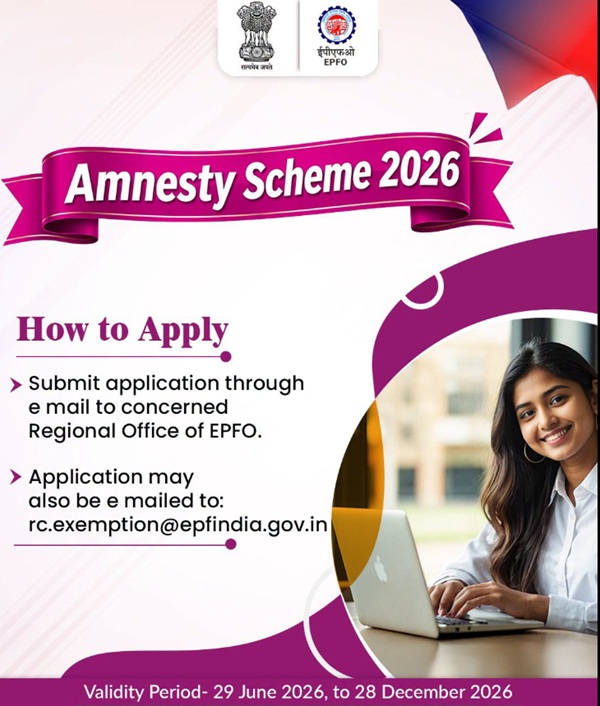
The EPFO Amnesty Scheme 2026 was notified on 29 June 2026 and is available for six months from the date of notification. Therefore, eligible establishments can avail the scheme up to 28 December 2026. The scheme is not an individual EPF claim process; establishments seeking retrospective regularisation of their eligible PF Trust should submit their application through the jurisdictional EPFO Regional Office as per the prescribed procedure.
Establishments can also express their willingness to avail the scheme by writing to [email protected]. Since the process may involve checking PF Trust records, completing the required audit and providing additional information to EPFO, eligible establishments should start the process well before the last date and coordinate with their concerned Regional Office for further guidance.
EPFO Amnesty Scheme 2026 vs Other EPFO Measures
Several EPFO compliance measures have been announced around the same period. Since their objectives are different, employers should identify the correct measure before applying.
Measure | Main Purpose | Main Target |
|---|---|---|
Amnesty, 2026 | Retrospective regularisation of eligible PF Trust exemption status | Eligible establishments operating recognised PF Trusts without formal exemption |
Employees' Enrolment Campaign 2026 | Enrolment of eligible employees who were previously left out of EPF coverage | Employers and eligible employees left out of EPF coverage |
VISHWAS, 2026 | Settlement of eligible disputes relating to EPF damages and penalties | Employers with eligible damages or penalty disputes |
The ₹100 lump-sum damages provision associated with the Employees' Enrolment Campaign should not be treated as a benefit of Amnesty, 2026. Likewise, VISHWAS, 2026 has a separate dispute-settlement framework.
Important Points to Remember
- Amnesty, 2026 is primarily meant for eligible establishments operating PF Trusts.
- The scheme was notified on 29 June 2026.
- The current validity period ends on 28 December 2026.
- The PF Trust must satisfy the specific eligibility conditions prescribed under the scheme.
- Retrospective regularisation is subject to the conditions and procedure specified by EPFO.
- Specified employee headcount, corpus-size and three-year compliance requirements receive relief under the scheme.
- PF Trust financial accounts must be audited by a Chartered Accountant.
- EPFO may require a special or compliance audit.
- The scheme does not automatically waive every PF contribution, interest or employee-related liability.
- Employers should coordinate with their jurisdictional EPFO Regional Office for case-specific guidance.
Relevant Links
- EPFO Official Website
- Ministry of Labour & Employment
- EPFO Exemption Information
- Performance of Exempted Establishments
- EPFO List of Exempted Establishments
- EPFO Amnesty Scheme 2026 Invitation
Contact Information
- Department: Employees' Provident Fund Organisation (EPFO), Ministry of Labour & Employment, Government of India
- EPFO Helpdesk: 14470
- Amnesty/Exemption Email: [email protected]
- Application Support: Concerned EPFO Regional Office
Frequently Asked Questions
EPFO Amnesty Scheme 2026, officially called AMNESTY, 2026, is a one-time scheme that allows eligible establishments to seek retrospective regularisation of their PF Trust exemption status, subject to the prescribed conditions.
The scheme is meant for eligible establishments operating PF Trusts that are recognised under the Income Tax Act, 1961 but do not have the required formal exemption under EPF law.
AMNESTY, 2026 was notified on 29 June 2026 and is available for six months. The applicable last date is 28 December 2026.
The main benefit is an opportunity for eligible PF Trusts to regularise their exemption status retrospectively. The scheme also provides specified relaxations and relief from certain proceedings, subject to its conditions.
Yes. The specified minimum employee headcount requirement under the Code on Social Security, 2020 is relaxed for eligible establishments covered by the scheme.
Yes. The specified corpus-size requirement is waived for eligible establishments seeking relief under AMNESTY, 2026, subject to the scheme's conditions.
Yes. Subject to the prescribed conditions, certain pending assessments relating to EPF dues, damages and interest may be withdrawn and abated.
Certain finalised assessment orders may be treated as void ab initio where the specific conditions of AMNESTY, 2026 are fulfilled.
The establishment should contact the EPFO Regional Office having jurisdiction over it and follow the application procedure communicated by the concerned office. An establishment can also express its willingness to avail the scheme by writing to [email protected].
No. AMNESTY, 2026 is primarily meant for eligible establishments operating PF Trusts. It is not a scheme for individual employees to withdraw, transfer or claim their personal EPF balance.
Add new comment