



- Eligible Goa residents can regularise their existing homes under Mhaje Ghar Yojana.
- Government land can be regularised up to 400 sq. m, subject to eligibility.
- The scheme also covers eligible Comunidade land and 20-Point Programme plots.
- GoaOnline Support: 8882988000
- GoaOnline Email: [email protected]
- For Individual Application: Concerned Mamlatdar / Deputy Collector / Sub-Divisional Office
Summary of the Scheme | |
|---|---|
| Name of Scheme | Goa Mhaje Ghar Yojana |
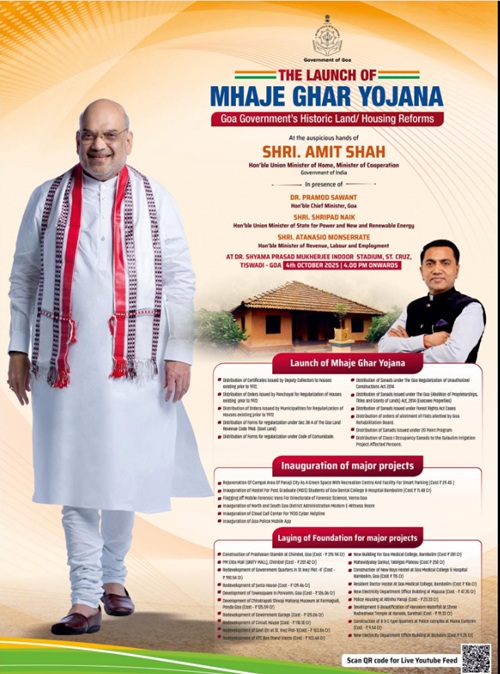
| Launched On | 4 October 2025 |
| Benefit | Eligible residents can legally regularise their existing house and eligible land and receive the applicable Sanad, Class I Occupancy or other legal document. |
| Beneficiaries | Eligible families and occupants with qualifying houses built before 28 February 2014 |
| Department | Revenue Department, Government of Goa |
| Subscription | Subscribe Here to Get Update Regarding Scheme. |
| Mode of Application | Offline; GoaOnline provides supporting services |
Scheme Introduction: A Brief Overview
A home provides security only when the person living in it also has legally recognised rights over the house and the land on which it stands. In Goa, many families have been living for years in dwelling houses constructed on Government land, Comunidade land, plots allotted under the 20-Point Programme or in houses requiring regularisation under the applicable law.
To address these long-standing housing and land-related issues, the Government of Goa launched the Mhaje Ghar Yojana on 4 October 2025. The scheme brings together legal reforms relating to Government land, Comunidade land and unauthorised constructions to provide eligible residents with a legal route to regularise their homes and obtain secure and legally recognised rights over their dwelling houses and the eligible land on which they stand.
The scheme is not simply a cash assistance programme for constructing a new house. Its main focus is regularisation, legal recognition and secure occupancy rights. Depending on the category of the property, an eligible beneficiary may receive a Class I Occupancy Sanad, regularisation order, certificate or other applicable document. This helps long-term occupants resolve old land and documentation issues and provides greater security over their homes.
The framework mainly covers dwelling houses constructed before 28 February 2014 under the specific provisions dealing with Government and Comunidade land. It also provides legal routes for eligible 20-Point Programme plots and unauthorised constructions. Through these provisions, the Government aims to address long-pending housing and land-related cases and make the regularisation process clearer for eligible families.
To make the process easier, the Government has also created supporting services through the GoaOnline Portal for structure certification, house-number bifurcation and permission for repairs of existing dwelling units. Special camps are also being organised to help applicants verify their documents, submit missing records and resolve pending issues related to their applications.
Applications are mainly submitted offline to the concerned Revenue authority. Applicants can also receive assistance through Revenue offices, Panchayats and special facilitation camps.
Benefits of the Scheme
- Legal rights over the house and land: Eligible families can get legal recognition for their existing house and the eligible land covered under the scheme.
- Class I Occupancy/Sanad: Eligible applicants on Government land can receive Class I Occupancy and the related Sanad after successful regularisation.
- Regularisation of Comunidade land: Eligible families living on Comunidade land can get their house and eligible land regularised under the prescribed rules.
- Secure home ownership: The scheme helps long-term occupants obtain proper legal documents for their homes, giving them greater security over the property.
- Benefit for 20-Point Programme beneficiaries: Eligible 20-Point Programme beneficiaries can get their Class II grant converted into Class I Occupancy, subject to the applicable conditions.
- House repair facility: Eligible residents can use the simplified facility for obtaining permission to repair an existing single dwelling house or structure.
- House number bifurcation: Separate facilities are available for eligible house-number bifurcation through Municipalities and Village Panchayats.
- Support for pending cases: Special camps and help counters are being organised to verify documents, resolve deficiencies and help applicants move their pending cases forward.
- Additional assistance for eligible ST families: Scheduled Tribe beneficiaries who meet the conditions can get separate financial reimbursement under the Mukhya Mantri Janjatiya Mhaje Ghar Yojana.
Legal Framework of Mhaje Ghar Yojana
Mhaje Ghar Yojana operates through amendments and Government orders under different laws. The legal route applicable to an applicant depends mainly on the type of land and the nature of the dwelling house.
Legal Provision | What It Covers |
|---|---|
Section 38A of the Goa Land Revenue Code, 1968 | Regularisation of eligible unauthorised dwelling houses constructed on Government land |
Article 372-B of Legislative Diploma No. 2070 dated 15 April 1961 | Regularisation of eligible dwelling houses constructed on Comunidade land |
20-Point Programme Scheme | Regularisation/conversion of eligible plots allotted under the 20-Point Programme |
Goa Regularisation of Unauthorised Construction Act, 2016 | Regularisation of eligible unauthorised constructions under the applicable amended provisions |
Who Can Benefit Under Mhaje Ghar Yojana?
There is no single eligibility condition that applies identically to every applicant because the scheme covers different legal categories. The applicant must satisfy the conditions of the particular route under which the case is being processed.
The main categories covered under the Mhaje Ghar framework include:
Category | Applicable Benefit/Route |
|---|---|
20-Point Programme plot holders | Eligible Class II grants may be converted into Class I Occupancy Sanad subject to prescribed conditions |
Vacant 20-Point Programme plots | Plots meeting the specified vacant-plot conditions may revert to the Government |
Third-party occupied 20-Point Programme plots | One-time regularisation may be available subject to the prescribed premium and penalty |
Government land occupants | Eligible dwelling houses may be regularised under Section 38A |
Comunidade land occupants | Eligible dwelling houses may be regularised under Article 372-B |
Unauthorised constructions | Eligible structures may be regularised under the applicable provisions of the Goa Regularisation of Unauthorised Construction Act |
Eligible pre-1972 dwelling structures | Special provisions and Government measures apply to qualifying old structures, subject to the applicable records and conditions |
Eligibility Criteria
For Government Land Under Section 38A
The main requirements for regularisation of a dwelling house on Government land include the following:
- The dwelling house must have been constructed before 28 February 2014.
- The applicant must fall within the definition of an eligible applicant under Section 38A.
- The applicant must be a landless person in Goa as required under the provision.
- The applicant must have been a resident of Goa for at least 15 years immediately preceding 28 February 2014.
- The applicant must not own another plot of land, house, flat, apartment or separately allotted undivided share in ancestral property in Goa, as applicable under the provision.
- The dwelling house must be located on land that is not covered by the prohibited categories specified under Section 38A.
- The applicant must submit the prescribed application and supporting documents and pay the applicable fee and occupancy price.
For Comunidade Land Under Article 372-B
- The dwelling house must have been constructed before 28 February 2014.
- The land must belong to the concerned Comunidade and must fall within the scope of Article 372-B.
- The applicant must satisfy the prescribed conditions, including the applicable residence and landless-person requirements.
- The applicant must submit the prescribed application and affidavit.
- The required processing fee and compensation payable to the concerned Comunidade must be deposited.
- Where required, consent of the concerned Comunidade must be obtained or deemed consent may arise under the prescribed procedure.
For 20-Point Programme Plots
- The applicant must fall within the category covered by the Government's 20-Point Programme policy.
- The conditions attached to the original allotment are important for determining eligibility.
- For original allottees who constructed the dwelling house and are residing there, the Class II grant may be converted to Class I Occupancy subject to the prescribed conditions and premium.
- Special provisions apply where the plot is vacant or has been occupied by a third party.
Area Limits for Land Regularisation
The amount of land that can be regularised is restricted under the law. The permitted area is not simply the total area occupied by the applicant.
Land Category | Maximum Area |
|---|---|
Government Land – Section 38A | Up to 400 sq. metres |
Comunidade Land – Article 372-B | Up to 300 sq. metres |
In both cases, the regularisable area generally consists of the plinth area of the dwelling house plus adjoining land up to 2 metres from the outer walls, where available.
If the occupied area exceeds the permissible limit, the excess area has to be surrendered in accordance with the applicable legal provision before regularisation can be granted.
Land Areas Excluded From Regularisation
The Government-land and Comunidade-land provisions do not permit regularisation of houses situated in several protected or restricted categories of land. These include, subject to the exact wording of the applicable law:
- Protected forest areas
- Wildlife sanctuaries
- No Development Zones
- Open spaces
- Eco Sensitive Zone-I
- Khazan land
- Road setback or right of way
- Construction obstructing a natural water channel
- Structures constructed by filling water bodies
The applicable provision also contains specific restrictions relating to Coastal Regulation Zone areas and Eco Sensitive Zone-II. Therefore, the zoning and land status of the property must be verified before applying.
Fee and Premium Structure
The amount payable depends on the category of land and the year in which the dwelling house was constructed. The applicable occupancy price for Government land is officially prescribed based on the construction period.
Government Land – Section 38A
Year of Construction | Rate for Regularisation |
|---|---|
Pre-1972 | ₹25 per sq. metre |
1973–1986 | 50% of the minimum land rate |
1987–2000 | 75% of the minimum land rate |
2001–2014 | Minimum land rate |
For this purpose, the minimum land rate means the rate notified by the Government under the Goa Stamp (Determination of True Market Value of Property) Rules, 2003, as prevailing on 28 February 2014.
The occupancy price is calculated according to the applicable rate and the area being regularised.
Comunidade Land – Article 372-B
Year of Construction | Base Rate | Additional Penalty |
|---|---|---|
Pre-1972 | ₹25 per sq. metre | 20% of the calculated amount |
1973–1986 | 50% of minimum land rate | 20% of the calculated amount |
1987–2000 | 75% of minimum land rate | 20% of the calculated amount |
2001–2014 | Minimum land rate | 20% of the calculated amount |
The total compensation payable to the Comunidade consists of the calculated regularisation amount plus the applicable 20% penalty. The Government order also clarifies that pre-1972 dwelling houses must be reflected in the original survey records, such as Form I and XIV/Form D and Survey Plan. For houses constructed during 1973–2014, the prescribed rate cannot be less than ₹50 per sq. metre.
20-Point Programme Plots
- Original eligible allottees: Premium of 1/20th of the fair market value/minimum land rate, subject to the applicable Government policy.
- Third-party occupied plots: Premium of 1/20th of fair market value plus an additional penalty equal to the premium.
Application Fee
- For an application under Section 38A for Government land, the prescribed application fee is ₹100.
- For an application for regularisation of Comunidade land under Article 372-B, the prescribed processing fee is also ₹100, payable through the prescribed Court Fee or Special Adhesive Stamp.
Required Documents
Documents vary according to the category of the applicant and the land. Applicants should keep the following documents ready wherever applicable:
- Prescribed application form
- Identity proof
- Proof of residence in Goa
- Proof establishing the date/existence of the dwelling house
- Form I and XIV / Form D, wherever applicable
- Survey plan
- Site plan
- Zoning Certificate from the Town and Country Planning authority, where required
- House number details
- House tax receipt, where applicable
- Electricity/water bills or other supporting evidence of occupation, where required
- Allotment letter for 20-Point Programme cases
- Residence Certificate issued by the concerned Mamlatdar, where required
- Affidavit/self-declaration
- Any relevant Government order, notice or correspondence
- Proof of payment of applicable fee, premium or compensation
The exact document list should be checked according to the category under which the application is being submitted.
Steps to Apply
There is no single application form for all Mhaje Ghar cases. Applicants must use the prescribed form according to the type of land and property. The application is generally submitted to the concerned Revenue authority.
Use the prescribed form for your property category: Form XXIII for eligible Government-land cases, Form I along with Form II affidavit for Comunidade-land cases, and the applicable category-specific forms for 20-Point Programme cases.
For Government Land – Section 38A
- Identify the concerned Deputy Collector and Sub-Divisional Officer having jurisdiction over the property.
- Obtain and complete the prescribed Form XXIII for regularisation of the dwelling house on Government land.
- Attach the required residence, land, house, survey, zoning and other supporting documents.
- Submit the prescribed affidavit and declaration wherever required.
- Pay the prescribed ₹100 application fee.
- Pay the applicable occupancy price after determination under the prescribed rate.
- Submit the complete application to the concerned authority.
For Comunidade Land – Article 372-B
- Obtain the prescribed Form I for regularisation of grant/allotment of encroached Comunidade land.
- Complete the application with details of the applicant, encroacher, Comunidade, survey number, house, construction date and area.
- Attach the required documents and submit the prescribed Form II affidavit.
- Pay the prescribed ₹100 processing fee.
- Apply for the consent of the concerned Comunidade through the prescribed procedure where required.
- Deposit the applicable compensation amount and penalty.
- After completion of the consent and verification process, the authorised officer processes the regularisation case.
For 20-Point Programme Cases
- Identify the category of the original allotment or present occupation.
- Keep the original allotment documents and proof of construction/residence ready.
- Submit the application to the concerned Revenue authority as prescribed under the 20-Point Programme policy.
- Pay the applicable premium and penalty, wherever required.
- After verification and approval, the eligible case may receive Class I Occupancy/Sanad.
Application Process After Submission
The application process involves document verification, field inspection and coordination between the departments concerned with land records, Revenue, local bodies and other authorities, depending on the case.
- The concerned authority checks the application and supporting documents.
- Records such as survey documents, residence proof, house details and construction-date evidence are examined.
- The property and dwelling house may be inspected to verify the physical situation and area.
- In Government-land cases, the prescribed procedure includes publication of a public notice inviting objections or suggestions.
- Depending on the case, Revenue officials coordinate with Survey and Land Records, Panchayats, Municipalities, Comunidades and other concerned departments.
- The competent authority passes the applicable regularisation order after completing the required process.
- Once approved, the beneficiary receives the applicable Sanad, certificate, occupancy document or order.
Public Notice and Objection Process for Government Land
- Before an order under Section 38A is passed, the prescribed rules require a public notice to be displayed at the office of the Deputy Collector, Mamlatdar, concerned local body and the official website of the respective Collector.
- The public is given 15 days from the date of the notice to submit objections or suggestions. The Deputy Collector is required to consider and dispose of the objections or suggestions within 30 days after expiry of the notice period.
Comunidade Consent and Deemed Consent
The Comunidade-land route has a specific consent mechanism. The applicant can use the prescribed form to request the consent of the concerned Comunidade for regularisation.
- If the Comunidade does not take a decision within 30 days and does not communicate its decision to the applicant within the prescribed additional 15-day period, then after 45 days from receipt of the application, the consent may be treated as deemed consent under Article 372-B.
- The Administrator of Comunidades can issue the prescribed Certificate of Deemed Consent where the statutory conditions are satisfied.
Important Conditions and Facilities Under Mhaje Ghar Yojana
After a Government-land property is regularised, the beneficiary must follow certain conditions. The regularised land must be used only for the dwelling house and cannot be used for another purpose.
- The property generally cannot be sold, assigned or transferred for 20 years from the date of grant. However, a gift to a family member is allowed under the prescribed exception. After the 20-year period, any transfer will remain subject to the applicable provisions of the Goa Land Revenue Code.
- If the beneficiary violates the conditions of the grant, the Government may take back possession of the land and the occupancy price paid may be forfeited.
- Applicants must provide correct information and genuine documents. If false information, declarations or documents are found, the regularisation may be cancelled. Under the Government-land provisions, the land may revert to the Government, and the applicant may face imprisonment of up to two years and a fine of up to ₹1 lakh, in addition to other legal action.
House Number and Repair Facilities
- The Government has introduced supporting facilities through GoaOnline for houses covered under the Mhaje Ghar framework. These include house-number bifurcation through Municipalities and Village Panchayats and permission to repair an existing single dwelling house or structure.
- The house-number bifurcation facility can be useful where separate family members or co-occupiers live in different portions of an existing house and require separate house numbers, subject to the applicable conditions.
- Separate repair-permission services are available for properties under a Municipality and a Village Panchayat. At the launch of the scheme, the Government stated that permission for house repairs would be provided within three days. Applicants must still submit the required documents and follow the prescribed procedure.
Protection During Application Processing
The Government's implementation directions provide protection for qualifying pre-2014 dwelling houses from demolition during the applicable grace period or while a valid Mhaje Ghar application is pending decision. This gives applicants an opportunity to complete document verification and address deficiencies in their applications.
Recent Implementation Update
- The Government is processing Mhaje Ghar applications through document verification, field-level scrutiny and special facilitation camps. A Mega Camp was organised at Ravindra Bhavan, Margao, on 4 June 2026 for applicants from South Goa and Kushavati districts.
- Separate counters were arranged for Salcete, Ponda, Mormugao, Quepem, Sanguem, Dharbandora and Canacona. Deputy Collectors, Mamlatdars and officials from the Comunidades, BDOs, Municipal Councils and Survey and Land Records were present to examine pending cases, verify documents and assist applicants.
- Applicants with missing or deficient documents were also given an opportunity to submit the required records. The camp further facilitated the distribution of Certificates, Sanads, title documents and other orders to eligible beneficiaries.
Impoertent Form
Important Links
- GoaOnline Mhaje Ghar Yojana
- Department of Information and Publicity, Goa
- Government of Goa
- Mhaje Ghar Yojana Announcement
- 20-Point Programme Policy
- Mhaje Ghar Yojana North Goa
- Category A,B,C Description
- Majhe Ghar Yojana Key Details
Contact Details
- North Goa Collector – Mhaje Ghar Helpline: 8806917119
- GoaOnline Support: 8882988000
- GoaOnline Email: [email protected]
- For Individual Application: Concerned Mamlatdar / Deputy Collector / Sub-Divisional Office
- ST Financial Assistance: Directorate of Tribal Welfare, Panaji
Frequently Asked Questions
Mhaje Ghar Yojana is a Government of Goa framework for regularising eligible existing dwelling houses and providing legally recognised occupancy or ownership-related documents to eligible residents.
Eligibility depends on the property category. The framework covers eligible long-term occupants of houses on Government land, Comunidade land, 20-Point Programme plots and certain unauthorised constructions.
For the main Government-land and Comunidade-land routes, the dwelling house must generally have been constructed before 28 February 2014.
Eligible applicants can get their existing house and eligible land regularised and receive the applicable Sanad, Class I Occupancy or other legal order/certificate.
No. The main Mhaje Ghar framework is primarily for regularisation and legal recognition of existing houses and land, not for financial assistance to construct a new house.
The maximum area is 400 sq. metres for eligible Government-land cases and 300 sq. metres for eligible Comunidade-land cases, subject to the applicable conditions.
Form XXIII is the prescribed application form for regularisation of an unauthorised dwelling house on Government land under Section 38A of the Goa Land Revenue Code, 1968.
Form XXIII is prescribed in the Official Gazette rules and is submitted to the concerned Deputy Collector and Sub-Divisional Officer.
Documents vary by category, but applicants may need the prescribed form, identity and residence proof, land records, survey/site plan, house details, construction-date proof, zoning documents and other records required by the concerned authority.
For the Comunidade-land route, Form I is the prescribed application form and Form II is the affidavit, as provided under the applicable rules.
Do you have any question regarding schemes, submit it in scheme forum and get answers:
Feel free to click on the link and join the discussion!
This forum is a great place to:
- Ask questions: If you have any questions or need clarification on any aspect of the topic.
- Share your insights: Contribute your own knowledge and experiences.
- Connect with others: Engage with the community and learn from others.
I encourage you to actively participate in the forum and make the most of this valuable resource.


Add new comment