



- Eligible CBG projects can get up to ₹2 crore per TPD to set up or expand their plants.
- CBG producers can get an assured market and an administered price of ₹2,110 per MMBTU.
- Eligible MSME projects can get up to 85% credit guarantee to make it easier to get loans.
- The scheme supports pipelines, biomass collection and other CBG infrastructure.
- The scheme can create more opportunities for farmers and rural entrepreneurs and is expected to generate over 1.5 lakh jobs.
Summary of the Scheme | |
|---|---|
| Name of Scheme | GOBARdhan Scheme - National Unified Scheme for Compressed Biogas (CBG) |
| Benefits |
|
| Beneficiary |
|
| Nodal Agency | Ministry of Petroleum and Natural Gas (MoPNG) |
| Subscription | Subscribe here to get Update Regarding Scheme |
| Mode of Apply | Online registration through the GOBARdhan Unified Registration Portal |
Scheme Introduction: A Brief Overview
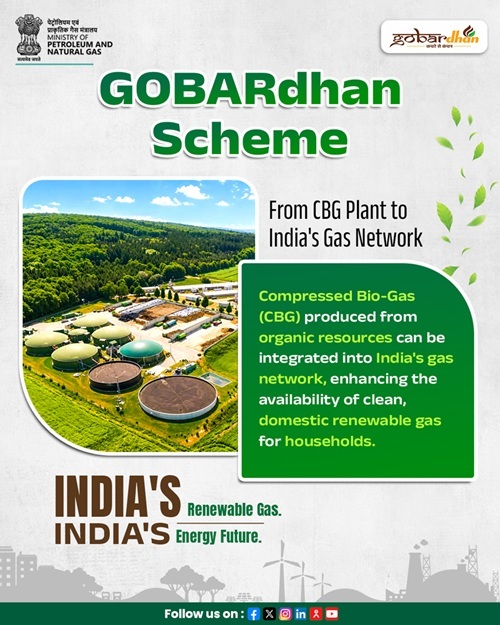
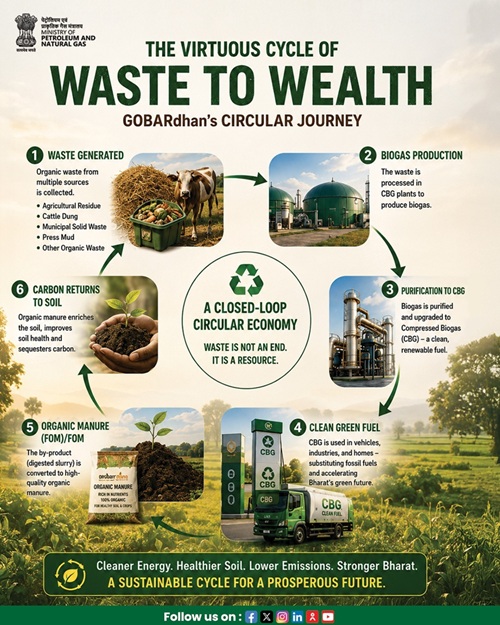
GOBARdhan is a Government of India initiative that promotes the conversion of cattle dung, agricultural residue, municipal organic waste and other biodegradable waste into useful products such as biogas, Compressed Biogas (CBG) and organic manure. The initiative aims to turn organic waste into economic value, support clean energy production, improve waste management and create opportunities across the rural and CBG value chains. The name GOBARdhan stands for Galvanizing Organic Bio-Agro Resources Dhan.
GOBARdhan was launched in 2018 under the Swachh Bharat Mission (Grameen) and has also supported village-level biogas projects. Under SBM-G Phase II, financial assistance of up to ₹50 lakh per district is available for community and cluster-based biogas plants during the programme period up to FY 2026-27. This earlier framework focuses on converting locally available organic waste into biogas and bio-slurry and forms part of the broader development of India's bioenergy ecosystem.
Over the years, the Government also introduced several measures to develop the Compressed Biogas (CBG) sector, including SATAT, Market Development Assistance (MDA), Biomass Aggregation Machinery (BAM), Development of Pipeline Infrastructure (DPI) and Central Financial Assistance for CBG plants. These initiatives helped develop different parts of the CBG value chain and created the foundation for a more integrated national approach.
On 6 August 2026, the Union Cabinet approved GOBARdhan as India's National Unified Scheme for Compressed Biogas (CBG) with an outlay of ₹23,731 crore for the period from FY 2026-27 to FY 2035-36. The Ministry of Petroleum and Natural Gas (MoPNG) will administer this framework through an integrated platform covering the CBG value chain. The new framework aims to increase India's domestic CBG production nearly ten-fold and bring greater investment, market certainty and infrastructure support to the sector.
The National Unified GOBARdhan framework provides six major forms of support: assured CBG offtake, stable CBG pricing, capital assistance, pipeline infrastructure, credit guarantee support and the CBG Ecosystem Challenge Fund. Eligible greenfield CBG projects can receive capital assistance of up to ₹2 crore per TPD of installed capacity, while eligible brownfield projects undertaking capacity expansion can also receive support. The framework also provides an administered CBG price of ₹2,110 per MMBTU, assured offtake arrangements, pipeline connectivity and credit guarantee support of up to 85% of eligible loans for eligible MSME-based projects.
The new framework is intended to expand participation by private CBG developers, MSMEs, cooperatives and rural entrepreneurs, while also widening participation by women entrepreneurs and first-time developers through the credit-support mechanism. It is also expected to create opportunities for farmers and other participants in the feedstock and CBG value chain. The Government expects the integrated framework to generate more than 1.5 lakh jobs, contribute more than ₹75,000 crore to GDP and save more than ₹40,000 crore in foreign exchange over its 10-year implementation period. It also aims to expand the production and use of organic manure and reduce India's dependence on imported fossil fuels.
For the CBG/Bio-CNG component, entities operating or intending to establish eligible plants can register through the GOBARdhan Unified Registration Portal. The registration system provides a common platform for CBG/Bio-CNG plants to access applicable support under the integrated framework. Therefore, readers should understand the current GOBARdhan framework as the Government's unified national approach to developing the CBG ecosystem, while the earlier SBM-G biogas support continues to form an important part of GOBARdhan's background and waste-to-energy development.
Scheme Benefits
The National Unified GOBARdhan framework provides financial, market, infrastructure and credit support for developing the CBG sector. The benefits available to a project depend on the applicable component and eligibility conditions.
- Converts cattle dung, agricultural residue, municipal organic waste and other biomass into CBG and organic manure.
- Provides capital assistance of up to ₹2 crore per TPD for eligible greenfield CBG projects and support for eligible brownfield capacity expansion.
- Provides an assured market for CBG through the offtake framework involving City Gas Distribution entities.
- Provides an administered CBG price of ₹2,110 per MMBTU, with a minimum 10-year pricing horizon, giving producers greater price certainty.
- Supports pipeline infrastructure to connect CBG plants with trunk pipelines and City Gas Distribution networks.
- Provides credit guarantee coverage of up to 85% for eligible MSME-based CBG projects, helping improve access to institutional finance.
- Supports feedstock assessment, biomass aggregation and district-level CBG planning to help plants secure the resources needed for CBG production.
- Provides Market Development Assistance of ₹1,500 per metric tonne for eligible FOM, LFOM and PROM produced from CBG plants.
- Creates more opportunities for farmers, feedstock aggregators, cooperatives and rural entrepreneurs involved in the CBG value chain.
- Creates more employment opportunities across feedstock collection, transportation, CBG production and related activities, with more than 1.5 lakh jobs expected during the 10-year implementation period.
- Promotes the productive use of organic waste and supports the development of a larger organic manure economy.
- Helps reduce dependence on imported fossil fuels and strengthen India's energy security by increasing domestic CBG production.
- Is expected to increase India's domestic CBG production nearly ten-fold and contribute to economic growth and fuel-import savings.
Earlier Government Support for CBG Projects
Before the National Unified GOBARdhan Scheme, the Government supported biogas and CBG development through multiple programmes and initiatives. These included the SATAT initiative, Central Financial Assistance under the MNRE Waste to Energy Programme, Market Development Assistance (MDA), Biomass Aggregation Machinery (BAM), Development of Pipeline Infrastructure (DPI) and other measures for developing the CBG ecosystem.
Under Swachh Bharat Mission (Grameen) Phase-II, GOBARdhan continued to support village-level biogas projects. Financial assistance of up to ₹50 lakh per district is available for setting up community and cluster-based biogas plants during the programme period from 2020-21 to 2026-27. This support is aimed at converting cattle dung, kitchen waste and other biodegradable waste into biogas and bio-slurry.
Separately, the MNRE Waste to Energy Programme provided Central Financial Assistance for eligible BioCNG, enriched biogas and Compressed Biogas projects. Its 2022 guidelines also included provisions for BioCNG projects operating under the SATAT framework.
These initiatives helped build different parts of India's CBG ecosystem. The Government has now brought these efforts together under the National Unified GOBARdhan Scheme, creating an integrated framework covering CBG offtake, pricing, capital assistance, pipeline infrastructure, credit support and ecosystem development. Therefore, the earlier ₹50 lakh district-level biogas assistance and other historical support provisions should not be treated as the benefits of the new CBG component.
Eligibility Requirements
- Any government or private entity operating or intending to establish a CBG/Bio-CNG plant can register through the GOBARdhan Unified Registration Portal.
- The designed gas production capacity of the CBG/Bio-CNG plant should be at least 10 cubic metres per day.
- Eligible CBG project developers can include private developers, MSMEs, cooperatives and rural entrepreneurs, subject to the conditions applicable to the relevant scheme component.
- Eligible greenfield CBG projects can seek capital assistance, while eligible brownfield projects undertaking capacity expansion can also receive support.
- Eligible MSME-based CBG projects can seek credit guarantee support of up to 85% of eligible loans, subject to the applicable conditions.
Note: Eligibility and support conditions may vary according to the particular GOBARdhan component under which assistance is being sought.
Required Documents
- Applicant's identity and KYC documents
- Certificate of Incorporation/registration and constitutional documents of the entity, wherever applicable
- Detailed Project Report (DPR) of the CBG/Bio-CNG project
- GOBARdhan Registration Certificate
- Land ownership or lease-related documents for the project site
- Loan sanction letter, if the project is financed through a loan
- Letter of Intent (LoI) from the concerned Oil Marketing Company, wherever applicable
- Relevant statutory approvals and No Objection Certificates (NOCs), as applicable
- Latest photographs of the plant/project site with timestamp and geo-coordinates
- Bank account details for receiving applicable financial assistance
- Other project-specific documents required under the particular GOBARdhan component for which support is being claimed
Note: The exact documents may vary depending on the type of CBG project and the particular benefit or financial assistance being sought.
Steps to Apply
The GOBARdhan Unified Registration Portal is used for registering CBG/Bio-CNG plants. Any government or private entity operating or intending to establish such a plant can apply, provided the designed gas production capacity is at least 10 cubic metres per day.
- Visit the GOBARdhan Unified Registration Portal.
- Enter the name and designation of the authorised person.
- Enter the email ID and verify it using the OTP.
- Enter the mobile number of the authorised person.
- Create a username and password. The password must contain uppercase and lowercase characters, a special character and a number, and must be at least 8 characters long.
- Enter the captcha and submit the registration form.
- After successful registration, log in to the portal using the registered username and password.
- Provide the required CBG/Bio-CNG plant and project details on the portal.
- Submit the required information to complete the process.
The GOBARdhan Unified Registration Portal brings together registration and access to applicable support from participating Ministries and Departments involved in the CBG ecosystem. These include the Ministry of Petroleum and Natural Gas, Ministry of Housing and Urban Affairs, Ministry of New and Renewable Energy, Department of Animal Husbandry and Dairying, Department of Agriculture and Farmers Welfare and Department of Fertilisers.
Components of GOBARdhan Scheme
The new GOBARdhan framework integrates different aspects of the CBG value chain through six major components. These components provide support from creating a market for CBG and developing plants to arranging finance, building pipeline infrastructure and strengthening the wider CBG ecosystem.
| Component | What It Provides |
|---|---|
| Assured CBG Offtake | Creates an assured market for CBG through an offtake mechanism involving City Gas Distribution entities. |
| Stable CBG Pricing | Provides an administered price of ₹2,110 per MMBTU to offer greater price certainty to CBG producers. |
| Capital Assistance | Provides eligible greenfield CBG projects with capital assistance of up to ₹2 crore per TPD of installed CBG capacity. Eligible brownfield capacity expansion projects can also receive support. |
| Pipeline Infrastructure | Supports pipeline infrastructure connecting CBG plants with trunk pipelines and City Gas Distribution networks. |
| Credit Guarantee Support | Provides eligible MSME-based CBG projects with credit guarantee coverage of up to 85% of eligible loans. |
| CBG Ecosystem Challenge Fund | Supports feedstock assessment and mapping, biomass aggregation, district-level CBG planning, technology adoption, process improvement, organic manure value addition, capacity building and stakeholder awareness. |
Relevant Links
- GOBARdhan Scheme Online Registration
- GOBARdhan Scheme PIB Notification
- GOBARdhan Portal
- Ministry of Petroleum and Natural Gas Portal
Contact Information
Frequently Asked Questions
GOBARdhan is a Government of India initiative that promotes the conversion of organic waste such as cattle dung, agricultural residue and other biomass into biogas, Compressed Biogas (CBG) and organic manure.
The new National Unified CBG framework mainly supports CBG project developers, MSMEs, cooperatives, rural entrepreneurs and other participants in the CBG value chain. It also creates opportunities for farmers, feedstock aggregators and other rural stakeholders.
Eligible greenfield CBG projects can receive capital assistance of up to ₹2 crore per tonne per day (TPD) of installed CBG capacity. Eligible brownfield projects undertaking capacity expansion can also receive support.
Yes. The scheme provides an assured CBG offtake framework involving City Gas Distribution entities, giving eligible CBG producers greater certainty about the market for their product.
Eligible MSME-based CBG projects can receive credit guarantee coverage of up to 85% of eligible loans, subject to the applicable conditions.
The designed gas production capacity of the CBG/Bio-CNG plant should be at least 10 cubic metres per day for registration on the CBG portal.
The earlier GOBARdhan initiative under SBM-G focused strongly on village-level biogas and organic waste management. The new National Unified CBG framework brings earlier CBG-related initiatives and support measures together to develop India's CBG ecosystem at a national scale.
The new framework will be implemented from FY 2026-27 to FY 2035-36 with a total outlay of ₹23,731 crore.
Do you have any question regarding schemes, submit it in scheme forum and get answers:
Feel free to click on the link and join the discussion!
This forum is a great place to:
- Ask questions: If you have any questions or need clarification on any aspect of the topic.
- Share your insights: Contribute your own knowledge and experiences.
- Connect with others: Engage with the community and learn from others.
I encourage you to actively participate in the forum and make the most of this valuable resource.
| Govt |
|---|
Add new comment