


- Interest subsidy of up to 5% per annum on eligible loans
- Individual beneficiaries can avail the benefit on loans up to ₹5 lakh.
- Eligible Self Help Groups (SHGs) can receive the benefit on loans or Cash Credit Limits up to ₹10 lakh.
- Available for Scheduled Castes (SC), Other Backward Classes (OBC), and Safai Karamcharis, including identified Manual Scavengers, Waste Pickers, and their dependents.
For scheme-related assistance, beneficiaries can contact the concerned Implementing Agency based on their category:
- National Scheduled Castes Finance and Development Corporation (NSFDC) Helpline: 1800110396
- Email: [email protected]
- National Backward Classes Finance and Development Corporation (NBCFDC) Helpline: 18001023399
- Email: [email protected]
- National Safai Karamcharis Finance and Development Corporation (NSKFDC) Helpline: 01126382476
- Email: [email protected]
Summary of Scheme | |
|---|---|
Name of Scheme | Vanchit Ikai Samooh aur Vargon ki Aarthik Sahayata (VISVAS) Yojana |
Launched By | |
Benefits | Interest Subsidy up to 5% per annum |
Beneficiary | SC, OBC and Safai Karamcharis (including identified Manual Scavengers, Waste Pickers and their dependents) |
Subscription | |
Mode of Apply | Online Through PM- SURAJ |
Scheme Introduction: A Brief Overview
The Vanchit Ikai Samooh aur Vargon ki Aarthik Sahayata (VISVAS) Yojana is an Interest Subvention Scheme launched by the Ministry of Social Justice and Empowerment, Government of India. The scheme has been introduced to make institutional loans more affordable for eligible people belonging to the Scheduled Castes (SC), Other Backward Classes (OBC), and Safai Karamcharis, including identified Manual Scavengers, Waste Pickers, and their dependents. It supports beneficiaries who wish to take loans for self-employment, entrepreneurship, and other income-generating activities by reducing the interest burden on eligible borrowings.
Under the VISVAS Scheme, the Government provides an interest subsidy of up to 5% per annum on eligible loans obtained from participating Lending Institutions. Individual beneficiaries can receive this benefit on loans of up to ₹5 lakh, while eligible Self Help Groups (SHGs) can receive the interest subsidy on loans or Cash Credit Limits of up to ₹10 lakh. By lowering the effective cost of borrowing, the scheme encourages beneficiaries to start new businesses, expand existing livelihood activities, and improve their financial stability through institutional credit.
To make the scheme more accessible, the Government has also provided a VISVAS Applicant Portal. Through this portal, eligible applicants can register online by selecting their beneficiary category, entering their personal and loan-related details, uploading the required documents, and choosing whether they are applying for a New Loan Request or registering an Existing Loan under the scheme. Participating Lending Institutions use the VISVAS Portal to upload beneficiary details and submit claims for interest subvention in accordance with the scheme guidelines.
The scheme is implemented through Public Sector Banks, Regional Rural Banks, Private Sector Banks, Small Finance Banks, and other eligible Financial Institutions that have partnered with the concerned Implementing Agency. Depending on the beneficiary category, the scheme is administered by the National Scheduled Castes Finance and Development Corporation (NSFDC), National Backward Classes Finance and Development Corporation (NBCFDC), or the National Safai Karamcharis Finance and Development Corporation (NSKFDC). After the Lending Institution verifies the beneficiary's eligibility and submits the prescribed claim, the approved interest subsidy is credited directly to the beneficiary's operational bank account through the Direct Benefit Transfer (DBT) system.
Objectives of the Scheme
The main objectives of the VISVAS Scheme are:
- To provide the benefit of a lower effective rate of interest to eligible beneficiaries.
- To improve access to institutional credit for SC, OBC and Safai Karamcharis.
- To encourage self-employment and income-generating activities.
- To support eligible Self Help Groups and Individual borrowers by reducing their financial burden.
- To ensure that eligible borrowers receive interest subsidy directly through the banking system.
Scheme Benefits
Eligible beneficiaries under the VISVAS Scheme receive the following benefits:
- Interest subsidy of up to 5% per annum on eligible loans.
- Individual beneficiaries can avail the benefit on loans up to ₹5 lakh.
- Eligible Self Help Groups (SHGs) can receive the subsidy on loans or cash credit limits up to ₹10 lakh.
- Helps reduce the overall interest burden on borrowers.
- Encourages entrepreneurship and self-employment among economically weaker sections.
- Promotes income-generating activities through affordable institutional finance.
- Interest subsidy is transferred directly into the beneficiary's bank account through the DBT system.
- The benefit is available only on standard loan accounts and only where no other interest subsidy has been received for the same loan.
Eligibility Requirements
Individual Beneficiaries
- An Individual applicant is eligible if he or she:
- Belongs to the Scheduled Caste (SC), Other Backward Class (OBC) or Safai Karamchari category (including identified Manual Scavengers, Waste Pickers and their dependents).
- Has an annual family income of not more than ₹3 lakh in the case of SC and OBC applicants.
- Has obtained an eligible loan from a participating Lending Institution.
- Maintains a standard loan account.
- There is no income ceiling for Safai Karamcharis covered under the scheme.
Self Help Groups (SHGs)
- An SHG can avail the scheme if:
- At least 70% of its members belong to the Target Group.
- The remaining members belong to other vulnerable or weaker sections.
- The SHG has obtained an eligible loan or Cash Credit Limit from a participating Lending Institution.
- The SHG maintains a standard loan account.
- The President, Secretary or Chief Office Bearer submits a declaration confirming at least 70% of the members belong to the Target Group.
- Interest subsidy will be available only for loans that are not already receiving interest subsidy under another Government scheme.
Target Group
The scheme covers the following categories:
- Scheduled Castes (SC)
- Other Backward Classes (OBC)
- Safai Karamcharis
- Identified Manual Scavengers
- Waste Pickers Dependents of identified Manual Scavengers and Waste Pickers
Income Criteria
For SC and OBC beneficiaries, the annual family income should not exceed ₹3 lakh.
However, the guideline recognises multiple methods for establishing income eligibility. These include:
- Income Certificate issued by the Competent Authority.
- Antyodaya Anna Yojana (AAY) Card.
- Below Poverty Line (BPL) Card.
- Socio Economic Caste Census (SECC-2011) deprivation criteria.
- Self-certification endorsed by a notified Gazetted Officer.
- Self-certification endorsed by the Branch Manager where the loan is obtained through a bank.
In addition, the guideline prescribes deemed income norms for certain agricultural categories:
Category | Annual Family Income |
Landless agricultural labourers and marginal farmers (up to one hectare) | ₹1.5 Lakh |
Small farmers (one to two hectares) | Up to ₹3 Lakh |
Safai Karamcharis (including identified Manual Scavengers, Waste Pickers and their dependents) | No Income Limit |
Financial Assistance
The scheme provides interest subvention up to 5% per annum on eligible borrowings.
The maximum loan amount eligible under the scheme is:
Beneficiary | Maximum Eligible Loan |
Individual Beneficiary | ₹5 Lakh |
Self Help Group (SHG) | ₹10 Lakh (Loan/Cash Credit Limit) |
Implementing Agencies
The scheme is implemented through three National Corporations based on the beneficiary category.
Implementing Agency | Category Covered |
National Backward Classes Finance and Development Corporation (NBCFDC) | OBC beneficiaries |
National Scheduled Castes Finance and Development Corporation (NSFDC) | SC beneficiaries |
National Safai Karamcharis Finance & Development Corporation (NSKFDC) | Safai Karamchari beneficiaries |
Scheme Period
The VISVAS Scheme is applicable during Financial Years 2024-25 and 2025-26.
- Beneficiaries enrolled during this period remain eligible to receive the approved interest subsidy for the tenure of their loan or up to FY 2029-30, whichever is earlier.
Eligible Lending Institutions
The VISVAS Scheme is implemented through eligible Lending Institutions that have entered into the required agreement with the respective Implementing Agency.
The following institutions can extend loans covered under the scheme:
- Public Sector Banks (PSBs)
- Regional Rural Banks (RRBs)
- Private Sector Banks
- Small Finance Banks (SFBs)
- Other similar Financial Institutions approved under the scheme.
Applicants can visit the PM Suraj Portal to view the list of Lending Institutions implementing the VISVAS Scheme and obtain additional scheme information.
Convergence with Other Government Schemes
The VISVAS Scheme also allows convergence with certain Government loan programmes. However, the interest subsidy under VISVAS is available only for the loan or loan portion that has not already received interest subvention under another scheme.
The guideline identifies the following schemes for convergence:
- MUDRA Shishu Loans (up to ₹50,000)
- MUDRA Kishore Loans (₹50,000 to ₹5 lakh)
- DAY-NRLM Loans (₹5 lakh to ₹10 lakh)
- PM SVANidhi
- Other eligible Government loan programmes, subject to the scheme conditions.
Important Conditions of the Scheme
Applicants and Lending Institutions should keep the following conditions in mind:
- The loan must be taken only for an income-generating purpose.
- Only standard loan accounts are eligible for interest subvention.
- Interest subsidy cannot be claimed on any loan or loan portion that is already receiving interest subsidy under another Government scheme.
- SHGs must submit the prescribed declarations regarding member composition and income eligibility.
- Lending Institutions must upload beneficiary details on the VISVAS Portal and submit quarterly claims in the prescribed format.
Required Documents
The guideline does not prescribe a fixed checklist of documents for applicants. However, based on the prescribed eligibility and verification process, beneficiaries may be required to provide the following:
- Aadhaar Card or another valid identity proof.
- Caste Certificate, wherever applicable.
- Income Certificate issued by the Competent Authority or any other accepted proof of income.
- AAY or BPL Card, if applicable.
- Self-certification of annual family income, wherever permitted.
- Loan Account details provided by the Lending Institution.
- For SHGs, declarations regarding member composition and annual family income as prescribed in the guideline.
Note: The exact document requirements may differ from one Lending Institution to another during loan processing.
Steps to Apply
- Step 1: Visit the PM-SURAJ Portal
- Visit the official PM-SURAJ Portal and open the homepage.
- Step 2: Open the VISVAS Menu
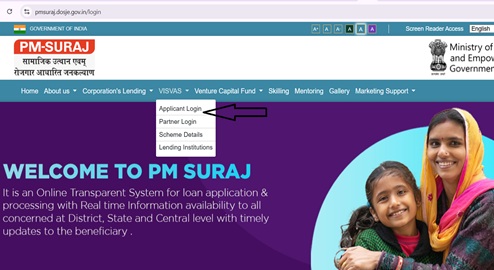
- From the top navigation bar, click VISVAS. A drop-down menu will appear with the following options:
- Applicant Login
- Partner Login
- Scheme Details
- Lending Institutions
- Since you are applying as a beneficiary, click Applicant Login.(Individual applicants should select Applicant Login, while Partner Login is meant for participating Lending Institutions and Implementing Agencies.)
- Step 3: Click on Register
- On the Applicant Login page, click the Register option available at the top-right corner. This will open the VISVAS Registration Form.
- Step 4: Select Your Category
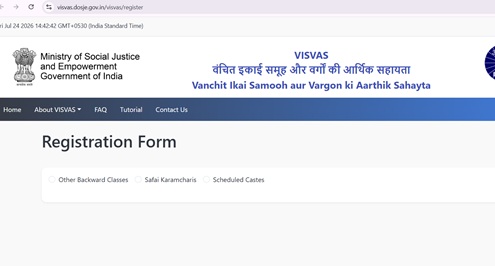
- Choose the category under which you are applying:
- Other Backward Classes (OBC)
- Safai Karamcharis
- Scheduled Castes (SC)
- Step 5: Enter Your Personal Details
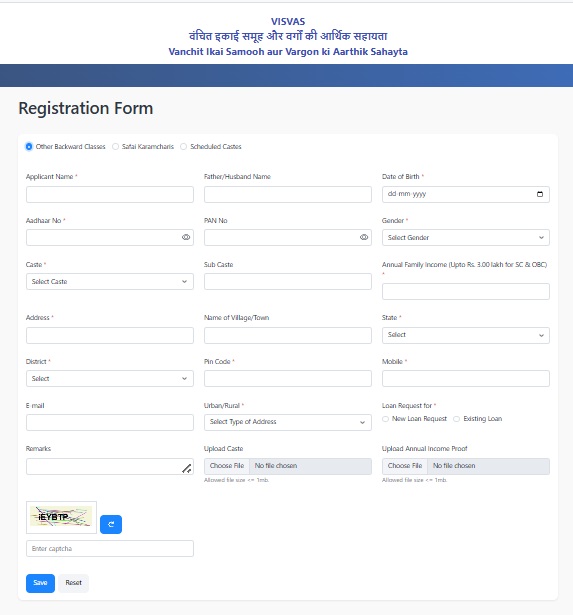
- Fill in all the required information, including:
- Applicant Name
- Father's/Husband's Name
- Date of Birth
- Aadhaar Number
- PAN Number
- Gender
- Caste and Sub-Caste
- Annual Family Income (for SC/OBC applicants)
- Complete Address
- Village/Town
- State
- District
- PIN Code
- Mobile Number
- Email ID
- Urban/Rural Area
- Step 6: Select the Loan Request Type
- Choose the appropriate option:
- New Loan Request, if you are applying for a new loan.
- Existing Loan, if you already have an eligible loan and wish to receive the interest subvention under the VISVAS Scheme.
- Step 7: Upload the Required Documents
- Upload the required documents in the prescribed format, including:
- Caste Certificate Annual Income Proof Step 8: Complete CAPTCHA Verification
- Enter the CAPTCHA code displayed on the screen. If the code is unclear, click the refresh icon to generate a new CAPTCHA.
- Step 9: Submit the Registration Form
- After reviewing all the information, click the Save button to submit your registration.
- If you need to make changes before submitting, click Reset to clear the form and re-enter the details.
- Step 10: Wait for Further Processing
- After successful registration, keep your registered mobile number and email ID active.
- The concerned Lending Institution or Implementing Agency may contact you for further verification or the next stage of the loan and interest subvention process.
What Happens After Registration?
After the registration process, explain what happens next.
- Step 1: Registration Verification
- The details submitted by the applicant are verified by the concerned authorities and the participating Lending Institution.
- Step 2: Loan Processing
- If the applicant has selected a New Loan Request, the participating Lending Institution processes the loan application according to its eligibility criteria and loan approval procedures.
- Applicants who selected Existing Loan are considered for interest subvention on their eligible loan, subject to the scheme conditions.
- Step 3: Loan Approval
- Once all eligibility conditions are fulfilled, the Lending Institution sanctions the eligible loan or verifies the existing loan account under the VISVAS Scheme.
- Step 4: Submission of Beneficiary Details
- The Lending Institution uploads the eligible beneficiary's details to the VISVAS Portal and submits the prescribed claim for interest subvention to the concerned Implementing Agency.
- Step 5: Release of Interest Subvention
- After the claim is verified and approved, the interest subvention is released by the concerned Implementing Agency and credited directly to the beneficiary's operational bank account through the Direct Benefit Transfer (DBT) system. The beneficiary is also notified through an automated SMS after the subsidy is credited.
Monitoring & Evaluation
The implementation of the VISVAS Scheme is monitored at different levels to ensure that the interest subvention is provided to eligible beneficiaries and the scheme is implemented according to the prescribed guidelines.
The monitoring responsibilities are divided as follows:
- Ministry of Social Justice and Empowerment (MoSJ&E): Overall monitoring of the scheme at the Central Government level.
- NBCFDC: Supervises the implementation for OBC beneficiaries.
- NSFDC: Supervises the implementation for Scheduled Caste (SC) beneficiaries.
- NSKFDC: Supervises the implementation for Safai Karamcharis (including identified Manual Scavengers, Waste Pickers and the ir dependents).
Physical Evaluation
The respective Implementing Agencies and their authorised State Agencies carry out field-level inspections to:
- Assess whether the scheme benefits are being properly utilised.
- Evaluate the socio-economic improvements achieved by beneficiaries.
- Verify the implementation of the scheme at the field level.
During these inspections, Lending Institutions are required to provide all necessary assistance and records.
Third-Party Evaluation
- The Ministry of Social Justice and Empowerment may conduct an independent impact assessment or third-party evaluation of the scheme.
- Lending Institutions are required to cooperate and provide the necessary support for such evaluations.
Relevant Links
- Ministry of Social Justice and Empowerment (MoSJ&E Website )
- NBCFDC Portal
- Lending Insitutions list
- PM Suraj Portal
- VISWAS Portal
- Guidelines of the Vanchit Ikai Samooh aur Vargon ki Aarthik Sahayata (VISVAS) Yojana
Contact Information
For scheme-related assistance, beneficiaries can contact the concerned Implementing Agency based on their category:
- National Scheduled Castes Finance and Development Corporation (NSFDC)
- Helpline: 1800110396
- Email: [email protected]
- National Backward Classes Finance and Development Corporation (NBCFDC)
- Helpline: 18001023399
- Email: [email protected]
- National Safai Karamcharis Finance and Development Corporation (NSKFDC)
- Helpline: 01126382476
- Email: [email protected]
For More Information Visit Your Bank.
Frequently Asked Questions
Ans: Scheduled Caste (SC) and Other Backward Class (OBC) members with Annual Family Income upto Rs 3.00 lakh and Safai Karamcharis (including identified manual scavengers, waste pickers and their dependants) (SK). No income criteria will be applicable in case of SK.
SHGs with atleast 70% members from the target group will be eligible for interest subvention @ 5% to avail the loan/credit uptoRs10 lakhs.
The scheme is implemented by:
- NSFDC for SC beneficiaries.
- NBCFDC for OBC beneficiaries.
- NSKFDC for Safai Karamchari beneficiaries.
No. Only eligible SHGs with a standard loan account can receive interest subvention under the scheme.
Yes. SC and OBC SHG members must have an annual family income of up to ₹3 lakh. There is no income limit for Safai Karamchari members.
The SHG's President, Secretary, or Chief Office Bearer can submit declarations confirming the member composition and annual family income of eligible members.
Yes. Lending Institutions may conduct random checks to verify the income and caste details declared by the SHG.
Yes, but interest subvention is available only for the loan amount that is not receiving interest subsidy under another scheme. SHGs receiving only capital subsidy under another scheme are also eligible.
Yes. Eligible DAY-NRLM SHGs can receive VISVAS interest subvention only on the portion of the loan that is not already covered by another interest subsidy scheme.
No. The VISVAS Scheme provides interest subvention only on eligible loans or cash credit limits up to ₹10 lakh, subject to the scheme conditions.
Do you have any question regarding schemes, submit it in scheme forum and get answers:
Feel free to click on the link and join the discussion!
This forum is a great place to:
- Ask questions: If you have any questions or need clarification on any aspect of the topic.
- Share your insights: Contribute your own knowledge and experiences.
- Connect with others: Engage with the community and learn from others.
I encourage you to actively participate in the forum and make the most of this valuable resource.
| Caste | Person Type | Scheme Type | Govt |
|---|---|---|---|


Matching schemes for sector: കടം
| Sno | CM | സ്കീം | Govt |
|---|---|---|---|
| 1 | 
|
കിസാൻ ക്രെഡിറ്റ് കാർഡ് | CENTRAL GOVT |
| 2 |
|
স্টার্টআপের জন্য ক্রেডিট গ্যারান্টি স্কীম | CENTRAL GOVT |
| 3 |
|
প্রধানমন্ত্রী মুদ্রা যোজনা (PMMY) | CENTRAL GOVT |
| 4 |
|
Divyangjan Swavalamban Scheme | CENTRAL GOVT |
| 5 |
|
ക്രെഡിറ്റ് ബന്ധപ്പെടുത്തിയ സർക്കാർ പദ്ധതിക്ക് വേണ്ടിയുള്ള ജാൻസമർഥ് പോർട്ടൽ ദേശിയ പോർട്ടൽ | CENTRAL GOVT |
| 6 |
|
പിഎം സ്വനിധി പദ്ധതി | CENTRAL GOVT |
| 7 |
|
പിഎം വിശ്വകർമ യോജന | CENTRAL GOVT |
| 8 |
|
पीएम विद्यालक्ष्मी योजना | CENTRAL GOVT |
| 9 |
|
प्रधान मंत्री आवास योजना शहरी | CENTRAL GOVT |
| 10 |
|
PM-USP Central Sector Interest Subsidy Scheme (CSIS) | CENTRAL GOVT |
Add new comment