



- Stand-Up India was designed for women and SC/ST entrepreneurs.
- The scheme supported greenfield or new enterprises.
- Loan amounts ranged from ₹10 lakh to ₹1 crore.
- Loans covered manufacturing, services, trading and eligible agriculture-allied activities.
- The repayment period could extend up to 7 years.
- Stand-Up India
- Toll Free Helpline Number: 02267001526
- Email ID: [email protected]
Summary of the Scheme | |
|---|---|
| Name of Scheme | Stand-Up India Scheme (SUPI) |
| Launch Year | 2016 |
| Benefits | Composite bank loan of ₹10 lakh to ₹1 crore for eligible greenfield enterprises |
| Beneficiary | SC/ST and women entrepreneurs above 18 years |
| Nodal Agency | Department of Financial Services, Ministry of Finance |
| Subscription | Subscribe here to get Update Regarding Scheme |
| Mode of Apply | Through Scheduled Commercial Banks, Stand-Up Mitra and JanSamarth |
Scheme Introduction: A Brief Overview
Starting a new business often requires more than a good idea. Access to suitable bank finance, guidance and support can make a major difference, especially for people entering entrepreneurship for the first time. The Stand-Up India Scheme (SUPI) was introduced with this purpose, focusing specifically on Scheduled Castes (SC), Scheduled Tribes (ST) and women entrepreneurs. Launched on 5 April 2016, the scheme facilitated composite bank loans from ₹10 lakh to ₹1 crore for setting up eligible greenfield enterprises in manufacturing, services, trading and specified activities allied to agriculture. The scheme also provided for a repayment period of up to seven years, including a moratorium of up to 18 months, while the borrower was required to contribute at least 10% of the project cost from their own funds.
The scheme was implemented by the Department of Financial Services (DFS), Ministry of Finance, through Scheduled Commercial Banks. Its objective was not limited to providing credit; the Stand-Up India framework also included handholding support to help prospective entrepreneurs with training, project preparation, loan applications and other business-related requirements.
The Stand-Up India Scheme was extended for the 15th Finance Commission period and remained valid up to 31 March 2025. By 28 February 2025, a total of 2.67 lakh accounts had been sanctioned, with loans worth ₹60,504 crore sanctioned under the scheme.
The scheme was meant to help women and SC/ST entrepreneurs start new, or greenfield, businesses. Eligible applicants had to be above 18 years of age and should not be in default to any bank or financial institution. For non-individual businesses, at least 51% of the shareholding and controlling stake had to be held by a woman or an SC/ST entrepreneur.
Loans under the scheme were available for greenfield enterprises in manufacturing, services, trading and activities allied to agriculture. The scheme covered activities such as dairy, fisheries, poultry and beekeeping, while ordinary crop loans were not covered.
For readers looking for the Stand-Up India Scheme in 2026, it is important to note that the original scheme ended on 31 March 2025. In the Union Budget 2025-26, the government announced a new scheme for 5 lakh first-time entrepreneurs, including women and SC/ST entrepreneurs, with term loans of up to ₹2 crore over five years. The new scheme is intended to incorporate lessons from Stand-Up India.
Therefore, the earlier Stand-Up India loan limit of ₹10 lakh to ₹1 crore should be treated as a feature of the original scheme. Applicants should check the latest official notification for the current scheme before applying.
For entrepreneurs looking for other business-credit options, readers can also explore Pradhan Mantri Mudra Yojana (PMMY), which provides credit support to eligible micro enterprises, and Pradhan Mantri Employment Generation Programme (PMEGP), which supports eligible new micro-enterprises through a credit-linked subsidy. These schemes have different eligibility conditions, loan structures and objectives, so applicants should check the individual scheme requirements before applying.
Scheme Benefits
The Stand-Up India Scheme was designed to make it easier for eligible women and SC/ST entrepreneurs to start a new business with access to bank finance and business support. The main benefits of the scheme included:
- Eligible entrepreneurs could get a composite bank loan ranging from ₹10 lakh to ₹1 crore for setting up a greenfield enterprise.
- The loan could cover up to 85% of the project cost, subject to the scheme conditions.
- The loan could cover both term-loan and working-capital requirements of the new business.
- The borrower was required to contribute at least 10% of the project cost from their own funds, while the remaining margin requirement could be supported through eligible government schemes.
- The loan could be repaid over a period of up to 7 years, with a moratorium of up to 18 months.
- Working-capital requirements of up to ₹10 lakh could be provided through an overdraft facility with a RuPay debit card. Higher working-capital requirements could be provided through a cash-credit limit.
- The scheme provided access to credit-guarantee support through the Credit Guarantee Fund for Stand-Up India, subject to applicable bank and guarantee conditions.
- Eligible businesses could be established in manufacturing, services, trading and specified agriculture-allied activities.
- Entrepreneurs could receive handholding support for preparing project reports, completing loan applications, training, skill development and connecting with relevant support agencies.
- The Stand-Up India portal connected prospective borrowers with 8,000+ handholding agencies, including training centres, mentors, Entrepreneurship Development Programme centres and District Industries Centres.
- The scheme was specifically designed to increase access to institutional credit for women and SC/ST entrepreneurs who wanted to start a new enterprise.
Note: The original Stand-Up India Scheme was operational up to 31 March 2025. These benefits describe the original scheme. The government has announced a revamped version, but its final operational guidelines should be checked against the latest official notification before treating these terms as applicable to new applications in 2026.
Activities Covered Under Stand-Up India Scheme
The Stand-Up India Scheme supported new or greenfield enterprises in the manufacturing, services and trading sectors. It also covered several activities allied to agriculture. This expansion allowed eligible entrepreneurs to seek finance for a wider range of businesses connected with agriculture and related services.
Activities allied to agriculture covered under the scheme included:
- Pisciculture and fisheries
- Beekeeping
- Poultry
- Livestock rearing
- Dairy farming
- Grading, sorting and aggregation
- Agro-industries
- Food and agro-processing
- Agri-clinics and agri-business centres
- Services supporting eligible agriculture-allied activities
Crop loans and activities such as land improvement through canals, irrigation and wells were not covered under the agriculture-allied category of the scheme.
Loan Amount and Repayment Period
Loan Amount and Repayment Period | |
|---|---|
| Loan Amount | ₹10 lakh to ₹1 crore |
| Type of Loan | Composite loan covering term loan and working capital requirements |
| Maximum Project Financing | Up to 85% of the project cost, subject to applicable conditions |
| Borrower's Contribution | At least 10% of the project cost |
| Maximum Repayment Period | Up to 7 years |
| Moratorium Period | Up to 18 months |
| Working Capital up to ₹10 lakh | May be provided through an overdraft facility with a RuPay debit card |
| Working Capital above ₹10 lakh | May be provided through a cash credit limit |
| Repayment Schedule | Determined by the lending bank based on the loan and project assessment |
Interest Rate and Margin Money
Under the Stand-Up India Scheme, there was no single fixed interest rate for all borrowers. The interest rate depended on the bank's applicable rate for the borrower's category and was subject to the limit prescribed under the scheme.
Interest Rate and Margin Money | |
|---|---|
| Interest Rate | Based on the bank's applicable rate for the borrower's category. |
| Maximum Interest Rate | Could not be more than the applicable base rate plus 3% and the tenor premium. |
| Margin Money | Up to 15% of the total project cost. |
| Government Scheme Support | Eligible Central or State Government schemes could be used to meet part of the margin money requirement. |
| Borrower's Contribution | The borrower had to contribute at least 10% of the project cost from their own funds. |
| Primary Security | The loan required security as applicable to the assets or project being financed. |
| Collateral Security | The bank could ask for additional collateral security based on its assessment. |
| Credit Guarantee | Credit guarantee coverage under the applicable Stand-Up India guarantee scheme could be used, subject to the prescribed conditions. |
The final interest rate, margin and security requirements depended on the lending bank's assessment and the applicable scheme rules.
Eligibility Requirements
The Stand-Up India Scheme was meant for entrepreneurs from specific beneficiary groups who wanted to start a new business. To be eligible under the original scheme, applicants had to meet the following conditions:
- The applicant must be a woman or belong to the Scheduled Caste (SC) or Scheduled Tribe (ST) category.
- The applicant must be above 18 years of age.
- The proposed business must be a greenfield enterprise, meaning it should be the applicant's first venture in the relevant business activity.
- The enterprise can be set up in manufacturing, services, trading or specified agriculture-allied activities.
- The applicant must not be in default to any bank or financial institution.
- For a company, partnership, LLP or other non-individual enterprise, at least 51% of the shareholding and controlling stake must be held by an SC/ST and/or woman entrepreneur.
- The proposed business must meet the lending and documentation requirements of the participating Scheduled Commercial Bank.
The scheme was not intended for the expansion of an already established business because its main focus was on supporting new or first-time enterprises. The original scheme ended on 31 March 2025, so these are the eligibility conditions of the earlier Stand-Up India Scheme; applicants should check the latest government notification for the eligibility rules of any revamped scheme.
Required Documents
To apply for a Stand-Up India loan, applicants generally need documents that verify their identity, category, business plan and financial contribution. The exact list may vary depending on the bank, type of enterprise and loan proposal. Commonly required documents include:
- Identity proof such as Aadhaar Card, PAN Card, Voter ID or Passport.
- Address proof of the applicant and proposed business premises, where applicable.
- SC/ST caste certificate for applicants applying under the SC/ST category.
- Recent passport-size photographs.
- Project report describing the proposed business, estimated cost, expected income and repayment plan.
- Documents showing the applicant's own contribution towards the project cost.
- Business registration or constitution documents, such as a partnership deed, certificate of incorporation or Memorandum and Articles of Association, where applicable.
- Documents related to the business premises, such as ownership or lease documents, where applicable.
- Quotations or estimates for machinery, equipment and other items to be purchased for the business.
- Bank statements, income-tax returns or other financial documents, if required by the lending bank.
- Any licences, registrations or approvals required for the proposed business activity.
Applicants should check the document requirements with the concerned bank before submitting the application, as additional documents may be requested based on the nature and size of the proposed enterprise.
Steps to Apply
When the Stand-Up India Scheme was operational, eligible entrepreneurs could apply through Scheduled Commercial Banks or use online platforms for guidance and loan application support. The process generally involved preparing the business proposal, submitting the required details and documents, and completing the bank's loan appraisal process.
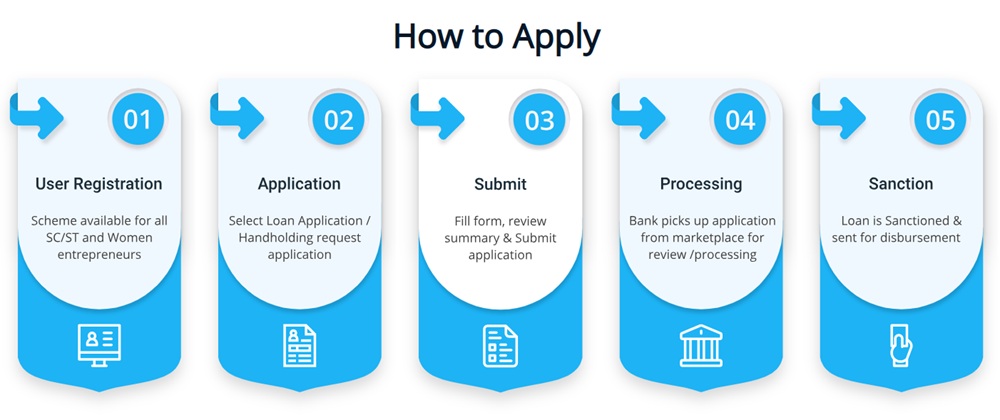
- Prepare your business proposal: Start by preparing a basic business plan for your proposed greenfield enterprise. Include details such as the type of business, project cost, loan amount required, working capital requirement and your own contribution.
- Choose an application channel: Applicants could approach a Scheduled Commercial Bank directly. They could also use Stand-Up Mitra for guidance and handholding support. The scheme also allowed loan applications through JanSamarth.
- Get guidance if required: Stand-Up Mitra provided support to prospective entrepreneurs, including help with training, preparing the business proposal and filling out the loan application according to bank requirements.
- Submit your details and documents: Provide the required personal, category and business details along with information about the project cost, loan requirement and your own contribution. Keep the documents required by the lending bank ready.
- Submit the loan application: Submit the completed application through the selected channel. The application was then forwarded to the concerned Scheduled Commercial Bank for further processing.
- Bank checks the application: The bank assessed the business proposal, project cost, repayment capacity, documents and other applicable lending conditions before taking a decision on the loan.
- Loan sanction and disbursement: If the application was approved, the bank completed the required formalities and sanctioned the loan. The loan amount was then disbursed according to the applicable terms and conditions.
Important: The original Stand-Up India Scheme was operational up to 31 March 2025. The Department of Financial Services has stated that a new scheme for first-time entrepreneurs was proposed in Budget 2025-26 and was under the process of finalisation. Therefore, the above steps describe the process followed under the original scheme and should not be treated as confirmation of a new 2026 application window. Applicants should check the latest information from the Department of Financial Services before applying.
Relevant Links
- Department of Financial Services (DFS)
- Stand-Up India Scheme (SUPI)
- Official SIDBI scheme portal- Stand-Up Mitra
- JanSamarth Portal
- Stand-Up India Scheme FAQs
- Stand-Up India Factsheet
- Stand-Up India Scheme Details
Contact Information
Stand-Up India
- Toll Free Helpline Number: 02267001526
- Email ID: [email protected]
Department of Financial Services, Ministry of Finance, Government of India
- Phone: 0120-2395152, 0120-2395157
- Email: [email protected]
- Address: Department of Financial Services, Ministry of Finance, Jeevan Deep Building, 3rd Floor, Sansad Marg, New Delhi – 110001
For a grievance related to banking or financial services, the Department of Financial Services also provides a dedicated grievance channel through CPGRAMS and its Grievance Handling Cell. The official DFS website lists the Grievance Handling Cell phone number as 011-23346785 and email as [email protected].
Frequently Asked Questions
Stand-Up India was a government scheme that provided bank loans to women and SC/ST entrepreneurs for starting new or greenfield enterprises.
Women and SC/ST entrepreneurs above 18 years of age were eligible, provided they were not in default to any bank or financial institution.
The scheme provided composite loans ranging from ₹10 lakh to ₹1 crore for eligible greenfield enterprises.
Loans were available for greenfield enterprises in manufacturing, services, trading and eligible activities allied to agriculture.
Yes. For a non-individual enterprise, at least 51% of the shareholding and controlling stake had to be held by a woman or SC/ST entrepreneur.
The loan could generally be repaid over a period of up to 7 years, including a moratorium of up to 18 months.
The margin money requirement was up to 15% of the project cost, while the borrower had to contribute at least 10% from their own funds.
The original Stand-Up India Scheme ended on 31 March 2025. Therefore, its earlier loan rules should not be treated as a current 2026 application window.
The Union Budget 2025-26 announced a new scheme for 5 lakh first-time entrepreneurs, including women and SC/ST entrepreneurs, with term loans of up to ₹2 crore over five years.
Applicants should check the latest information and official notifications from the Department of Financial Services before applying, as the new first-time entrepreneur scheme is separate from the original Stand-Up India Scheme.
Do you have any question regarding schemes, submit it in scheme forum and get answers:
Feel free to click on the link and join the discussion!
This forum is a great place to:
- Ask questions: If you have any questions or need clarification on any aspect of the topic.
- Share your insights: Contribute your own knowledge and experiences.
- Connect with others: Engage with the community and learn from others.
I encourage you to actively participate in the forum and make the most of this valuable resource.
| Caste | Person Type | योजना प्रकार | Govt |
|---|---|---|---|


क्षेत्रासाठी जुळणाऱ्या योजना: कर्ज
| Sno | CM | Scheme | Govt |
|---|---|---|---|
| 1 | 
|
किसान क्रेडिट कार्ड योजना | केंद्र सरकार |
| 2 |
|
স্টার্টআপের জন্য ক্রেডিট গ্যারান্টি স্কীম | केंद्र सरकार |
| 3 |
|
প্রধানমন্ত্রী মুদ্রা যোজনা (PMMY) | केंद्र सरकार |
| 4 |
|
दिव्यांगजन स्वावलंबन योजना | केंद्र सरकार |
| 5 |
|
जनसमर्थ पोर्टल-क्रेडिट लिंक्ड सरकारी योजनाओं के लिए राष्ट्रीय पोर्टल | केंद्र सरकार |
| 6 |
|
প্ৰধানমন্ত্ৰী স্বনিধি আঁচনি | केंद्र सरकार |
| 7 |
|
पीएम विश्वकर्मा योजना | केंद्र सरकार |
| 8 |
|
পিএমএফএমই (PMFME) আঁচনি | केंद्र सरकार |
| 9 |
|
पीएम विद्यालक्ष्मी योजना | केंद्र सरकार |
| 10 |
|
प्रधान मंत्री आवास योजना शहरी | केंद्र सरकार |
| 11 |
|
विश्वास योजना | केंद्र सरकार |
| 12 |
|
PM-USP Central Sector Interest Subsidy Scheme (CSIS) | केंद्र सरकार |
| 13 |
|
SBI Surya Shakti Solar Finance | केंद्र सरकार |
| 14 |
|
Agriculture Infrastructure Fund | केंद्र सरकार |
| 15 |
|
Emergency Credit Line Guarantee Scheme | केंद्र सरकार |
Comments
Agricultural kit nashan Dba
Loans provide
नवी प्रतिक्रिया द्या