



- The NAMASTE Scheme was launched in July 2023 to improve the safety and livelihoods of sanitation workers.
- It covers Sewer and Septic Tank Workers, waste pickers and identified manual scavengers under applicable components.
- Eligible individual projects can receive a capital subsidy of up to ₹7.50 lakh, while group projects can receive up to ₹25 lakh.
- Eligible workers can get PPE kits, safety training and health insurance coverage of up to ₹5 lakh per family per year.
- NAMASTE helpline at 14473
Summary of the Scheme | |
|---|---|
| Name of Scheme | National Action for Mechanised Sanitation Ecosystem (NAMASTE) Scheme |
| Launch Year | 2023 |
| Benefits | Up to ₹7.50 lakh individual capital subsidy; ₹25 lakh group subsidy; ₹5 lakh annual health insurance cover; PPE kits and occupational safety training. |
| Beneficiary | Sewer and Septic Tank Workers (SSWs), waste pickers, and identified manual scavengers and their eligible dependents. |
| Nodal Agency | National Safai Karamcharis Finance & Development Corporation (NSKFDC) |
| Subscription | Subscribe here to get Update Regarding Scheme |
| Mode of Apply | Through beneficiary identification and profiling by Urban Local Bodies (ULBs); waste pickers are enumerated through designated agencies and verified by ULBs or Gram Panchayats. |
Scheme Introduction: A Brief Overview
Sanitation workers often face serious health and safety risks while cleaning sewer lines, septic tanks and collecting waste. To protect them and improve their working conditions, the Government of India launched the National Action for Mechanised Sanitation Ecosystem (NAMASTE) Scheme in July 2023. It aims to reduce hazardous cleaning practices, promote mechanised sanitation and provide workers with safer livelihoods.
The scheme is jointly implemented by the Ministry of Social Justice and Empowerment (MoSJE) and the Ministry of Housing and Urban Affairs (MoHUA), with the National Safai Karamcharis Finance and Development Corporation (NSKFDC) as the implementing agency. It covers Sewer and Septic Tank Workers (SSWs), while waste pickers were added from FY 2024–25. Identified manual scavengers and their eligible dependents can also receive selected rehabilitation benefits from the earlier SRMS.
Eligible workers can receive PPE kits, occupational safety training and health insurance coverage of up to ₹5 lakh per family per year under Ayushman Bharat-PMJAY, subject to eligibility. The scheme also supports safer cleaning through mechanised equipment and Emergency Response Sanitation Units (ERSUs).
Under the Swachhata Udyami Yojana (SUY), eligible individual sanitation projects can receive a capital subsidy of up to ₹7.50 lakh, while eligible group projects involving up to five beneficiaries can receive up to ₹25 lakh. Eligible private sanitation organisations can also receive capital subsidy for mechanised equipment, subject to scheme conditions. Waste pickers can access additional support, including occupational identity cards, PPE kits, training and assistance for eligible waste collection vehicles through Dry Waste Collection Centres (DWCCs).
To receive benefits, workers must complete the prescribed identification and verification process. Sewer and septic tank workers can contact their local Urban Local Body (ULB) for profiling. Waste pickers are identified through designated organisations using the NAMASTE Waste Picker Enumeration App. Those interested in starting a sanitation-related business can also approach their ULB or designated lending agency for guidance on loans and subsidies.
For scheme-related assistance, workers can contact their concerned ULB or NSKFDC at 011-26382476 or 011-26382478.
Workers and families interested in exploring other financial assistance opportunities can also read about the VISVAS Yojana, which provides interest subsidy support to eligible Safai Karamcharis, waste pickers and their dependents. Similarly, the Pradhan Mantri Shram Yogi Maandhan Yojana (PM-SYM) offers pension benefits to eligible unorganised-sector workers, including waste pickers and sanitation workers. These schemes provide additional avenues for financial security and social protection.
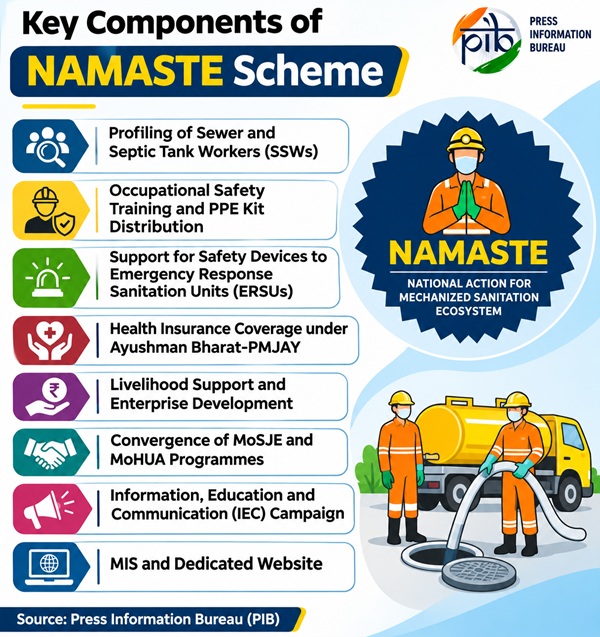
Scheme Benefits
The NAMASTE Scheme offers several benefits to improve the safety, health and livelihood of sanitation workers and waste pickers. Its major benefits include:
- Worker Identification: Profiling and occupational identity cards help recognise Sewer and Septic Tank Workers and waste pickers and connect them with eligible welfare benefits.
- Mechanised Cleaning: The scheme encourages the use of machines and modern equipment for sewer and septic tank cleaning to reduce workers' dependence on hazardous manual methods.
- Personal Safety: Eligible workers receive Personal Protective Equipment (PPE) kits to protect themselves from workplace hazards while carrying out sanitation and waste collection activities.
- Occupational Training: Workers receive safety training to learn proper cleaning methods, handle equipment and reduce the risk of workplace accidents.
- Health Protection: Eligible workers and their families can access health insurance benefits under Ayushman Bharat-PMJAY, subject to the applicable conditions.
- Self-Employment Opportunities: The scheme encourages eligible sanitation workers to start their own mechanised sanitation businesses and become Sanipreneurs.
- Support for Waste Picker Collectives: Waste pickers are encouraged to form groups and collectives to improve waste collection, sorting and recycling activities.
- Dry Waste Collection Centres: Eligible waste picker groups can receive support for setting up and operating Dry Waste Collection Centres (DWCCs), helping them participate in organised waste management.
- Rehabilitation Support: Identified manual scavengers and their eligible dependents can access applicable skill development and self-employment benefits under the rehabilitation components incorporated from the earlier SRMS.
- Emergency Response Support: Emergency Response Sanitation Units (ERSUs) receive safety equipment to help ensure safer sewer and septic tank cleaning operations.
Financial Assistance and Subsidy Details
Under the NAMASTE Scheme, eligible beneficiaries can receive financial assistance for mechanised sanitation equipment, waste collection vehicles and other livelihood-related activities. The scheme also provides support for health coverage, occupational training and personal safety. The benefits and assistance amounts depend on the beneficiary category and applicable scheme guidelines.
1. Capital Subsidy for Sewer and Septic Tank Workers
Under the Swachhata Udyami Yojana (SUY), eligible Sewer and Septic Tank Workers (SSWs) can receive an upfront capital subsidy to purchase mechanised cleaning vehicles and equipment.
Project Type | Subsidy Amount |
|---|---|
Individual project | Up to ₹7.50 lakh. |
Group project (up to 5 beneficiaries) | Up to ₹25 lakh for the group. |
The subsidy helps eligible workers establish mechanised sanitation businesses and purchase the required equipment. It is subject to the applicable eligibility, loan and project approval conditions. Registration under NAMASTE alone does not guarantee approval.
2. Subsidy for Waste Collection Vehicles
Eligible waste picker groups and collectives can receive capital subsidy to purchase vehicles for Dry Waste Collection Centres (DWCCs). The amount is calculated according to the vehicle's project cost.
Vehicle Cost | Capital Subsidy |
|---|---|
Up to ₹5 lakh | 50% of the project cost. |
Above ₹5 lakh and up to ₹15 lakh | ₹2.50 lakh plus 25% of the remaining project cost. |
A DWCC can receive a maximum subsidy of ₹5 lakh. It can procure up to two waste collection vehicles under this support. The subsidy is provided for the eligible DWCC project and is not paid separately to individual waste pickers.
3. Subsidy for Private Sanitation Organisations
Eligible Private Sanitation Service Organisations (PSSOs) and private contractors can receive an upfront capital subsidy for purchasing mechanised sewer and septic tank cleaning vehicles and equipment.
- Subsidy: 25% of the project cost.
- Maximum assistance: ₹10 lakh per unit.
- Eligibility condition: The PSSO or private contractor must have an active model contract issued by the Ministry of Housing and Urban Affairs (MoHUA) when applying for the subsidy.
4. Health Insurance Coverage
Eligible and identified sanitation workers and waste pickers can receive health insurance coverage of up to ₹5 lakh per family per year under Ayushman Bharat-Pradhan Mantri Jan Arogya Yojana (AB-PMJAY). Coverage is subject to the applicable eligibility, identification and enrolment rules of the health insurance scheme.
5. Training and Stipend
The NAMASTE Scheme provides occupational safety and skill development training to help workers perform their jobs more safely and improve their livelihood opportunities. The training support differs by beneficiary category.
- Sewer and Septic Tank Workers: Eligible SSWs can receive ₹1,000 as support for occupational safety training, including travel expenses, under the applicable revised guidelines.
- Waste Pickers: Eligible waste pickers can receive ₹1,000 through Direct Benefit Transfer (DBT) as wage compensation for the prescribed five-day training.
- Identified Manual Scavengers and Eligible Dependents: They can receive a stipend of ₹3,000 per month during applicable skill development training under the rehabilitation component.
These payments are linked to specific training programmes. They are not regular monthly allowances for all NAMASTE beneficiaries.
6. PPE Kits and Safety Equipment
The scheme provides protective equipment to reduce workplace risks and improve the safety of sanitation workers and waste pickers.
- SSWs: Eligible Sewer and Septic Tank Workers receive Personal Protective Equipment (PPE) kits for safer sewer and septic tank cleaning.
- Waste Pickers: Eligible waste pickers receive suitable PPE kits for protection during waste collection, sorting and handling.
- Emergency Response Sanitation Units: ERSUs receive safety devices and equipment to support safer mechanised sewer and septic tank cleaning operations.
These kits and devices are provided as in-kind support under the scheme. They are not cash payments made directly to workers.
Eligibility Requirements
The NAMASTE Scheme is intended for workers engaged in sanitation and waste management activities who need better occupational safety, health protection and livelihood opportunities. To receive its benefits, applicants must belong to an eligible worker category and complete the prescribed identification, profiling and verification process.
The following categories of workers are covered under the scheme:
- Sewer and Septic Tank Workers (SSWs) directly engaged in emptying septic tanks or cleaning and maintaining sewerage networks.
- Workers employed by Urban Local Bodies (ULBs), government or parastatal agencies, Private Sanitation Service Organisations (PSSOs) and private contractors for sewer and septic tank cleaning activities.
- Independent workers engaged in sewer and septic tank cleaning who are identified and validated through the prescribed NAMASTE profiling process.
- Informal waste pickers collecting recyclable waste from streets, households, transfer stations, open dumpsites, landfills and other waste collection locations.
- Informal waste sorters working at waste processing, material recovery and recycling facilities.
- Waste pickers and informal waste sorters must generally have been engaged in the relevant occupation for at least six months to qualify under the waste picker component.
- Itinerant waste buyers involved in collecting and purchasing recyclable materials are also covered under the waste picker component, subject to the prescribed identification and verification requirements.
- Identified manual scavengers and their eligible dependents can access applicable rehabilitation benefits, including skill development training and self-employment assistance incorporated from the earlier SRMS.
- Eligible workers must participate in the prescribed profiling and verification process conducted through the concerned Urban Local Body (ULB), designated agency or Gram Panchayat, as applicable.
For waste pickers, occupational proof may include scrap-sale receipts, an endorsement from a scrap dealer or local sanitation staff, or membership of a recognised waste picker organisation. Aadhaar-based e-KYC and other prescribed verification requirements may also apply.
Receiving an occupational ID card or completing profiling does not automatically guarantee every financial benefit. Health insurance, capital subsidy, loans and rehabilitation assistance are provided according to the eligibility conditions of their respective components.
Required Documents
To complete the beneficiary identification and verification process under the NAMASTE Scheme, workers may need to provide certain documents and details. The exact requirements depend on the type of beneficiary and the benefits being applied for. The commonly required documents include:
- Aadhaar card or another accepted identity document for identity verification and e-KYC, wherever applicable.
- Proof of engagement in sanitation work, such as an employment certificate, ULB record, contractor certificate or endorsement from the concerned sanitation agency.
- Bank account details or a copy of the bank passbook, particularly when applying for financial assistance or receiving benefits through Direct Benefit Transfer (DBT).
- Recent passport-size photograph for beneficiary profiling and issuance of an occupational identity card.
- Mobile number for registration, verification and communication regarding scheme benefits.
- Proof of waste-picking occupation, such as scrap-sale receipts, an endorsement from a scrap dealer or local sanitation staff, or membership of a recognised waste picker organisation, wherever applicable.
- Family details or relevant family identification documents when required for linking eligible family members with Ayushman Bharat-PMJAY health insurance.
- Project report, machinery or vehicle quotations and other loan-related documents when applying for capital subsidy under the sanitation entrepreneurship component.
- Additional documents required by the concerned bank, State Channelising Agency, Urban Local Body or implementing agency, depending on the benefit being requested.
Applicants should check the document requirements with their concerned Urban Local Body (ULB), Gram Panchayat or NSKFDC before applying, as all documents may not be required for every beneficiary or scheme component.
Steps to Apply
The NAMASTE Scheme does not require every sanitation worker to submit a separate online application. Beneficiaries are generally identified through profiling and enumeration conducted by the concerned local authorities. The registration process is different for Sewer and Septic Tank Workers and waste pickers, as explained below.
For Sewer and Septic Tank Workers (SSWs)
- Contact your nearest Municipal Corporation, Municipality or Urban Local Body (ULB) and enquire about the NAMASTE beneficiary profiling process and upcoming registration camps.
- Attend the profiling camp organised by the ULB. The concerned officials will collect your personal details, employment information, occupation details and other required information.
- Provide your Aadhaar details and other necessary documents for identity verification and completion of the profiling process.
- After verification, your details will be entered into the NAMASTE Management Information System (MIS), and you will be included in the database of identified Sewer and Septic Tank Workers.
- Once identified and validated, you can access applicable benefits such as occupational safety training, PPE kits and health insurance linkage under Ayushman Bharat-PMJAY, subject to eligibility.
- If you want to start a sanitation-related business, contact your ULB for nomination and the required Work Assurance Letter. You can then approach a designated bank or State Channelising Agency for a loan and applicable capital subsidy under the Swachhata Udyami Yojana (SUY).
For Waste Pickers
- Contact your concerned Urban Local Body (ULB), Gram Panchayat or a designated Civil Society Organisation (CSO), Common Service Centre (CSC) or resource organisation involved in waste picker enumeration.
- Participate in the waste picker identification process through the NAMASTE Waste Picker Enumeration App. The designated agency will record your personal details and information about your waste collection or sorting work.
- Provide acceptable proof of your occupation, such as scrap-sale receipts, an endorsement from a scrap dealer or local sanitation staff, or membership of a recognised waste picker organisation, wherever required.
- Complete the prescribed Aadhaar-based e-KYC and other verification requirements. Your details will then be submitted to the concerned ULB or Gram Panchayat for validation.
- After successful verification, you can receive an occupational photo ID card and access applicable benefits, including PPE kits, occupational safety training and health insurance linkage under AB-PMJAY.
- If you are interested in waste collection or recycling activities, enquire about the support available through eligible Self-Help Groups (SHGs), waste picker collectives and Dry Waste Collection Centres (DWCCs).
For Sanitation-Related Loans and Capital Subsidy
Workers interested in purchasing mechanised sanitation vehicles or equipment can seek assistance through the Swachhata Udyami Yojana (SUY). The concerned ULB can guide eligible workers regarding beneficiary nomination and the Work Assurance Letter. After completing these requirements, applicants can approach a participating bank or State Channelising Agency with their project proposal and required loan documents. The eligible capital subsidy is processed through the prescribed lending and implementing agency procedure.
Waste pickers can also contact the NAMASTE waste picker helpline at 14473 for assistance with identification and scheme-related queries.
Relevant Links
- Ministry of Social Justice and Empowerment
- NAMASTE Scheme Operational Portal
- National Action for Mechanised Sanitation Ecosystem (NAMASTE) Scheme Guidelines and Related Documents
- National Action for Mechanised Sanitation Ecosystem (NAMASTE) Scheme Revised Guidelines
- National Action for Mechanised Sanitation Ecosystem (NAMASTE) Scheme SOP
Contact Information
National Safai Karamcharis Finance & Development Corporation (NSKFDC)
Ministry of Social Justice and Empowerment, Government of India
- Phone: 011-26382476, 011-26382477, 011-26382478
- Email: [email protected]
- Address: NSKFDC, NTSC, 3rd Floor, E-Block, NSIC, Okhla Industrial Estate-III, New Delhi – 110020, India
Waste pickers can also contact the NAMASTE helpline at 14473 for scheme-related assistance.
Frequently Asked Questions
The National Action for Mechanised Sanitation Ecosystem (NAMASTE) Scheme is a Central Sector Scheme launched in July 2023 to improve the safety, health and livelihood opportunities of sanitation workers and waste pickers.
The scheme covers Sewer and Septic Tank Workers (SSWs), eligible waste pickers and identified manual scavengers and their eligible dependents under specific rehabilitation components.
Eligible beneficiaries can receive PPE kits, occupational safety training, health insurance coverage under AB-PMJAY and financial support for mechanised sanitation equipment and waste collection vehicles.
Eligible individual sanitation projects can receive a capital subsidy of up to ₹7.50 lakh, while eligible group projects involving up to five beneficiaries can receive up to ₹25 lakh.
Yes. Eligible workers and their families can receive health insurance coverage of up to ₹5 lakh per family per year under Ayushman Bharat-PMJAY, subject to applicable conditions.
Sewer and septic tank workers can contact their local Urban Local Body (ULB) for beneficiary profiling. Waste pickers are identified through designated organisations using the NAMASTE Waste Picker Enumeration App.
There is no single general application form for all beneficiaries. Workers are identified through the prescribed profiling and verification process. Separate procedures apply for loans and capital subsidies.
Yes. Waste pickers were included from FY 2024–25. They can receive occupational identity cards, PPE kits, safety training, health insurance linkage and other eligible support.
Yes. Eligible workers can receive capital subsidy and institutional loan support under the Swachhata Udyami Yojana (SUY) to purchase mechanised sanitation vehicles and equipment.
Yes. Identified manual scavengers and their eligible dependents can access selected rehabilitation benefits incorporated from the earlier Self Employment Scheme for Rehabilitation of Manual Scavengers (SRMS).
Do you have any question regarding schemes, submit it in scheme forum and get answers:
Feel free to click on the link and join the discussion!
This forum is a great place to:
- Ask questions: If you have any questions or need clarification on any aspect of the topic.
- Share your insights: Contribute your own knowledge and experiences.
- Connect with others: Engage with the community and learn from others.
I encourage you to actively participate in the forum and make the most of this valuable resource.


Matching schemes for sector: Subsidy
| Sno | CM | Scheme | Govt |
|---|---|---|---|
| 1 | 
|
PMFME Scheme | CENTRAL GOVT |
| 2 |
|
Agri-Clinics and Agri-Business Centres Scheme | CENTRAL GOVT |
| 3 |
|
SHREYAS Scheme | CENTRAL GOVT |
| 4 |
|
PAHAL (Pratyaksh Hansrakshit Labh) Scheme | CENTRAL GOVT |
| 5 |
|
Housing Loan Interest Subsidy Scheme | CENTRAL GOVT |
| 6 |
|
National Livestock Mission | CENTRAL GOVT |
| 7 |
|
Sub-Mission on Agricultural Mechanization (SMAM) | CENTRAL GOVT |
| 8 |
|
Deendayal Antyodaya Yojana-National Rural Livelihood Mission | CENTRAL GOVT |
Add new comment