



- The Production Linked Incentive (PLI) Scheme covers 14 strategic manufacturing sectors in India.
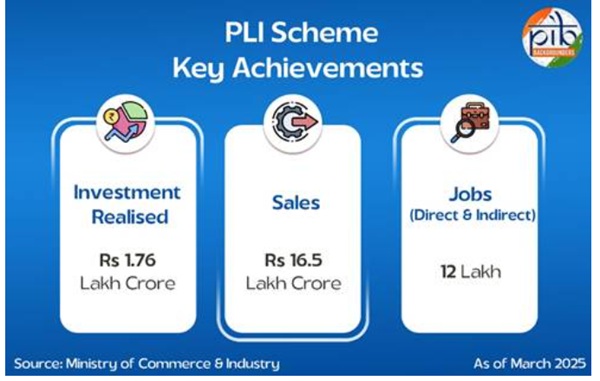
- The latest Government data reports ₹2.40 lakh crore in actual investment as of 31 March 2026.
- More than 14.15 lakh direct and indirect employment opportunities have been reported under the PLI framework.
- Cumulative exports under the PLI framework reached ₹15.2 lakh crore by FY 2025-26.
- Department for Promotion of Industry and Internal Trade (DPIIT)
- Phone: 011 23062947
Summary of the Scheme | |
|---|---|
| Name of Scheme | Production Linked Incentive (PLI) Scheme |
| Launch Year | 2020 |
| Benefits | Performance-linked financial incentives for eligible manufacturing companies across 14 sectors |
| Beneficiary | Eligible domestic and global companies, including eligible MSMEs, manufacturing notified products in India |
| Nodal Agency | Department for Promotion of Industry and Internal Trade (DPIIT) |
| Subscription | Subscribe here to get Update Regarding Scheme |
| Mode of Apply | Online through the notified application process of the respective sector-specific PLI scheme |
Scheme Introduction: A Brief Overview
India's manufacturing sector covers a wide range of industries, but building large-scale production capacity requires sustained investment, technology, skilled employment and strong domestic supply chains. To support this transition, the Government of India introduced the Production Linked Incentive (PLI) Scheme in 2020. Rather than providing a general benefit to all businesses, the scheme links financial incentives to the performance of eligible manufacturing companies. The PLI framework now covers 14 key sectors, and the latest Government data shows that these schemes had attracted more than ₹2.40 lakh crore in actual investment and generated more than 14.15 lakh direct and indirect employment opportunities as of 31 March 2026. Cumulative exports reported under the PLI schemes reached ₹15.2 lakh crore in FY 2025-26.
The PLI Scheme aims to boost manufacturing in India by encouraging new investment, higher production, exports and greater domestic value addition. It covers 14 sectors, including electronics, pharmaceuticals, automobiles, solar PV, textiles, telecom and food processing.
Each sector has its own eligible products, investment requirements, performance targets and incentive rates. Therefore, the rules and benefits are different for each PLI scheme.
The Department for Promotion of Industry and Internal Trade (DPIIT) under the Ministry of Commerce and Industry acts as the nodal department for the overall coordination and monitoring of the PLI schemes. However, the individual sector-specific schemes are implemented by their respective Administrative Ministries and Departments. The Government's latest update also confirms that the PLI framework has an approved financial outlay of ₹1.91 lakh crore. For the latest coordination-related information and official updates, readers can visit the official DPIIT website.
The PLI Scheme is meant for eligible manufacturing companies and is not a general subsidy or loan for individuals. To receive the benefit, a company must meet the conditions set for its particular sector. These may include minimum investment, sales, production, domestic value addition, turnover or other performance requirements.
The incentive is linked to the company's actual manufacturing performance. In several PLI schemes, the incentive is calculated using incremental sales over a specified base year. However, the incentive rate, calculation method and performance conditions are different for each sector. Companies should therefore check the guidelines for their specific PLI scheme.
There is no single application form or common portal for all 14 PLI sectors. Companies must identify the relevant sector, check whether applications are open and use the online portal notified by the concerned Ministry or Department. After approval, the company must continue to meet the applicable conditions and submit its incentive claim through the prescribed process.
Project Management Agencies may be involved in reviewing applications, checking documents and examining incentive claims, depending on the sector. For any questions about eligibility, application or claims, companies should contact the concerned implementing Ministry, Department or Project Management Agency.
Readers interested in the electric-vehicle ecosystem can also explore the PM E-Drive Scheme on GovtSchemes.in. It is relevant alongside PLI-Auto and PLI-ACC because it supports electric-vehicle adoption, charging infrastructure and the broader EV manufacturing ecosystem.
Scheme Benefits
The PLI Scheme supports companies that increase production and meet the performance conditions set for their sector. The main benefits include:
- Eligible companies can receive financial incentives for meeting the production, sales or other performance targets prescribed under their sector.
- It supports large-scale investment in manufacturing. As of 31 March 2026, actual investment under the PLI framework reached ₹2,40,138 crore.
- It encourages new investment and expansion in key sectors such as electronics, pharmaceuticals, automobiles, solar PV and textiles.
- It helps companies increase manufacturing capacity, achieve economies of scale and improve their competitiveness.
- It promotes greater domestic value addition by encouraging the production of components, inputs and other products within India.
- It supports exports by helping Indian manufacturers increase production and compete in international markets. Cumulative exports under the PLI framework reached ₹15.2 lakh crore by FY 2025-26.
- It supports employment across manufacturing and related industries. The Government reported more than 14.15 lakh direct and indirect employment opportunities as of 31 March 2026.
The actual benefit depends on the relevant sector-specific PLI scheme because incentive rates, eligible products and performance conditions differ across sectors.
How Does the Production Linked Incentive (PLI) Scheme Work?
The PLI Scheme works on a simple principle: companies receive incentives after achieving the manufacturing and performance targets prescribed for their sector. The process can be understood in five simple steps:
Step | What the Company Does | What Happens Next |
|---|---|---|
| 1. Check Eligibility | The company identifies the relevant PLI sector and checks the eligible products, investment limit and other conditions. | If the company meets the conditions, it can apply when the sector's application window is open. |
| 2. Invest & Manufacture | The company makes the required investment and starts manufacturing the eligible products in India. | The company must follow the investment, production and localisation requirements of the scheme. |
| 3. Meet Performance Targets | The company achieves the required incremental sales, production, domestic value addition or other notified targets. | Its performance becomes eligible for incentive calculation under the applicable PLI rules. |
| 4. Submit the Claim | The company submits an incentive claim with the required investment, sales, production and other supporting documents. | The concerned Ministry or designated agency verifies the claim and supporting records. |
| 5. Receive the Incentive | After successful verification, the eligible incentive is calculated according to the sector-specific formula. | The approved incentive is released to the company. |
Where does the base year come in? In schemes that calculate incentives using incremental sales, the company's eligible sales are compared with the specified base year. FY 2019-20 is used as the base year in several PLI schemes, but the base year and calculation method are not the same for every sector.
Eligibility Requirements
The PLI Scheme is meant for companies that manufacture eligible products covered under one of the 14 PLI sectors. Since every sector has different rules, the exact eligibility requirements may vary.
- The applicant must be an eligible company or business entity under the concerned PLI scheme.
- The company must manufacture the products covered under the relevant PLI sector in India.
- The company must meet the minimum investment requirement applicable to its sector and category.
- It must achieve the sales, production or other performance targets specified under the scheme.
- Some sectors may also require minimum domestic value addition, turnover, net worth or other financial conditions.
- The company must apply within the application period notified for the concerned PLI sector.
- It must provide the required company, financial, investment, production and sales documents for verification.
- Eligible Indian companies and foreign-owned companies can participate where allowed under the sector-specific rules.
- MSMEs can participate in PLI schemes where the concerned scheme provides eligibility for them.
- Individuals cannot apply because the PLI Scheme is designed for eligible manufacturing companies and business entities.
- The company must continue to meet the applicable conditions to receive incentives against verified claims.
Since the rules are different for each sector, meeting the general requirements does not automatically make a company eligible. Always check the latest guidelines for the relevant PLI scheme before applying.
List of 14 Production Linked Incentive (PLI) Sectors
The PLI framework covers 14 strategic manufacturing sectors. Each sector is administered by the Ministry or Department responsible for that industry and has its own products, eligibility conditions, incentive structure and implementation process.
S. No. | Production Linked Incentive (PLI) Sectors | Implementing Ministry/Department | Approved Outlay |
|---|---|---|---|
1 | Large Scale Electronics Manufacturing | MeitY | ₹40,995 crore |
2 | IT Hardware (PLI 2.0) | MeitY | ₹17,000 crore |
3 | Telecom & Networking Products | Department of Telecommunications | ₹12,195 crore |
4 | Pharmaceutical Drugs | Department of Pharmaceuticals | ₹15,000 crore |
5 | Bulk Drugs | Department of Pharmaceuticals | ₹6,940 crore |
6 | Medical Devices | Department of Pharmaceuticals | ₹3,420 crore |
7 | Food Products | Ministry of Food Processing Industries | ₹10,900 crore |
8 | Automobiles & Auto Components | Ministry of Heavy Industries | ₹25,938 crore |
9 | Advanced Chemistry Cell (ACC) Battery | Ministry of Heavy Industries | ₹18,100 crore |
10 | High-Efficiency Solar PV Modules | Ministry of New and Renewable Energy | ₹24,000 crore |
11 | Textiles | Ministry of Textiles | ₹10,683 crore |
12 | White Goods | DPIIT | ₹6,238 crore |
13 | Specialty Steel | Ministry of Steel | ₹6,322 crore |
14 | Drones & Drone Components | Ministry of Civil Aviation | ₹120 crore |
Required Documents
Companies applying for a Production Linked Incentive (PLI) scheme need to submit documents that help the concerned Ministry verify their business details, investment, manufacturing activity and financial performance. The exact list can differ between the 14 sector-specific schemes, but applicants may generally need the following documents:
- Certificate of incorporation or registration of the company.
- Company PAN and other applicable registration details.
- GST registration certificate and relevant tax details.
- Details of the company's directors, authorised signatory and ownership structure.
- Audited financial statements and relevant financial records for the prescribed years.
- Details of annual turnover, sales and other financial information required under the concerned scheme.
- Details of the proposed or completed investment, including eligible plant, machinery and other assets.
- Details of the manufacturing facility and the eligible products proposed to be manufactured in India.
- Documents supporting investment and expenditure, such as invoices, purchase records and other prescribed evidence.
- Production and sales records required to establish achievement of the applicable performance targets.
- Domestic value addition or localisation-related documents, where required under the relevant PLI scheme.
- Bank account details and other documents required for receiving the approved incentive.
- Any additional declarations, certificates, undertakings or documents specified in the sector-specific Production Linked Incentive (PLI) guidelines.
Applicants should check the latest guidelines and application instructions of their respective PLI sector before submitting documents, as the required documents and verification process may vary from one scheme to another.
Steps to Apply
The PLI Scheme has a sector-specific application process. Before applying, a company should first identify the relevant sector and check whether applications are open. The actual application is then completed through the portal notified for that sector.
Before Applying
- Identify the PLI sector that covers your product.
- Read the latest guidelines issued by the concerned Ministry or Department.
- Check whether your company and product meet the basic eligibility requirements.
- Check the latest notification to confirm that the application window is open.
- Keep the required company, financial and product-related information ready.
During the Online Application
- Open the official PLI application portal for your sector.
- Register your company on the portal and create the required login credentials.
- Fill in the requested company, product and other details.
- Upload the documents specified under the relevant PLI guidelines.
- Pay the application fee, if applicable.
- Review the information and submit the application.
- Save the application number or acknowledgement for future reference.
For example, companies applying under the White Goods PLI can use the official PLI White Goods portal for registration and application-related services.
After Submitting the Application
The concerned Ministry, Department or designated Project Management Agency reviews the application according to the applicable scheme rules. If additional information or documents are required, the applicant may need to provide them through the prescribed process.
Production Linked Incentive (PLI) Scheme vs Other Manufacturing Schemes
The PLI Scheme is often discussed alongside newer manufacturing and technology programmes, but these are separate Government schemes with different objectives and support mechanisms.
Scheme | Main Focus | How It Differs from PLI |
|---|---|---|
| Performance-linked support for manufacturing | Provides incentives to eligible companies based on the performance conditions of 14 sector-specific schemes. | |
| Manufacturing of electronics components | A separate electronics manufacturing scheme focused specifically on strengthening the domestic components ecosystem. | |
| Electric mobility and EV ecosystem | Focuses on EV adoption, charging infrastructure and related electric-mobility support rather than operating as a general PLI manufacturing incentive. | |
| Semiconductor and display ecosystem | Supports the development of semiconductor manufacturing and related capabilities through separate Government support programmes. |
Relevant Links
- DPIIT Official Website
- Latest Production Linked Incentive (PLI) Scheme Update
- Production Linked Incentive (PLI) White Goods Portal
- MeitY – Production Linked Incentive (PLI) for Large Scale Electronics Manufacturing
- IT Hardware Production Linked Incentive (PLI) 2.0 Guidelines
- Telecom Production Linked Incentive (PLI) Guidelines
- MoFPI – Food Processing PLI Scheme
- MHI – Production Linked Incentive (PLI) Auto Scheme
- MHI – ACC Battery PLI Scheme
- MNRE – Solar PV PLI Scheme
- Ministry of Steel – Specialty Steel Production Linked Incentive (PLI)
- Ministry of Textiles – Textile Production Linked Incentive (PLI) Portal
- Drone PLI Guidelines
Contact Information
Since PLI consists of 14 sector-specific schemes, there is no single helpline that handles every PLI application or incentive claim. For general coordination-related information, applicants can contact DPIIT. For an application, eligibility issue or incentive claim, the concerned implementing Ministry or its designated Project Management Agency should be contacted.
Department for Promotion of Industry and Internal Trade (DPIIT)
- Phone: 011 23062947
- Other Departments Contact Details
- Address: Department for Promotion of Industry and Internal Trade, Ministry of Commerce and Industry, Udyog Bhawan, New Delhi – 110011
Frequently Asked Questions
The PLI Scheme is a Government programme that provides performance-linked incentives to eligible manufacturing companies in selected sectors.
The PLI framework covers 14 sectors, including electronics, pharmaceuticals, automobiles, solar PV, textiles, telecom, food processing and specialty steel.
Eligible manufacturing companies and business entities can apply if they meet the conditions of the relevant sector-specific PLI scheme.
No. The PLI Scheme is designed for eligible manufacturing companies and business entities, not individuals.
No. Each PLI sector has its own application process and notified portal. Companies must apply through the portal specified for their respective sector.
The calculation depends on the sector-specific scheme. In several schemes, incentives are linked to incremental sales over a specified base year, while some schemes use other performance conditions.
No. Incentive rates, eligible products, investment requirements and calculation methods differ across the 14 PLI schemes.
No. PLI is generally a performance-linked incentive. Eligible companies must meet the prescribed conditions and have their claims verified before receiving the incentive.
Application windows are sector-specific. As of September 2026, there is no single application window open across all 14 PLI sectors. Companies should check the latest notification for their particular sector.
According to the latest Government update, actual investment under the PLI framework reached ₹2,40,138 crore as of 31 March 2026.
Do you have any question regarding schemes, submit it in scheme forum and get answers:
Feel free to click on the link and join the discussion!
This forum is a great place to:
- Ask questions: If you have any questions or need clarification on any aspect of the topic.
- Share your insights: Contribute your own knowledge and experiences.
- Connect with others: Engage with the community and learn from others.
I encourage you to actively participate in the forum and make the most of this valuable resource.


Matching schemes for sector: Business
| Sno | CM | Scheme | Govt |
|---|---|---|---|
| 1 | 
|
Credit Guarantee Scheme for Startups | CENTRAL GOVT |
| 2 |
|
Prime Minister's Employment Generation Programme | CENTRAL GOVT |
| 3 |
|
Atal Vayo Abhyuday Yojana (AVYAY) | CENTRAL GOVT |
Add new comment