

What is PM-DHARA? A Simple Overview
The Union Cabinet, chaired by Prime Minister Narendra Modi, approved PM-DHARA as a new scheme on 30 September 2026. The government notified its official name as the Green Energy Corridor Phase-III (GEC-III) programme. However, it is widely referred to as PM-DHARA, short for "PM-Developing Harmonised and Accelerated Renewable-energy Access." Both names refer to the same scheme, which aims to strengthen India's electricity grid so it can carry much more solar and wind power to States and Union Territories in the coming years.
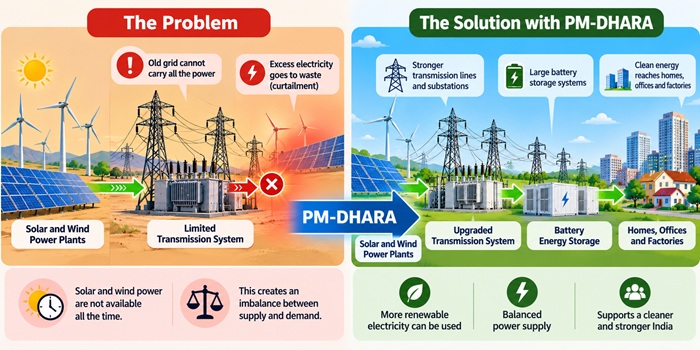
In simple words, PM-DHARA is about building better "roads" for electricity. India is adding solar and wind power plants very quickly, but the wires and substations that carry this electricity were not built to handle this much power. PM-DHARA fixes this by upgrading the power grid within states and by adding large battery storage units (BESS) that can store extra electricity and release it when needed, helping reduce grid congestion and meet demand during hours when solar power is unavailable.
The scheme supports infrastructure capable of evacuating up to 135 GW of renewable energy, along with 50 GWh of battery storage, at a total outlay of ₹1,86,405 crore, including ₹54,082 crore of Central Financial Support. This support is meant to offset transmission charges and help keep power costs under control for consumers, with implementation targeted by FY 2032-33.
PM-DHARA is not a direct financial assistance scheme that individual citizens can apply for. It is a power-sector infrastructure programme, implemented by the Ministry of New and Renewable Energy (MNRE) along with the Ministry of Power, Power Grid Corporation of India, and State Transmission Utilities, aimed at supporting India's renewable energy growth and its target of 900 GW of installed non-fossil capacity by 2035.
PM-DHARA is part of a broader set of large-scale infrastructure programmes introduced by the government in 2026. Around the same time, the government also approved the Bharat Audyogik Vikas Yojana (BHAVYA), a scheme focused on developing modern industrial parks. While BHAVYA builds industrial locations for manufacturing to grow, PM-DHARA builds the power grid needed to supply reliable, clean electricity to such industries and to the country as a whole.
Why Was PM-DHARA Needed?
To understand why the government introduced PM-DHARA, it helps to understand a simple problem India has been facing with its renewable energy.
Over the past several years, India has built a large number of solar and wind power plants, especially in states like Rajasthan, Gujarat, and the Union Territory of Ladakh, which receive a lot of sunlight and wind. This is good news for clean energy. But there is a catch: generating electricity is only half the job. That electricity still needs to travel from the solar park or wind farm to homes, factories, and offices through a network of wires, towers, and substations. This network is called the "transmission system" or, in simple terms, the power grid.
The problem is that in many parts of India, this grid was built years ago and was never designed to carry this much power from renewable sources. As a result, on many days, power plants generate more electricity than the grid can carry. When this happens, some of that electricity simply cannot be used and goes to waste. This is known as "curtailment."
This is not a small or occasional issue. According to a report published in May 2026, India lost around 300 GWh (Gigawatt-hours) of renewable energy in just the first three months of 2026 alone, purely because the grid could not carry all the power that was being generated. To put this in perspective, that is enough electricity to power lakhs of homes for an extended period, simply wasted due to weak infrastructure.
There is a second, related problem too. Solar and wind power are not available all the time. Solar panels only generate electricity during daylight hours, and wind speeds vary throughout the day. This creates an imbalance: there may be too much power during sunny afternoons, and not enough during the evening or at night when demand is still high. Without a way to store the extra power generated during the day and use it later, the grid struggles to balance supply and demand smoothly.
The Ministry of New and Renewable Energy (MNRE), which is responsible for this scheme, has summed up the thinking behind PM-DHARA in one simple principle: "transmission must precede renewable energy generation." In other words, before India builds more solar and wind power plants, it first needs to build the wires and storage systems that can actually carry and manage all that power. Building power plants without a strong enough grid is like building more cars without widening the roads; it only leads to more traffic jams- except here, the "traffic jam" means wasted electricity and higher costs for everyone.
This is exactly the gap that PM-DHARA is designed to fill. By upgrading transmission lines and substations within states, and by adding large battery storage systems at key locations, the scheme aims to make sure that the renewable electricity India generates is not wasted, and that the power grid is ready for the much larger amount of clean energy the country plans to add in the coming years.
PM-DHARA Key Highlights and Financial Outlay
PM-DHARA covers large-scale power transmission and energy storage infrastructure to support the growing share of renewable energy in India's electricity system. The scheme combines intra-state transmission development with Battery Energy Storage Systems and has a total project outlay of ₹1,86,405 crore.
| Key Highlight | Details |
|---|---|
| Renewable Energy Evacuation | Up to 135 GW |
| Battery Energy Storage Systems | 50 GWh |
| Total Project Outlay | ₹1,86,405 crore |
| Intra-State Transmission Component | ₹1,36,378 crore |
| BESS Component | ₹50,000 crore |
| Central Financial Support | ₹54,082 crore |
| Target Completion | FY 2032-33 |
Financial Outlay Under PM-DHARA
The government has allocated ₹1,86,405 crore for the overall PM-DHARA programme. Out of this amount, ₹1,36,378 crore is earmarked for the development of intra-state transmission systems under Green Energy Corridor Phase-III, while ₹50,000 crore is allocated for 50 GWh of Battery Energy Storage Systems.
The scheme also provides ₹54,082 crore as Central Financial Support. According to the government, this support will help offset intra-state transmission charges and contribute towards keeping power costs down for end users.
135 GW Renewable Energy Evacuation and 50 GWh Battery Storage
PM-DHARA focuses on two important requirements for India's growing renewable-energy sector: stronger transmission infrastructure and large-scale battery storage. The scheme will support the evacuation of up to 135 GW of renewable energy and provide 50 GWh of Battery Energy Storage Systems (BESS).
135 GW Renewable Energy Evacuation
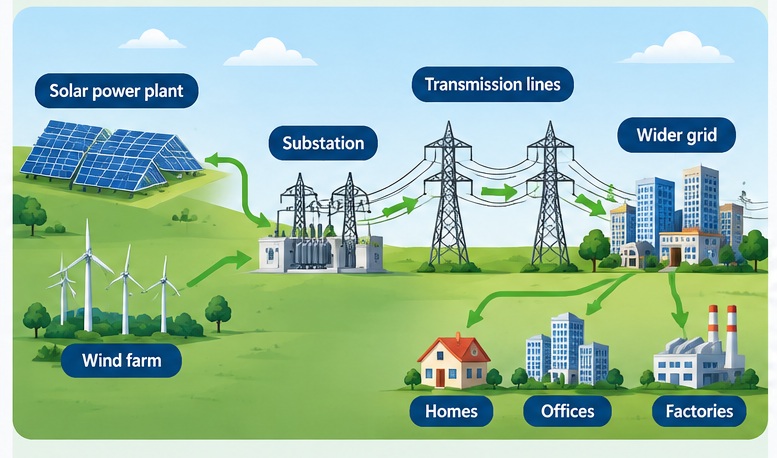
"Evacuation" is a term used in the power sector to describe the process of moving electricity away from the place where it is generated, such as a solar park or a wind farm, to the wider grid, from where it can reach homes, offices, and factories. When experts say PM-DHARA will support the evacuation of up to 135 GW, they mean that the transmission lines and substations being built or upgraded under this scheme will be capable of safely carrying this much renewable power at any given time, across different states and union territories.
This number is significant because it is directly tied to India's broader renewable energy targets. As more solar and wind projects come online in the coming years, the amount of power being generated will only increase. Without a transmission network capable of handling 135 GW, a large portion of this power would either have to be reduced at the source or lost altogether, which is the exact problem the scheme is trying to prevent.
50 GWh Battery Energy Storage Systems
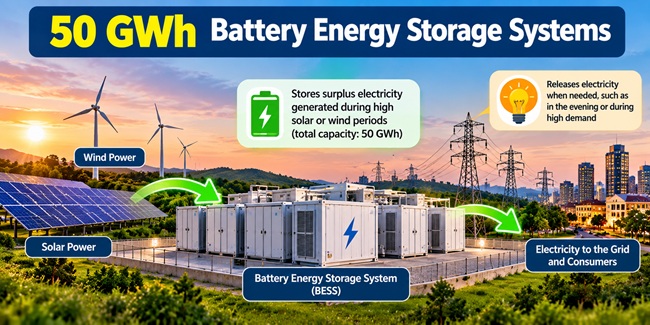
A GWh, or Gigawatt-hour, is a unit used to measure how much energy a battery system can store and deliver over time. Fifty GWh is a very large amount of storage capacity, enough to store surplus electricity generated during peak sunlight or windy hours and release it later when it is actually needed, such as in the evening when solar generation drops to zero, but household and commercial demand remains high.
Under PM-DHARA, these battery systems (referred to as Battery Energy Storage Systems, or BESS) will not be installed in just one place. They will be set up either directly at the site of the renewable power plant itself, or at other locations within the grid that are considered important for maintaining overall stability. This flexible approach allows the storage capacity to be placed exactly where it is most useful, rather than being limited to a single fixed model.
How PM-DHARA Will Be Implemented
PM-DHARA will be implemented through different methods depending on whether a project involves building new transmission infrastructure or upgrading an existing network. The government has provided separate implementation mechanisms for greenfield projects and brownfield works under the Intra-State Transmission System component.
Greenfield Transmission Projects
All new greenfield projects under the Intra-State Transmission System component will be implemented through Tariff Based Competitive Bidding (TBCB). Under this approach, eligible transmission service providers compete through a bidding process to develop and operate the required transmission infrastructure.
Upgradation and Network Strengthening
Existing transmission infrastructure that requires improvement or expansion will be handled differently. The government will implement brownfield upgradation and network strengthening works under the Cost Plus Basis (CPB). This approach will cover work needed to improve existing transmission networks rather than building an entirely new transmission system.
Role of State Transmission Utilities
State Transmission Utilities (STUs) will serve as the overall implementing agencies for the Intra-State Transmission System component. They will oversee the implementation of the transmission infrastructure projects within their respective States.
Role of Transmission Service Providers
Transmission Service Providers (TSPs) will participate in projects awarded through the TBCB route. These providers will follow the Build-Own-Operate-Maintain (BOOM) model, under which they will build, own, operate and maintain the transmission assets assigned to them.
The government has targeted PM-DHARA for implementation by FY 2032-33. Through this structure, the scheme will combine competitive bidding for new projects with a cost-based approach for upgrading and strengthening existing transmission infrastructure.
Benefits and Expected Impact of PM-DHARA
PM-DHARA will strengthen India's power system and make it easier to use electricity generated from renewable sources. The scheme will improve the transmission network and add battery storage to help manage the changing supply of renewable energy.
- More renewable electricity can reach the grid: The scheme will provide stronger transmission infrastructure for renewable energy.
- Better movement of electricity: The improved network will help carry renewable electricity to places where it is needed.
- Better use of solar and wind power: Battery storage will help manage changes in electricity generation from renewable sources.
- Less pressure on the power grid: Stronger transmission and battery storage will help manage grid congestion.
- Electricity support after solar hours: Battery storage can help meet demand when solar power is not being generated.
- Improved energy security: Better renewable-energy transmission will strengthen India's overall power system.
- More employment opportunities: The scheme is expected to create jobs in power, construction, manufacturing, energy storage and grid management.
- Support for cleaner energy: The scheme will help India use more renewable energy and reduce its carbon footprint.
- Support for the 2035 target: PM-DHARA will contribute to India's target of achieving 900 GW of installed non-fossil capacity by 2035.
Overall, PM-DHARA will help India build a stronger and more flexible electricity grid that can handle a larger share of renewable energy.
PM-DHARA and India's 900 GW Non-Fossil Energy Target
India plans to increase its non-fossil energy capacity to 900 GW by 2035. PM-DHARA will support this goal by strengthening the electricity transmission network needed to connect and move more renewable energy across States and Union Territories.
As more solar and wind power projects are added, India will need stronger transmission systems to carry the electricity they generate. PM-DHARA will support the evacuation of up to 135 GW of renewable energy, helping the power grid handle a larger share of clean energy.
The scheme also includes 50 GWh of Battery Energy Storage Systems. These storage systems will help manage changes in renewable-energy generation and provide greater flexibility to the electricity grid, including during periods when solar power is not available.
By strengthening transmission infrastructure and adding battery storage, PM-DHARA will provide important infrastructure support for India's long-term expansion of non-fossil energy and its target of 900 GW of installed non-fossil capacity by 2035.
Is PM-DHARA a Scheme for Individual Citizens?
No. PM-DHARA is not a direct financial assistance scheme for individual citizens. It is a power-sector infrastructure programme focused on strengthening intra-state transmission systems and developing Battery Energy Storage Systems.
Individual citizens do not need to apply for PM-DHARA to receive a subsidy, cash assistance or other direct financial benefit. The programme is implemented through the power-sector system, including State Transmission Utilities and Transmission Service Providers.
However, people can benefit indirectly from the scheme. Stronger transmission infrastructure and battery storage will help integrate more renewable electricity into the grid, improve power-system flexibility and support efficient movement of electricity.
Therefore, PM-DHARA does not have the usual individual eligibility criteria, document requirements or application process found in direct-benefit government schemes.
Latest Update and Official Documents
Latest Update: The Union Cabinet approved the Green Energy Corridor Phase-III (GEC-III) scheme for development of the Intra-State Transmission System with Battery Energy Storage Systems on 30 September 2026. The government has set a target to establish the scheme by FY 2032-33. The approved programme will support evacuation of up to 135 GW of renewable energy and deployment of 50 GWh of Battery Energy Storage Systems. The total project outlay is ₹1,86,405 crore, including ₹54,082 crore in Central Financial Support.
The government has also stated that the scheme will support India's target of achieving 900 GW of installed non-fossil capacity by 2035 and strengthen long-term energy security.
- PIB Press Release: Cabinet approves Green Energy Corridor Phase-III scheme for Development of Intra-State Transmission System with Battery Energy Storage Systems
- Ministry of New and Renewable Energy (MNRE) Website: mnre.gov.in
Frequently Asked Questions
PM-DHARA is a Government of India initiative focused on strengthening intra-state transmission systems and deploying Battery Energy Storage Systems to support renewable-energy integration.
PM-DHARA stands for PM-Developing Harmonized and Accelerated Renewable-energy Access.
PM-DHARA will support the evacuation of up to 135 GW of renewable energy.
The scheme provides for 50 GWh of Battery Energy Storage Systems (BESS).
The total project outlay under PM-DHARA is ₹1,86,405 crore.
The scheme includes ₹54,082 crore in Central Financial Support.
The government has targeted the establishment of PM-DHARA by FY 2032-33.
No. PM-DHARA is a power-sector infrastructure programme and does not provide direct cash assistance or subsidies to individual citizens.
No individual application process is provided for PM-DHARA. The scheme focuses on transmission infrastructure and Battery Energy Storage Systems rather than individual beneficiaries.
The scheme will strengthen the transmission network, improve renewable-energy evacuation, add battery storage and provide greater flexibility for managing renewable electricity.
PM-DHARA will provide transmission and storage infrastructure needed to integrate more renewable energy into the power grid and support India's target of 900 GW of installed non-fossil capacity by 2035.
Add new comment