



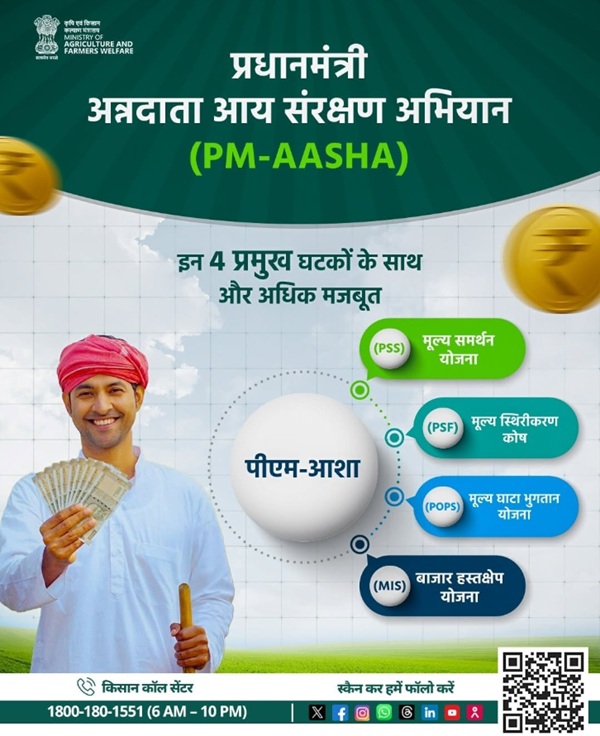
- The scheme works through PSS, PDPS, MIS and PSF.
- Eligible pulses, oilseeds and copra can be procured at MSP under PSS.
- Eligible oilseed farmers can receive price-deficiency support under PDPS.
- MIS provides support for eligible perishable agricultural and horticultural crops.
- Tur, Urad and Masur have special procurement support through NAFED and NCCF.
- Farmers generally need to pre-register before participating in notified procurement.
- Digital platforms such as e-Samridhi and e-Samyukti support procurement operations.
- Department of Agriculture & Farmers Welfare, Ministry of Agriculture & Farmers Welfare, Government of India
- Kisaan Helpline: 18001801551
Summary of the Scheme | |
|---|---|
| Name of Scheme | Pradhan Mantri Annadata Aay Sanrakshan Abhiyan (PM-AASHA) |
| Launch Year | 2018 |
| Benefits | Price support through MSP procurement, price-deficiency payments and market intervention for eligible agricultural produce |
| Beneficiary | Farmers growing notified pulses, oilseeds and copra, and eligible perishable crops under MIS |
| Nodal Agency | Department of Agriculture & Farmers Welfare |
| Subscription | Subscribe here to get Update Regarding Scheme |
| Mode of Apply | Pre-registration through the applicable State procurement system, e-Samridhi, e-Samyukti or designated procurement centres |
Scheme Introduction: A Brief Overview
For farmers, a good harvest does not always mean a good income, especially when market prices fall sharply. The Pradhan Mantri Annadata Aay Sanrakshan Abhiyan (PM-AASHA) was launched in 2018 to help farmers get better price support for eligible agricultural produce and reduce the need for distress sales. The scheme works through measures such as procurement at the Minimum Support Price (MSP), price-deficiency payments and market intervention, depending on the crop and the applicable component.
PM-AASHA is administered through the Department of Agriculture & Farmers Welfare (DA&FW), Ministry of Agriculture & Farmers Welfare. PM-AASHA works through four main components: 1. Price Support Scheme (PSS), 2. Price Deficiency Payment Scheme (PDPS), 3. Market Intervention Scheme (MIS) and 4. Price Stabilisation Fund (PSF). For farmers, the most important difference is how support is provided. Under PSS, eligible pulses, oilseeds and copra can be purchased at MSP when procurement is approved. Under PDPS, eligible oilseed farmers can receive support for the gap between MSP and the applicable market price without the government physically purchasing the crop. MIS provides support for eligible perishable crops when their market prices fall, while PSF is used to help manage sharp price fluctuations in selected essential agricultural commodities.
Farmers who want to take part in procurement generally need to register through the system notified by their State or the concerned procurement agency. Depending on the crop and location, registration may be available through designated procurement centres, NAFED's e-Samridhi, NCCF's e-Samyukti, PACS or FPOs. Farmers should keep their identity, bank and cultivation-related details ready and follow the crop and season-specific instructions issued by the concerned authority.
For pulses, Tur, Urad and Masur have received special procurement support. Registered farmers can offer these pulses for procurement through NAFED and NCCF under the current pulse procurement arrangement, which runs up to 2030–31. Procurement is subject to the applicable rules and requirements.
It is also important to understand that PM-AASHA is not a fixed cash-benefit scheme. The amount or form of support a farmer receives depends on the crop, the applicable component, the approved procurement operation and the prevailing market conditions.
The Pradhan Mantri Fasal Bima Yojana (PMFBY) provides crop insurance support against specified crop losses, while the Kisan Credit Card Scheme helps farmers meet eligible agricultural and allied-activity credit requirements. These schemes address different aspects of farming, while PM-AASHA focuses mainly on improving price realisation and reducing distress sales.
Pradhan Mantri Annadata Aay Sanrakshan Abhiyan (PM-AASHA) Latest Updates
PM-AASHA has continued to evolve through changes in procurement arrangements, digital systems and support for pulses. The latest updates are particularly important for farmers planning to participate in procurement during the current agricultural seasons.
- Special focus on pulses: Tur, Urad and Masur continue to receive special procurement support through the current pulse procurement arrangements. Pre-registered farmers can offer their produce through NAFED and NCCF as per the applicable rules.
- Pulse procurement through 2030–31: Under the Mission for Aatmanirbharta in Pulses, the Government has made arrangements for procurement of Tur, Urad and Masur from registered farmers through NAFED and NCCF up to 2030–31.
- Digital procurement: Platforms such as e-Samridhi and e-Samyukti are being used to support farmer registration and procurement operations through NAFED and NCCF.
- Aadhaar-based authentication: Procurement operations have been strengthened through Aadhaar-based biometric or facial authentication at procurement centres to improve transparency and ensure that the benefit reaches the registered farmer.
Pradhan Mantri Annadata Aay Sanrakshan Abhiyan (PM-AASHA) Components
PM-AASHA works through different components, with each one addressing a specific problem faced by farmers and agricultural markets. The support available to a farmer depends on the crop, market situation and component approved for that particular season.
- Price Support Scheme (PSS): Under PSS, eligible pulses, oilseeds and copra are procured from farmers at the Minimum Support Price (MSP) when the applicable procurement operation is approved. Procurement is carried out through agencies such as NAFED, NCCF and authorised State agencies.
- Price Deficiency Payment Scheme (PDPS): This component supports farmers growing notified oilseeds when the market price is lower than the MSP. Instead of physically purchasing the crop, the eligible price difference is paid to registered farmers according to the applicable rules.
- Market Intervention Scheme (MIS): MIS provides support for eligible perishable agricultural and horticultural commodities for which MSP is not announced. It can be activated when there is a significant fall in the market price of the notified commodity.
- Price Stabilisation Fund (PSF): PSF is used to help manage sharp price fluctuations in selected essential agricultural commodities. It supports measures aimed at maintaining price stability and protecting both farmers and consumers from extreme price movements.
Scheme Benefits
PM-AASHA helps farmers get better price support when market prices fall below the government-announced MSP or when eligible perishable crop prices decline sharply. The main benefits include:
- Farmers can sell eligible pulses, oilseeds and copra at the Minimum Support Price (MSP) under the Price Support Scheme (PSS), if procurement is approved for their crop and season.
- Under the Price Deficiency Payment Scheme (PDPS), eligible oilseed farmers can receive support for the difference between the MSP and the applicable market price, without the government physically buying the crop.
- The Market Intervention Scheme (MIS) provides price support for eligible perishable agricultural and horticultural crops when MSP is not available for those crops.
- Eligible pulses, oilseeds and copra are procured through agencies such as NAFED and NCCF, along with authorised State agencies.
- Under the special pulse procurement arrangement, pre-registered farmers can sell Tur, Urad and Masur through NAFED and NCCF, subject to the applicable rules.
- The scheme helps protect farmers from having to sell eligible produce at very low prices when market prices fall.
- Digital systems such as e-Samridhi and e-Samyukti make farmer registration and procurement more organised and transparent.
- PM-AASHA does not give a fixed cash amount to every farmer. The support depends on the crop, the scheme component, the approved procurement arrangement and the applicable government rules.
Eligibility Requirements
PM-AASHA is meant for farmers whose produce falls under the crops and market interventions covered by the scheme. The exact eligibility can vary depending on the component, crop and procurement arrangements notified for a particular season.
- Farmers growing notified pulses, oilseeds and copra can benefit under the Price Support Scheme (PSS), subject to the applicable procurement rules.
- Farmers growing notified oilseeds can be covered under the Price Deficiency Payment Scheme (PDPS) when the scheme is approved for the concerned crop and season.
- Farmers producing eligible perishable agricultural or horticultural commodities can be covered under the Market Intervention Scheme (MIS), where the required price-decline conditions are met.
- Farmers must register through the applicable State or authorised procurement system before participating in notified procurement operations.
- The produce must meet the prescribed Fair Average Quality (FAQ) standards for procurement under the applicable component.
- Farmers must follow the crop, season, quantity, registration and other conditions notified by the concerned State Government or procurement agency.
- For applicable procurement operations, farmers may need to provide details such as identity, bank account and land or cultivation records as required by the registration system.
- Registration does not mean that every quantity of produce will be purchased unconditionally. Procurement is carried out according to the approved component, crop, period and applicable government rules.
Required Documents
Farmers may need to provide basic personal, bank and farming-related details while registering for PM-AASHA procurement. The exact documents can vary depending on the State and the procurement agency.
- Aadhaar card or other valid identity proof.
- Bank account details for receiving eligible payments.
- Mobile number linked with the registration or farmer record.
- Land ownership or cultivation records, as required by the concerned State or procurement agency.
- Farmer registration details issued by the State agriculture or procurement system, where applicable.
- Details of the crop and the land on which the notified produce has been grown.
- Any additional document required by the State Government or authorised procurement agency for the particular crop and procurement season.
Farmers should check the latest document requirements with their State Agriculture Department or the designated procurement centre before registration, as requirements may differ by crop and State.
Steps to Apply
PM-AASHA does not use one common application form for every farmer. The registration process depends on the crop, State, procurement component and agency handling the procurement. Farmers should first confirm that procurement for their crop is open in their area and then complete registration through the channel notified for that procurement season.
- Check whether your crop is covered. Before registering, confirm that the crop is included in the PM-AASHA procurement operation announced for your State and season. Under PSS, the relevant pulses, oilseeds or copra must be notified for procurement. Different rules apply to oilseeds under PDPS and eligible perishable crops under MIS.
- Check the procurement dates and local instructions. PM-AASHA procurement is not open for every crop throughout the year. Check the dates announced by your State Agriculture Department, designated procurement agency or nearby procurement centre. This will also tell you where registration and produce delivery will take place.
- Complete farmer registration. Where NAFED is handling procurement, registration may be carried out through the e-Samridhi system. For procurement handled through NCCF, the e-Samyukti system may be used. State-level procurement systems and designated centres may also be used depending on the approved arrangement.
- Enter your required details carefully. Provide the information requested during registration, which may include your Aadhaar or other identification details, mobile number, bank account information, land or cultivation details and crop information. The exact details required can vary according to the State, crop and procurement agency.
- Complete any required verification. The registration details may be checked against the records required for the particular procurement operation. Farmers should make sure that their name, bank details, land or cultivation information and crop details are correct before completing the registration.
- Select or confirm the procurement centre. Once registration is completed, follow the instructions provided by the relevant system or procurement agency for the designated purchase centre. Where the digital system provides this facility, the farmer may be able to select a convenient procurement centre from the available options.
- Follow the allotted date or procurement schedule. If a slot, token or visit date is provided, reach the designated centre according to the schedule. Carry the required documents and the registered crop produce with you.
- Take the produce for quality checking. At the procurement centre, the produce is checked according to the applicable procurement conditions. For PSS procurement, the produce must meet the prescribed Fair Average Quality (FAQ) standards. Produce that does not meet the applicable requirements may not be accepted under the procurement operation.
- Complete the sale and procurement process. If the produce meets the applicable conditions and falls within the approved procurement arrangement, it is purchased according to the relevant rules. The quantity accepted and the price applicable to the transaction are recorded through the prescribed procurement system.
- Receive the eligible payment. After the procurement process is completed, the payment due to the farmer is processed through the prescribed system and transferred to the registered bank account, subject to successful verification and the applicable payment procedure.
- Keep the transaction details safely. Farmers should retain their registration details, receipt, procurement record or other acknowledgement issued by the procurement centre. These details can be useful if there is a delay in payment or a problem with the procurement transaction.
- Get local help if online registration is difficult. Farmers who cannot complete the online process should contact the concerned State Agriculture Department, designated procurement centre, PACS, FPO or authorised procurement agency. The available offline assistance can vary by State and procurement operation, so farmers should follow the local instructions rather than using an unrelated application form.
For Tur, Urad and Masur, farmers should pay particular attention to the registration instructions issued for the current pulse procurement arrangement through NAFED and NCCF. Registration alone does not mean that every quantity will be purchased automatically; the farmer must follow the applicable crop, season, quality and procurement conditions.
Farmers should also remember that PM-AASHA is not a general online cash-benefit application. There is no single PM-AASHA form through which every farmer can claim a fixed payment. The correct registration route depends on the crop and the procurement arrangement operating in the farmer's State.
Pradhan Mantri Annadata Aay Sanrakshan Abhiyan (PM-AASHA) vs Other Farmer Support Schemes
Pradhan Mantri Annadata Aay Sanrakshan Abhiyan (PM-AASHA) is different from schemes that provide direct income support, crop insurance or agricultural credit. The following comparison makes the main difference easier to understand:
Scheme | Main Purpose |
|---|---|
PM-AASHA | Provides price support and helps farmers deal with low market prices for eligible crops. |
PM-KISAN | Provides direct income support to eligible farmer families. |
Pradhan Mantri Fasal Bima Yojana (PMFBY) | Provides crop insurance protection against specified crop losses and risks. |
Kisan Credit Card (KCC) | Provides access to agricultural and allied-activity credit for eligible farmers. |
These schemes can address different financial needs of farmers. Pradhan Mantri Annadata Aay Sanrakshan Abhiyan (PM-AASHA)mainly focuses on improving price realisation for eligible agricultural produce, while PM-KISAN provides income support, PMFBY provides insurance protection and KCC supports access to agricultural credit.
Relevant Links
- Department of Agriculture & Farmers Welfare, Ministry of Agriculture & Farmers Welfare
- e-Samridhi Portal – NAFED
- e-Samyukti Portal – NCCF
- Pradhan Mantri Annadata Aay Sanrakshan Abhiyan (PM-AASHA) – Official Government Information
- Pradhan Mantri Annadata Aay Sanrakshan Abhiyan (PM-AASHA) Guidelines
Contact Information
Department of Agriculture & Farmers Welfare, Ministry of Agriculture & Farmers Welfare, Government of India
- Kisaan Helpline: 18001801551
- Contact List
e-Samridhi
- Phone Number: 01126340019
e-Samyukti
- Phone Number: 1800-202-6290
- Email Id: [email protected]
For crop-specific procurement, registration, payment or purchase-centre-related queries, farmers should also contact the concerned State Agriculture Department or the authorised procurement agency operating in their area.
Frequently Asked Questions
Pradhan Mantri Annadata Aay Sanrakshan Abhiyan (PM-AASHA) stands for Pradhan Mantri Annadata Aay Sanrakshan Abhiyan. It was launched in 2018 to provide price support to farmers for eligible agricultural produce.
Farmers growing notified pulses, oilseeds and copra, along with farmers producing eligible perishable crops covered under the Market Intervention Scheme, can benefit subject to applicable rules.
The scheme covers notified pulses, oilseeds and copra under PSS and PDPS, while eligible perishable agricultural and horticultural crops can be covered under MIS.
PM-AASHA has four components: Price Support Scheme (PSS), Price Deficiency Payment Scheme (PDPS), Market Intervention Scheme (MIS) and Price Stabilisation Fund (PSF).
No. PM-AASHA is not a fixed cash-transfer scheme. The support depends on the crop, applicable component, procurement arrangement and government rules.
Yes. Under PSS, eligible pulses, oilseeds and copra can be procured at MSP when procurement is approved for the concerned crop and season.
Under PDPS, eligible oilseed farmers can receive support for the difference between MSP and the applicable market price without the government physically purchasing the crop.
Farmers need to follow the registration process notified by their State or the concerned procurement agency. Depending on the procurement arrangement, registration may be available through designated centres, e-Samridhi, e-Samyukti or other authorised channels.
Yes. Registered farmers can offer Tur, Urad and Masur for procurement through NAFED and NCCF under the current pulse procurement arrangement, subject to applicable conditions.
Farmers should contact their State Agriculture Department, designated procurement centre or authorised procurement agency for information about registration, procurement dates, eligible crops, payments and nearby purchase centres.
Do you have any question regarding schemes, submit it in scheme forum and get answers:
Feel free to click on the link and join the discussion!
This forum is a great place to:
- Ask questions: If you have any questions or need clarification on any aspect of the topic.
- Share your insights: Contribute your own knowledge and experiences.
- Connect with others: Engage with the community and learn from others.
I encourage you to actively participate in the forum and make the most of this valuable resource.


Add new comment