


- Financial assistance of ₹1.20 lakh to ₹1.30 lakh for house construction
- Minimum house size of 25 sq. metres
- ₹12,000 toilet support through convergence
- 90/95 person-days of MGNREGS wage support
- PMAY-G / Awaas+ 2024 Support
- Phone: 011-23074307 – Rural Housing Division, Ministry of Rural Development
- Email: [email protected] – Awaas+ 2024 support
Summary of the Scheme | |
|---|---|
| Name of Scheme | Pradhan Mantri Awaas Yojana – Gramin (PMAY-G) |
| Launch Year | 2016 |
| Benefits | ₹1.20 lakh to ₹1.30 lakh for house construction |
| Beneficiary | Eligible rural households without a pucca house |
| Nodal Agency | Ministry of Rural Development |
| Subscription | Subscribe here to get Update Regarding Scheme |
| Mode of Apply | Offline |
Scheme Introduction: A Brief Overview
For many rural families, having a permanent and safe home remains difficult when the cost of construction is beyond their financial capacity. The Pradhan Mantri Awaas Yojana – Gramin (PMAY-G) addresses this need by providing financial assistance to eligible rural households that are houseless or living in kutcha or dilapidated houses. Under the current phase, the Government has approved assistance for the construction of 2 crore additional pucca houses during FY 2024-25 to 2028-29. Eligible beneficiaries receive ₹1.20 lakh in plain areas and ₹1.30 lakh in North-Eastern and specified hill areas for house construction. The scheme also provides convergence support for basic amenities and sets a minimum house size of 25 square metres, including a hygienic cooking space.
PMAY-G came into effect on 1 April 2016 after restructuring the erstwhile Indira Awaas Yojana. It is implemented by the Ministry of Rural Development through State Governments and Union Territory administrations. At the ground level, State Governments and UT administrations are the primary implementing authorities. The scheme has a total outlay of ₹3,06,137 crore for FY 2024-25 to 2028-29, including the Central and State shares.
PMAY-G benefits are meant for households that meet the prescribed housing-deprivation and exclusion criteria. Beneficiary identification has historically used the SECC-2011 database and Awaas+ lists, with verification through the Gram Sabha and the prescribed process. For the current phase, the Government has approved an update of the Awaas+ list using revised exclusion criteria. These criteria exclude households, among others, if they have a motorised three- or four-wheeler, certain agricultural equipment, a government employee in the household, a member earning more than ₹15,000 per month, or specified levels of irrigated or unirrigated land.
For identifying additional potentially eligible rural households under the current phase of PMAY-G, the Awaas+ 2024 mobile application was used to conduct both self-survey and assisted-survey. Self-survey was carried out using Aadhaar-based e-KYC and face authentication, while assisted surveys were conducted by pre-registered surveyors mapped to Gram Panchayats.
The financial assistance under PMAY-G is complemented by convergence with other government programmes. Eligible beneficiaries can receive ₹12,000 for toilet construction through the applicable convergence mechanism, while support for 90/95 days of unskilled wage employment is provided through MGNREGS as prescribed. Households may also receive support for drinking water, LPG and electricity through relevant government schemes, subject to the provisions of those schemes.
Beneficiaries who need assistance during the identification or survey process can approach their Gram Panchayat or concerned State/UT rural development authorities. The official PMAY-G portal also provides information related to the scheme and Awaas+ 2024 survey. For readers exploring other housing-related support, Pradhan Mantri Awas Yojana – Urban may be relevant for eligible urban households, while the Swachh Bharat Mission can be useful for information on sanitation support. These related schemes can be explored on GovtSchemes.in based on the household's requirements.
Scheme Benefits
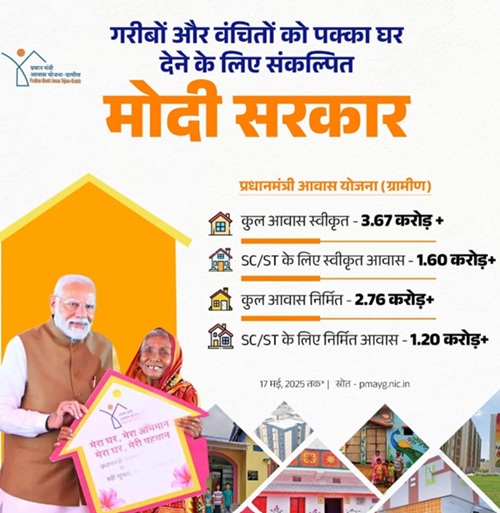
Pradhan Mantri Awaas Yojana – Gramin (PMAY-G) provides financial support to eligible rural households to help them build a permanent house with basic facilities. The main benefits include:
- Eligible beneficiaries receive ₹1.20 lakh for house construction in plain areas.
- Beneficiaries in the North-Eastern Region and specified hill areas receive ₹1.30 lakh.
- The house must have a minimum area of 25 square metres, including a hygienic cooking space.
- Eligible beneficiaries can get ₹12,000 for toilet construction through convergence with the Swachh Bharat Mission-Gramin.
- Convergence with MGNREGS can provide support for 90/95 days of unskilled wage employment, as applicable.
- Beneficiaries can also receive support through applicable government programmes for basic amenities such as drinking water, electricity and LPG.
- PMAY-G uses geo-tagged photographs, digital monitoring and Aadhaar-based payment systems to improve transparency in house construction and fund transfer.
- Under the current phase, assistance has been approved for 2 crore additional rural houses during FY 2024-25 to 2028-29.
The exact benefits and convergence support available to a household depend on its eligibility and the applicable provisions of the respective government programmes.
Eligibility Requirements
PMAY-G is meant for rural households that need support to build a permanent home. Eligibility is determined through the prescribed housing-deprivation criteria, survey data and verification process. The key requirements include:
- The household must be located in a rural area.
- The household should be houseless or living in a kutcha or dilapidated house, as per the applicable PMAY-G criteria.
- Households with a pucca roof or pucca wall and households having more than two rooms are excluded during the housing-deprivation assessment.
- The household must not fall under any of the applicable automatic exclusion criteria.
- A household is excluded if any member owns a motorised three-wheeler or four-wheeler.
- A household is excluded if any member owns certain mechanised agricultural equipment covered under the exclusion criteria.
- A household is excluded if any member has a Kisan Credit Card with a credit limit of ₹50,000 or more.
- A household is excluded if any member is a government employee.
- A household is excluded if it has a registered non-agricultural enterprise.
- A household is excluded if any member earns more than ₹15,000 per month.
- A household is excluded if any member pays income tax or professional tax.
- A household is excluded if it owns 2.5 acres or more of irrigated land or 5 acres or more of unirrigated land.
- The household must undergo the prescribed survey, verification and beneficiary selection process.
Households identified through the applicable PMAY-G lists or Awaas+ survey are still subject to verification before assistance is sanctioned.
How Beneficiaries Are Selected Under PMAY-G
PMAY-G does not work like a regular online application where anyone can apply and get the benefit. Eligible rural households are identified through government housing lists and surveys, followed by verification.
- Eligible households identified through the SECC-2011-based Permanent Wait List are considered under the PMAY-G framework.
- The Awaas+ lists are used to identify other eligible rural households not covered in the earlier list.
- Under the current phase, Awaas+ 2024 is being used to identify additional households through self-survey and assisted survey.
- The survey collects details about the family, existing house and other information needed to check eligibility.
- The household details are checked against the PMAY-G eligibility and exclusion criteria.
- The eligible households are verified through the prescribed process, including Gram Sabha verification.
- After verification and approval, the selected household is included in the beneficiary list and the house can be sanctioned.
Taking part in the Awaas+ 2024 self-survey does not guarantee a PMAY-G house. The household must meet the eligibility conditions and complete the required verification process.
Required Documents
PMAY-G beneficiary identification is based on survey, household details and the prescribed verification process. Depending on the State or UT and the stage of verification, applicants may be asked to provide or authenticate the following information:
- Aadhaar details of household members for identity verification and e-KYC.
- Bank account details for receiving the financial assistance through the prescribed payment system.
- Mobile number linked to the household or beneficiary, where required for authentication and communication.
- Household and family details required during the PMAY-G or Awaas+ survey.
- Information about the existing house, including its condition, as recorded during the survey.
- Photographs and geo-tagged details of the existing house and proposed construction site, where applicable.
Additional documents or information may be required during verification according to the applicable State/UT procedures. Beneficiaries should provide accurate details during the survey to avoid problems during verification.
Steps to Apply
PMAY-G does not have a regular online application form that guarantees housing assistance after submission. Beneficiaries are identified through the prescribed PMAY-G lists and surveys, followed by eligibility checks and verification. The Awaas+ 2024 survey was conducted through self-survey and assisted-survey facilities to identify additional potentially eligible rural households for the current phase.
- Households are identified through the applicable PMAY-G beneficiary database, including the SECC-2011-based Permanent Wait List and updated Awaas+ records.
- The Awaas+ 2024 survey was used to identify additional potentially eligible rural households for the FY 2024-25 to 2028-29 phase.
- During the survey, household details, Aadhaar-based e-KYC information, existing house conditions and other required information were recorded.
- The collected information is checked against the applicable PMAY-G eligibility and automatic exclusion criteria.
- The identified households undergo the prescribed verification process, including Gram Sabha verification and other applicable checks.
- After verification and selection, the eligible household can be included in the PMAY-G beneficiary database and the house can be sanctioned as per the available target.
- After sanction, the beneficiary receives the approved assistance through the prescribed payment system as construction progresses.
Since the Awaas+ 2024 survey has already been conducted, households that were not covered should contact their Gram Panchayat or the concerned State/UT rural development authority to know whether any further survey or beneficiary-identification process is available in their area.
PMAY-G Status Check
Beneficiaries can use the official PMAY-G system to check available details about their house, including sanction, construction progress and payment-related information.
- Open the official PMAY-G portal.
- Use the available beneficiary or reporting services to find the relevant PMAY-G record.
- Check the available details for house sanction, construction progress and instalments.
- If the information is missing or appears incorrect, contact the concerned Gram Panchayat or State/UT rural development authority.
Online information is based on records uploaded to the PMAY-G system, so there may sometimes be a delay between a local update and its appearance online.
PMAY-G House Construction and Instalment Process
After a household is selected and the house is sanctioned, the financial assistance is released in stages as the construction progresses.
- The first instalment is released after the house is sanctioned, as per the applicable State or UT procedure.
- Further instalments are released at different stages of house construction.
- Construction progress is recorded through the PMAY-G system using geo-tagged photographs and other monitoring methods.
- The approved assistance is transferred directly to the beneficiary's bank account through the prescribed payment system.
- The beneficiary needs to complete the house according to the prescribed PMAY-G requirements.
The timing and number of instalments may vary according to the implementation procedure followed by the concerned State or UT.
Pradhan Mantri Awaas Yojana – Gramin vs Pradhan Mantri Awas Yojana – Urban
Both schemes provide housing support, but they are meant for different areas. PMAY-G covers eligible rural households, while PMAY-U covers eligible households in urban areas.
| Particular | PMAY-G | PMAY-U |
|---|---|---|
Full Name | Pradhan Mantri Awaas Yojana – Gramin | Pradhan Mantri Awas Yojana – Urban |
Area | Rural areas | Urban areas |
Main Purpose | Housing support for eligible rural households | Housing support for eligible urban households |
Nodal Ministry | Ministry of Rural Development | Ministry of Housing and Urban Affairs |
Selection Process | PMAY-G lists, Awaas+ surveys and prescribed verification | As per the applicable PMAY-U eligibility and selection process |
In simple terms, a household's location determines which housing programme it should look at: PMAY-G for eligible rural households and PMAY-U for eligible urban households.
Relevant Links
- Official Website of The Ministry of Rural Development
- Pradhan Mantri Awaas Yojana – Gramin Official Portal
- Pradhan Mantri Awaas Yojana – Gramin Guidelines
- Awaas+ 2024
- Pradhan Mantri Awaas Yojana – Gramin Online Services
Contact Information
For PMAY-G-related assistance, beneficiaries should first contact the Gram Panchayat or the concerned State/UT Rural Development Department handling PMAY-G in their area. For Awaas+ 2024 app-related queries, the official PMAY-G support contact is:
PMAY-G / Awaas+ 2024 Support
- Phone: 011-23074307 – Rural Housing Division, Ministry of Rural Development
- Email: [email protected] – Awaas+ 2024 support
- Address: Rural Housing Division, Department of Rural Development, Ministry of Rural Development, Krishi Bhawan, New Delhi – 110001
- State Wise Contact Details
Frequently Asked Questions
Pradhan Mantri Awaas Yojana–Gramin (PMAY-G) is a government housing scheme that provides financial assistance to eligible rural households for building pucca houses.
Eligible beneficiaries receive ₹1.20 lakh in plain areas and ₹1.30 lakh in specified hill and North Eastern areas.
The minimum house size under PMAY-G is 25 square metres, including space for a hygienic cooking area.
Yes. Eligible beneficiaries can receive ₹12,000 for toilet construction through convergence with relevant sanitation programmes.
Eligible beneficiaries can receive wage support for 90/95 person-days of unskilled labour under MGNREGS, as applicable.
The scheme primarily covers rural households that are houseless or living in houses with kutcha walls and kutcha roofs, subject to the prescribed eligibility and exclusion criteria.
PMAY-G does not work like a regular online application scheme. Beneficiaries are identified through prescribed lists, surveys and verification processes rather than simply submitting an online application form.
Beneficiaries are identified through the SECC-2011-based Permanent Wait List, updated Awaas+ 2018 lists, and the Awaas+ 2024 survey for identifying additional potentially eligible rural households. The identified households then go through the prescribed eligibility and verification process.
Beneficiaries can use the official PMAY-G portal to check available information related to house sanction, construction progress and payment or instalment details.
PMAY-G is meant for eligible households in rural areas, while PMAY-U is meant for eligible households in urban areas. The two programmes have different implementing ministries and beneficiary identification frameworks.
Do you have any question regarding schemes, submit it in scheme forum and get answers:
Feel free to click on the link and join the discussion!
This forum is a great place to:
- Ask questions: If you have any questions or need clarification on any aspect of the topic.
- Share your insights: Contribute your own knowledge and experiences.
- Connect with others: Engage with the community and learn from others.
I encourage you to actively participate in the forum and make the most of this valuable resource.


Matching schemes for sector: Rural
| Sno | CM | Scheme | Govt |
|---|---|---|---|
| 1 | 
|
SVAMITVA Scheme | CENTRAL GOVT |
| 2 |
|
Pradhan Mantri Gram Sadak Yojana | CENTRAL GOVT |
Add new comment