



- Provides insurance protection against the death of insured livestock.
- The Government provides 85% support towards the insurance premium.
- Covers eligible milch animals, pack animals and other livestock.
- Insurance is available through the Pashudhan Bima Yojana Portal.
Summary of the Scheme | |
|---|---|
| Name of Scheme | Rashtriya Pashudhan Bima Yojana |
| Benefits | 85% subsidy on livestock insurance premium, with the beneficiary paying only 15% |
| Beneficiary | Farmers and livestock owners with eligible animals. |
| Nodal Agency | Department of Animal Husbandry & Dairying, Government of India |
| Subscription | Subscribe here to get Update Regarding Scheme |
| Mode of Apply | Online through the Pashudhan Bima Yojana Portal |
Scheme Introduction: A Brief Overview
Rashtriya Pashudhan Bima Yojana provides insurance protection to farmers and livestock owners against financial loss caused by the death of insured animals. The scheme operates under the Livestock Insurance activity of the National Livestock Mission. It covers eligible livestock such as indigenous and crossbred milch animals, horses, donkeys, mules, camels, ponies, male cattle and buffaloes, goats, sheep, pigs, rabbits, yaks and mithuns.
The scheme makes livestock insurance more affordable through government premium support. The beneficiary pays 15% of the applicable insurance premium, while the Central and State Governments together provide the remaining 85%. The subsidy is available for up to 10 cattle units per beneficiary household.
Farmers and livestock owners must complete the required identification, tagging, veterinary examination and animal valuation formalities before the insurance cover starts. The insurance value is based on the animal's current market value. The guidelines also prescribe valuation rules for cows and buffaloes based on milk yield or the applicable local market price, while other eligible livestock are valued through the prescribed assessment process.
The applicable premium rate depends on the policy period and region. Under the National Livestock Mission guidelines, the maximum premium rate for one year is 4.5% in normal areas and 5.5% in North Eastern and Himalayan States. For two-year policies, the maximum rates are 8% and 9%, while three-year policies have maximum rates of 11% and 11.5%, respectively.
The Department of Animal Husbandry & Dairying has also launched the Rashtriya Pashudhan Bima Yojana Portal to simplify livestock insurance services. The portal provides digital facilities for policy issuance, premium management, beneficiary verification, claim processing, monitoring and reporting. Farmers can use the Pashudhan Bima Yojana Portal to access the available insurance services. Livestock owners looking for working capital alongside insurance cover can also explore the Kisan Credit Card Scheme, which extends short-term credit for animal husbandry activities.
If an insured animal dies during the policy period, the beneficiary can submit an insurance claim through the prescribed process. The required claim documents include intimation to the insurance company, insurance policy paper, claim form and post-mortem report. The scheme therefore helps eligible livestock owners reduce the financial impact of animal death while providing access to subsidised livestock insurance.
Scheme Benefits
Rashtriya Pashudhan Bima Yojana provides insurance protection to livestock owners against financial loss caused by the death of insured animals. The government bears a major share of the insurance premium, reducing the financial burden on beneficiaries.
- Provides insurance cover against the death of an insured animal.
- The Central and State Governments together provide 85% of the insurance premium.
- The beneficiary pays only the remaining 15% share of the premium.
- The beneficiary receives the full insured amount in case of the death of the insured animal.
- Subsidised insurance is available for up to 10 Cattle Units per beneficiary household.
- A beneficiary owning fewer than one Cattle Unit can also avail the premium subsidy.
- Registration, insurance and claim submission can be completed online through the Pashudhan Bima Yojana Portal.
- A four-level grievance redressal mechanism is available to beneficiaries.
Premium and Insurance Value
The insurance company assesses the animal's current market value jointly with the beneficiary in the presence of a Veterinary Officer. The applicable premium rate depends on the policy period and the region in which the beneficiary is located.
- For cows, the minimum value is assessed at ₹3,000 per litre per day of milk yield or the prevailing local market price declared by the Government.
- For buffaloes, the minimum value is assessed at ₹4,000 per litre per day of milk yield or the prevailing local market price declared by the Government.
- For pack animals and other eligible livestock, the market value is assessed through negotiation between the owner and the insurance company in the presence of a Veterinary Doctor.
- In case of a dispute over valuation, the price is settled by the Gram Panchayat or the Block Development Officer.
- The maximum premium rate is 4.5% for one year, 8% for two years and 11% for three years in normal areas.
- In North Eastern and Himalayan States, the maximum premium rate is 5.5% for one year, 9% for two years and 11.5% for three years.
- The 85% government share is funded in a 60:40 ratio between the Centre and State in normal states, 90:10 in North Eastern and Himalayan States, and 100% by the Centre for Union Territories.
Claim Settlement
The livestock insurance guidelines keep the claim process simple by limiting the documents required for settlement and fixing a time limit for payment. Only four documents can be sought by the insurance company for settling a claim.
- Intimation to the insurance company
- Insurance policy paper
- Claim form
- Post-mortem report
- No claim can be considered before 21 days from the date of issuance of the policy.
- Claims are settled within 21 to 25 days of submission of all required documents.
- If the insurance company fails to settle the claim within the stipulated period, it is liable to pay the beneficiary a penalty of 12% compound interest per annum.
- All documents and forms for insuring animals and settling claims must be made available in the local language or in English.
- If the beneficiary loses their copy of the insurance policy paper, the insurance company must immediately issue a duplicate copy.
- If a claim is delayed or rejected, the insurance company must fully justify it to the claimant, with intimation to the District Monitoring Committee and the State Implementing Agency.
Eligibility Requirements
Farmers and livestock owners can avail the livestock insurance benefit under the Livestock Insurance component of the National Livestock Mission. The scheme covers different categories of livestock, subject to the prescribed identification, valuation and insurance conditions.
- The applicant should be a farmer or livestock owner who wants to insure eligible livestock.
- The animal should belong to an eligible livestock category covered under the Livestock Insurance component.
- The animal should be properly identified and tagged with a unique identification number.
- The animal must undergo veterinary examination before the insurance policy is issued.
- The current market value of the animal must be assessed for determining the insured value.
- The required animal identification, tagging, examination and valuation formalities must be completed before insurance coverage starts.
- The beneficiary must pay the applicable share of the insurance premium.
- The subsidy benefit is available for up to 10 cattle units per beneficiary household for eligible animals other than pigs and rabbits.
- For pigs and rabbits, the subsidy benefit is limited to 5 cattle units per beneficiary household.
- A beneficiary with fewer than 10 animals can also avail the applicable subsidy benefit.
Cattle Unit Calculation
The number of animals eligible for subsidised insurance under Pashudhan Bima Yojana is counted in Cattle Units, as given below.
- 1 Cattle Unit = 1 large animal such as a cow or buffalo
- 1 Cattle Unit = 10 sheep or goats
- 1 Cattle Unit = 5 rabbits or pigs
Livestock Covered Under the Scheme
The Livestock Insurance component covers indigenous and crossbred milch animals, pack animals and other livestock specified under the National Livestock Mission.
- Indigenous and crossbred milch animals
- Horses
- Donkeys
- Mules
- Camels
- Ponies
- Male cattle and buffalo
- Goats
- Sheep
- Pigs
- Rabbits
- Yak
- Mithun
Required Documents
Applicants should keep the required animal identification, photographs, veterinary assessment, and insurance details ready while applying for livestock insurance under the Pashudhan Bima Yojana. The following documents and details are supported by the livestock insurance guidelines:
Documents Required to Apply for Livestock Insurance
- Aadhaar/ID details of the livestock owner, if required by the portal or insurer.
- Animal's 12-digit UID/Ear Tag Number.
- Photo of the animal with the owner.
- Photo of the animal showing its ear tag clearly.
- Veterinary examination and animal identification details.
- Animal valuation details.
- Insurance premium payment details.
- Insurance Policy Paper.
Documents Required to File an Insurance Claim
- Intimation submitted to the insurance company
- Insurance policy paper
- Claim form
- Post-mortem report of the animal
As per the scheme guidelines, only these four documents can be sought by the insurance company for claim settlement, and all forms must be made available in the local language or in English. If the beneficiary loses their copy of the insurance policy paper, the insurance company is required to issue a duplicate copy immediately.
Steps to Apply
Applicants often search for how to apply for Pashudhan Bima Yojana online. Livestock insurance under this scheme is applied for online through the Pashudhan Bima Yojana Portal launched by the Department of Animal Husbandry and Dairying.
Before applying, the animal must already be ear-tagged with its 12-digit unique animal identification number and registered on the National Digital Livestock Mission (NDLM) database, and the applicant must have an NDLM-registered mobile number. Livestock owners whose animals are not yet tagged should contact their nearest veterinary officer or animal husbandry office to complete the tagging and registration first.
How to Apply for Livestock Insurance Online
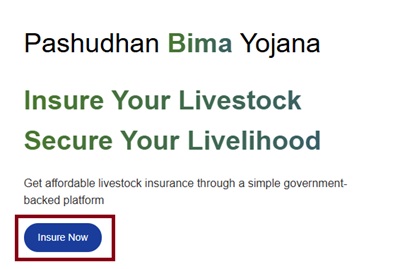
- Visit the Pashudhan Bima Yojana Portal at rashtriyapashubima.dahd.gov.in and click on "Insure Now".
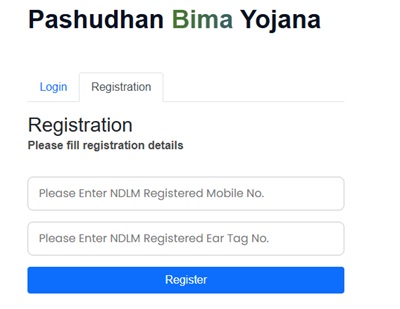
- Register on the portal using your NDLM-registered mobile number and one valid ear tag number of the animal.
- Verify and confirm your communication address.
- Select the livestock to be insured by their tag numbers.
- Submit the application form and proceed to the next stage for verification.
- Log in to the portal using your NDLM-registered mobile number to track your application status.
After submission, the animal is examined by a veterinary practitioner registered with the Veterinary Council of India, and its market value is assessed jointly by the beneficiary and the insurance company in the presence of a Veterinary Officer. Two photographs are attached to the insurance proposal, one showing the animal with its owner and the other showing the animal with its ear tag clearly visible. The policy is issued once these formalities are completed and the beneficiary pays their 15% share of the premium.
How to Claim the Insurance Amount
If the insured animal dies during the policy period, the beneficiary should inform the insurance company and submit the required claim documents through the prescribed process.
- Log in to the Pashudhan Bima Yojana Portal using your NDLM-registered mobile number.
- Click on the "My Claims" button.
- Enter the required claim details in the claim form.
- Upload the necessary supporting documents, if applicable.
Relevant Links
- Rashtriya Pashudhan Bima Yojana Registration
- Rashtriya Pashudhan Bima Yojana Login
- Rashtriya Pashudhan Bima Yojana Portal
- Department of Animal Husbandry And Dairying
- Pashudhan Bima Yojana Portal - Frequently Asked Questions
- State-wise List of Empanelled Insurance Companies
Contact Information
Frequently Asked Questions
Rashtriya Pashudhan Bima Yojana provides insurance protection to farmers and livestock owners against financial loss caused by the death of insured livestock under the Livestock Insurance activity of the National Livestock Mission.
Farmers and livestock owners with eligible livestock can apply for insurance under the scheme, subject to the prescribed requirements for identification, tagging, veterinary examination, and valuation.
The Central and State Governments together provide 85% of the insurance premium, while the beneficiary pays the remaining 15% share.
The scheme covers indigenous and crossbred milch animals, horses, donkeys, mules, camels, ponies, male cattle and buffaloes, goats, sheep, pigs, rabbits, yaks and mithuns, subject to the applicable conditions.
The subsidy benefit is available for up to 10 cattle units per beneficiary household for eligible animals other than pigs and rabbits. For pigs and rabbits, the subsidy benefit is limited to 5 cattle units.
The insurance company assesses the animal's current market value jointly with the beneficiary in the presence of a Veterinary Officer. The prescribed valuation rules apply to different categories of livestock.
Farmers can access livestock insurance services through the Pashudhan Bima Yojana Portal.
The beneficiary can submit a claim to the insurance company through the prescribed process. The guidelines provide for payment of the full insured amount in case of the death of an insured animal, subject to the applicable claim conditions.
No. The animal must first be tagged with its 12-digit unique animal identification number and registered on the NDLM database. Livestock owners whose animals are not yet tagged should contact their nearest veterinary officer or animal husbandry office.
Insurance is available in States and Union Territories where an insurance company has been empanelled under the scheme. The state-wise list of empanelled insurance companies is published on the Pashudhan Bima Yojana Portal.
No claim can be considered before 21 days from the date of issuance of the policy.
If the animal is sold or transferred before the policy expires, the beneficiary's rights for the remaining policy period must be transferred to the new owner.
No. An animal already tagged under another government programme need not be tagged again, as the existing Unique Identification number is used for insurance as well.
No. This is the central scheme implemented under the National Livestock Mission. Several states run their own livestock insurance schemes with different names, premium rates and coverage limits, which should not be confused with this scheme.
Do you have any question regarding schemes, submit it in scheme forum and get answers:
Feel free to click on the link and join the discussion!
This forum is a great place to:
- Ask questions: If you have any questions or need clarification on any aspect of the topic.
- Share your insights: Contribute your own knowledge and experiences.
- Connect with others: Engage with the community and learn from others.
I encourage you to actively participate in the forum and make the most of this valuable resource.
| Person Type | Scheme Type | Govt |
|---|---|---|


Matching schemes for sector: Insurance
| Sno | CM | Scheme | Govt |
|---|---|---|---|
| 1 | 
|
Pradhan Mantri Suraksha Bima Yojana (PMSBY) | CENTRAL GOVT |
| 2 |
|
Pradhan Mantri Jeevan Jyoti Bima Yojana (PMJJBY) | CENTRAL GOVT |
| 3 |
|
Niramaya Health Insurance Scheme | CENTRAL GOVT |
Add new comment