


- SMAM provides 40% to 50% subsidy on eligible farm machinery, with higher assistance for specified categories.
- Custom Hiring Centres can receive 40% assistance up to ₹250 lakh.
- Farm Machinery Banks can receive up to 80% assistance for projects up to ₹30 lakh.
- Eligible Kisan Drone activities can receive assistance of up to 100% or ₹10 lakh per drone, depending on the applicant category.
- From 2014-15 to 2025-26, SMAM supported 21.61 lakh machines, 27,554 CHCs, 646 Hi-Tech Hubs and 25,608 FMBs.
- Department of Agriculture & Farmers Welfare, Ministry of Agriculture & Farmers Welfare, Government of India
- Phone: 011-23604908
- Mobile: 8076258719
- Email: [email protected]
Summary of the Scheme | |
|---|---|
| Name of Scheme | Sub-Mission on Agricultural Mechanization (SMAM) |
| Launch Year | 2014-15 |
| Benefits | Up to 50% subsidy on eligible farm machinery; up to 40% assistance for Custom Hiring Centres; up to 80% assistance for Farm Machinery Banks |
| Beneficiary | Farmers, FPOs, SHGs, cooperatives and rural entrepreneurs |
| Nodal Agency | Department of Agriculture & Farmers Welfare |
| Subscription | Subscribe here to get Update Regarding Scheme |
| Mode of Apply | Online through the State Agriculture Department or Farm Machinery DBT Portal |
Scheme Introduction: A Brief Overview
Modern agricultural machinery can make farming faster, reduce manual effort and improve the timeliness of important farm operations, but the high cost of equipment can be difficult for small and marginal farmers to manage. The Sub-Mission on Agricultural Mechanization (SMAM) was introduced to address this gap by expanding access to farm machinery and mechanization services. Launched in 2014-15, the scheme provides financial assistance for eligible agricultural machinery, with assistance generally ranging from 40% to 50% for individual ownership, while special provisions provide higher support for certain categories and regions. It also supports Custom Hiring Centres (CHCs) with assistance of up to 40% of the project cost for projects up to ₹250 lakh and Farm Machinery Banks (FMBs) with assistance of up to 80% for projects up to ₹30 lakh. This allows farmers who may not be able to purchase costly equipment themselves to access machinery through shared and hiring facilities.
SMAM is implemented by the Department of Agriculture & Farmers Welfare (DA&FW), Ministry of Agriculture & Farmers Welfare, Government of India, through the State Governments and the designated agencies involved in agricultural mechanization. The scheme is currently implemented as a component of PM-RKVY and also covers activities such as training, demonstrations, machinery testing, post-harvest mechanization, crop residue management and the use of Kisan Drones. The funding pattern is generally 60:40 between the Centre and States, 90:10 for North-Eastern and Himalayan States, and 100% Central funding for Union Territories, with separate arrangements for specified Central Sector activities.
The scheme gives priority to small and marginal farmers, SC/ST farmers, women farmers and farmers in the North-Eastern and Himalayan regions, while other eligible farmers can also receive assistance under the applicable norms. Support is also available for groups and organizations such as FPOs, SHGs, cooperatives, farmer societies, Panchayats and rural entrepreneurs for eligible machinery-hiring and shared-access facilities. Farmers can apply through the State Agriculture Department or the applicable farm machinery portal, including the Government's Farm Machinery DBT Portal where the State uses it. Depending on the State and available targets, applications may be selected through a transparent process, including an online lottery where applications exceed the available target.
Farmers who need help with registration, eligibility, machinery selection or the application process can contact their State or district agriculture department for assistance. The online farm mechanization portal also provides information related to registration, machinery, applications and implementation. Since the exact machinery subsidy depends on the equipment, beneficiary category and applicable cost ceiling, applicants should check the current State-level provisions before purchasing any machinery.
Readers interested in financing agricultural infrastructure and Custom Hiring Centres can also explore the Agriculture Infrastructure Fund (AIF) on GovtSchemes.in. The scheme provides financial support for eligible agricultural infrastructure projects, including Custom Hiring Centres and other farm-related infrastructure, making it a useful option to consider alongside SMAM where the respective eligibility and scheme conditions are satisfied.
Scheme Benefits
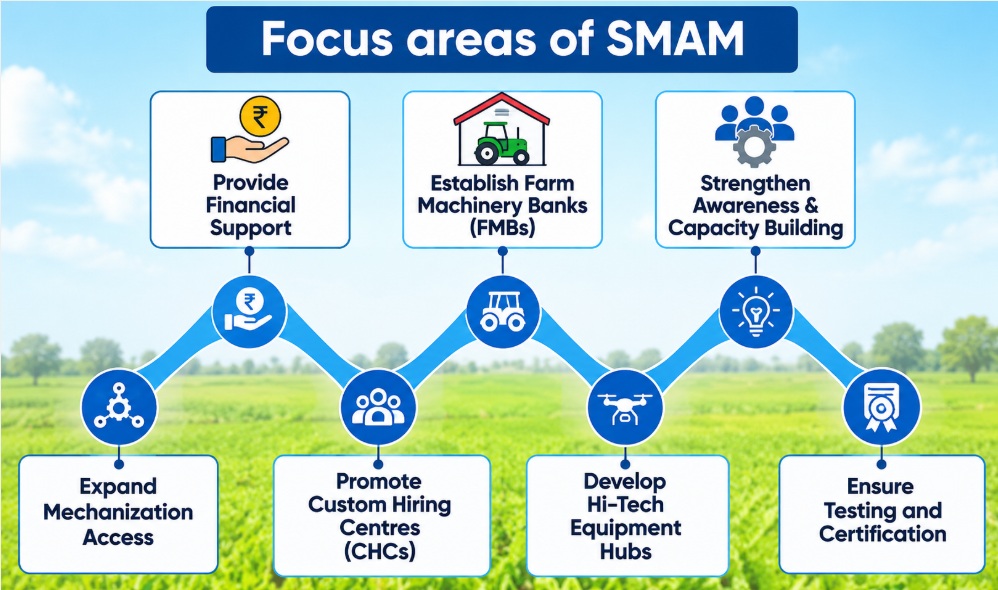
Sub-Mission on Agricultural Mechanization (SMAM) helps farmers access modern agricultural machinery at a lower cost and also supports shared machinery facilities for farmers who cannot afford to purchase expensive equipment individually.
- Eligible farmers can get 40% financial assistance for eligible farm machinery, while specified categories such as small and marginal farmers, SC/ST farmers and women farmers can receive 50% assistance, subject to the applicable machine-wise ceiling.
- Eligible FRA patta holders can receive higher assistance of up to 90% under specified provisions.
- Farmers in the North-Eastern region can receive 100% assistance for eligible machines costing up to ₹1.25 lakh, as per the applicable provisions.
- Custom Hiring Centres can receive 40% financial assistance for eligible projects costing up to ₹250 lakh.
- Farm Machinery Banks can receive up to 80% assistance for eligible projects costing up to ₹30 lakh, with higher support available under specified provisions for the North-Eastern region and FRA patta-holder groups.
- Farmers can access costly agricultural machines through Custom Hiring Centres and Farm Machinery Banks instead of purchasing the equipment themselves.
- The scheme supports machinery for activities such as sowing, planting, harvesting, threshing, spraying and post-harvest operations.
- Support is available for Hi-Tech Hubs and modern farm equipment to improve access to advanced agricultural technologies.
- Eligible agricultural drone activities receive financial support under different components, including support for drone demonstrations and drone-based Custom Hiring Centres.
- The scheme supports training and skill development so farmers, operators and other stakeholders can use agricultural machinery safely and effectively.
- Farm machinery is tested and evaluated through designated testing institutions to promote the use of suitable and reliable agricultural equipment.
- SMAM also supports crop residue management and post-harvest mechanization, helping farmers adopt machinery for better handling and management of agricultural produce and residue.
Overall, SMAM is designed not only to reduce the upfront cost of buying farm machinery but also to make expensive equipment available through shared and hiring facilities, particularly for small and marginal farmers.
Sub-Mission on Agricultural Mechanization Subsidy: Financial Assistance Available
The amount of assistance under SMAM depends on the type of applicant, machinery and activity. The scheme provides different support levels for individual farmers as well as shared machinery facilities, with higher assistance available for certain farmer categories and regions.
Category | Financial Assistance |
|---|---|
SC/ST, small and marginal farmers, women farmers, and farmers in NE and Himalayan States | 50% of eligible machine cost |
Other eligible farmers | 40% of eligible machine cost |
FRA patta holders | 90% of eligible machine cost |
Individual machines in the North-Eastern region costing up to ₹1.25 lakh | Up to 100% |
Custom Hiring Centres | 40% of project cost, up to ₹250 lakh |
Farm Machinery Banks | 80% of project cost, up to ₹30 lakh |
For individual machinery, the subsidy is calculated using the applicable percentage and the prescribed machine-wise ceiling under the SMAM guidelines. The eligible amount is based on the lower of the applicable percentage of the State-discovered price or the prescribed ceiling, before GST.
The revised guidelines also give greater importance to shared access to expensive machinery. High-cost equipment such as tractors above 40 HP, combine harvesters and sugarcane harvesters is mainly promoted through Custom Hiring Centres and Farm Machinery Banks rather than individual ownership.
Farm Machinery Covered Under Sub-Mission on Agricultural Mechanization
Sub-Mission on Agricultural Mechanization covers a wide range of agricultural equipment used at different stages of farming. The purpose is to help farmers reduce manual work, complete farm operations on time and improve access to modern machinery.
- Tractors and other tractor-operated agricultural equipment.
- Power tillers and machines used for land preparation.
- Seeders, planters and other sowing and planting equipment.
- Rice transplanters and other crop-specific planting machines.
- Reapers, reaper-cum-binders and harvesting equipment.
- Combine harvesters and other machines used for crop harvesting.
- Crop protection and plant-protection equipment.
- Post-harvest and processing machinery.
- Crop residue management machines such as Happy Seeders, Super SMS, mulchers, balers and straw choppers under the applicable provisions.
- Modern and high-value machinery provided through Custom Hiring Centres and Hi-Tech Hubs.
- Agricultural drones and related equipment under the applicable Kisan Drone provisions.
The exact subsidy ceiling differs from one machine to another. Applicants should therefore check the machinery listed and the applicable ceiling on the SMAM portal or through their State Agriculture Department before purchasing equipment.
Custom Hiring Centre Under Sub-Mission on Agricultural Mechanization
A Custom Hiring Centre (CHC) allows farmers to use agricultural machinery on a hiring basis instead of purchasing expensive equipment themselves. This is particularly useful for small and marginal farmers who may need modern machinery but cannot afford the full purchase cost.
- Eligible CHC projects can receive financial assistance of 40% of the project cost.
- The maximum eligible project cost for assistance is ₹250 lakh (₹2.5 crore).
- The assistance is provided as a credit-linked, back-ended subsidy through the prescribed banking process.
- Projects costing more than ₹50 lakh require a Detailed Project Report (DPR).
- Eligible applicants can include individual farmers, rural entrepreneurs, cooperatives, registered societies, FPOs, SHGs, Panchayats and other permitted entities.
- Training through an FMTTI or a reputed institution is required as prescribed under the guidelines.
- Priority is given to areas with low farm power availability and a high concentration of small landholdings.
- CHCs are required to be georeferenced and their information is uploaded through the prescribed digital system.
- A portion of CHC and Hi-Tech Hub funds is earmarked for eligible SHGs under DAY-NRLM.
The CHC model helps create a local source of farm machinery, allowing farmers to hire equipment when they need it and avoid the large investment required for individual ownership.
Farm Machinery Bank Under Sub-Mission on Agricultural Mechanization
A Farm Machinery Bank (FMB) is a shared machinery facility through which eligible farmer groups and local institutions can make agricultural equipment available to farmers. The revised SMAM guidelines increased the project ceiling, making this component particularly useful for villages where individual ownership of machinery is not practical.
- Eligible FMB projects can receive up to 80% of the project cost.
- The maximum project cost considered for assistance is ₹30 lakh, with the maximum assistance generally limited to ₹24 lakh.
- Eligible SHGs and FPOs consisting of FRA patta holders can receive 90% assistance, subject to a maximum assistance of ₹27 lakh.
- FMBs in the North-Eastern region can receive 95% assistance, subject to a maximum assistance of ₹28.50 lakh.
- Eligible applicants include FPOs, SHGs, cooperatives, registered farmer societies and Panchayats, subject to the scheme conditions.
- Credit linkage is required for projects above ₹10 lakh.
- Generally, a maximum of one tractor is permitted in one FMB project.
- At least 25% of the FMB budget is earmarked for processing and value-addition FMBs operated by eligible women SHGs under DAY-NRLM.
- Priority is given to low-mechanization villages, rainfed areas and aspirational districts.
Through an FMB, several farmers can access machinery without each farmer having to purchase the same equipment separately. This makes the facility especially useful in areas where expensive farm machines are needed only during particular agricultural operations.
Eligibility Requirements
SMAM is designed to make agricultural machinery more accessible to farmers and groups involved in farming activities. The eligibility conditions vary depending on whether the applicant is applying for individual machinery support, a Custom Hiring Centre, a Farm Machinery Bank or other supported activities.
- Individual farmers with valid land records can apply for eligible agricultural machinery under the scheme.
- Small and marginal farmers, SC/ST farmers and women farmers are eligible for higher assistance under the applicable provisions.
- Farmers belonging to the North-Eastern and Himalayan regions can receive benefits under the special provisions applicable to these areas.
- Eligible FRA patta holders can apply for the higher assistance available under the scheme.
- Custom Hiring Centres can be established by eligible individual farmers, rural entrepreneurs, cooperatives, registered societies, FPOs, SHGs, Panchayats and other eligible groups.
- Farm Machinery Banks can be established by eligible cooperatives, FPOs, SHGs, registered farmer societies and Panchayats.
- Eligible institutions, FPOs and agricultural graduates can apply for assistance under the Kisan Drone-related provisions, subject to the applicable conditions.
- Applicants must provide the required land, identity, bank and category-related documents as applicable to their application.
- Applicants seeking support for Custom Hiring Centres or Farm Machinery Banks must meet the applicable project requirements, including training and project documentation where required.
- For drone Custom Hiring Centre support available to agricultural graduates, the applicant must meet the prescribed educational and drone-pilot training requirements.
- The exact eligibility, machinery list and selection conditions may vary according to the State's implementation and the available target for that year.
Required Documents
Applicants need to keep a few basic documents ready before applying for SMAM assistance. The exact documents may vary depending on the type of machinery or facility being applied for and the requirements of the State.
- Aadhaar card or other prescribed identity proof.
- Valid land records or documents showing the applicant's farming or landholding details.
- Bank passbook or bank account details for receiving the subsidy through DBT.
- Recent passport-size photograph.
- Mobile number registered for application and OTP verification.
- Caste certificate, where applicable for availing category-based assistance.
- Soil Health Card, where required under the applicable provisions.
- For Custom Hiring Centres and Farm Machinery Banks, registration documents of the group or organization may be required.
- Project report or Detailed Project Report (DPR) for projects where it is prescribed.
- Bank loan sanction or related financing documents where credit linkage is required.
- Training or certification documents where the particular activity requires prescribed training.
- For eligible Kisan Drone-related applications, the required educational and drone-pilot training or certification documents must be provided.
Applicants should check the document requirements shown on the relevant State agriculture portal before submitting the application, as additional documents may be required for specific machinery or project categories.
Steps to Apply
Applying for Sub-Mission on Agricultural Mechanization assistance involves registration, selecting the required machinery and completing the approval process before purchasing the equipment. The process is mainly online, although the exact portal and procedure can vary from one State to another.
- First, check with your State Agriculture Department whether SMAM applications are being accepted through the central Farm Machinery DBT Portal or through a State-specific agriculture portal.
- If your State uses the Farm Machinery DBT Portal, open the portal and select the farmer registration option. The portal also provides separate registration categories for farmers, societies, entrepreneurs and manufacturers.
- During farmer registration, enter your name exactly as it appears on your Aadhaar card and select your district, sub-district, block and village from the available options. Choose the correct farmer category, farmer type and gender because these details are checked during verification.
- Enter your mobile number and complete OTP verification. The registered mobile number is also used for receiving notifications about transactions and the application.
- After registration, add your land details and bank account information to your profile. Bank details are required for receiving the subsidy, and the portal does not allow the machinery application to be completed without the required land and bank information.
- Once the profile is complete, use the machinery or implement application section to select the agricultural machine for which you want to claim assistance. Choose the machinery according to your farming requirement and the options available under your State's approved target.
- Submit the application and wait for the State Agriculture Department's approval process. Where applications are higher than the available target, selection may be carried out through an online lottery or other State-prescribed process.
- After receiving the required approval, permit or sanction, purchase the selected machinery from an approved or empanelled dealer. The applicable price and subsidy ceiling shown under the portal and scheme rules should be checked before making the purchase.
- The dealer uploads the purchase bill and other required details on the portal. Physical verification is then carried out as prescribed by the implementing authority before the subsidy is released.
- For machinery costing ₹1 lakh or more, the required georeferencing and machine identification process must be completed as applicable. After successful verification, the eligible subsidy is released through the prescribed DBT process to the beneficiary or dealer, depending on the option selected under the application.
- If you are applying for a Custom Hiring Centre, Farm Machinery Bank or another group-based facility, the process requires additional project-related documents and may include training, financing and project approval requirements. Such applicants should follow the procedure prescribed by their State Agriculture Department before purchasing equipment.
Relevant Links
- Department of Agriculture & Farmers Welfare, Ministry of Agriculture & Farmers Welfare
- Farm Machinery DBT Portal
- Revised Sub-Mission on Agricultural Mechanization Operational Guidelines 2025
- Farm Machinery DBT Portal FAQ
- CHC Mobile App FAQ
Contact Information
For assistance related to Sub-Mission on Agricultural Mechanization applications, the Farm Machinery DBT Portal, technical issues or general queries, applicants can contact the Mechanization & Training Division through the following official helpdesk details.
Department of Agriculture & Farmers Welfare, Ministry of Agriculture & Farmers Welfare, Government of India
- Phone: 011-23604908
- Mobile: 8076258719
- Email: [email protected]
- Address: Mechanization & Training Division, Department of Agriculture & Farmers Welfare, Ministry of Agriculture & Farmers Welfare, Krishi Bhawan, New Delhi
For State-specific assistance, applicants should contact the State Nodal Officer listed on the Farm Machinery DBT Portal, as the portal provides separate contact details for the implementing officers in each State and Union Territory.
Frequently Asked Questions
The Sub-Mission on Agricultural Mechanization (SMAM) is a Government of India scheme launched in 2014-15 to improve farmers’ access to agricultural machinery and modern farm mechanization. It also supports Custom Hiring Centres, Farm Machinery Banks, training, demonstrations and Kisan Drone activities.
Eligible farmers can generally receive 40% assistance on eligible machinery, while SC/ST farmers, small and marginal farmers and women farmers can receive 50%. FRA patta holders can receive up to 90% assistance, while eligible individual machines costing up to ₹1.25 lakh in the North-Eastern region can receive up to 100% assistance, subject to the applicable rules and ceilings.
A Custom Hiring Centre can receive 40% of the eligible project cost, subject to a maximum project cost of ₹250 lakh (₹2.5 crore).
A Farm Machinery Bank can receive up to 80% of the project cost for projects up to ₹30 lakh. The assistance can be higher in specified cases, including 95% in the North-Eastern region and 90% for eligible FRA patta-holder SHGs/FPOs.
Higher assistance is available to specified categories such as SC/ST farmers, small and marginal farmers, women farmers, farmers in North-Eastern and Himalayan States and eligible FRA patta holders.
The scheme supports various types of agricultural machinery, including tractors, power tillers, planting and sowing equipment, rice transplanters, harvesting machinery, crop-protection equipment, post-harvest machinery and crop-residue management equipment. Eligible drone-related activities are also supported under the applicable provisions.
Yes. Eligible institutions can receive 100% assistance up to ₹10 lakh per drone for demonstrations, while FPOs can receive up to 75% assistance. Eligible agricultural graduates establishing Drone Custom Hiring Centres can receive 50% assistance up to ₹5 lakh.
Farmers can apply through their State Agriculture Department. States using the central system provide applications through the Farm Machinery DBT Portal at agrimachinery.nic.in, while some States use their own integrated portals.
Applicants generally need to complete the prescribed application and approval process before purchasing the machinery. After purchase, the dealer uploads the required bill and transaction details, followed by physical verification. The eligible subsidy is then released through the prescribed DBT process.
Yes. When the number of applications exceeds the available target, beneficiary selection may be carried out through an online lottery or another selection process prescribed by the State.
Commonly required documents include Aadhaar, land records, bank account details or passbook, mobile number, photograph and caste certificate where applicable. Additional documents may be required for Custom Hiring Centres, Farm Machinery Banks and drone-related applications.
Yes. SMAM is currently implemented as a component of PM-RKVY. The revised SMAM Operational Guidelines were issued on 18 December 2025.
Do you have any question regarding schemes, submit it in scheme forum and get answers:
Feel free to click on the link and join the discussion!
This forum is a great place to:
- Ask questions: If you have any questions or need clarification on any aspect of the topic.
- Share your insights: Contribute your own knowledge and experiences.
- Connect with others: Engage with the community and learn from others.
I encourage you to actively participate in the forum and make the most of this valuable resource.


Matching schemes for sector: Subsidy
| Sno | CM | Scheme | Govt |
|---|---|---|---|
| 1 | 
|
PMFME Scheme | CENTRAL GOVT |
| 2 |
|
SHREYAS Scheme | CENTRAL GOVT |
| 3 |
|
PAHAL (Pratyaksh Hansrakshit Labh) Scheme | CENTRAL GOVT |
| 4 |
|
National Livestock Mission | CENTRAL GOVT |
Add new comment