



- The Credit Guarantee Fund Scheme for Education Loans (CGFSEL) was notified on 16 September 2015 under the PM-USP Yojana.
- Eligible students can obtain education loans of up to ₹7.5 lakh without collateral security or a third-party guarantee.
- The scheme provides 75% credit guarantee coverage on the eligible amount in default.
- Indian students pursuing eligible higher education courses in India and abroad can benefit from the scheme.
- Trustee and operating agency for the Credit Guarantee Fund Scheme for Education Loans (CGFSEL).
- CGFEL Helpline: 022-69035614 / 022-69035606
- Email: [email protected]
- General Enquiries: 022-69035600
Summary of the Scheme | |
|---|---|
| Name of Scheme | Credit Guarantee Fund Scheme for Education Loans (CGFSEL) |
| Launch Year | 2015 |
| Benefits | 75% credit guarantee on eligible education loan defaults up to ₹7.5 lakh, without collateral security or a third-party guarantee. |
| Beneficiary | Eligible Indian students pursuing higher education in India or abroad. |
| Nodal Agency | National Credit Guarantee Trustee Company Limited (NCGTC) |
| Subscription | Subscribe here to get Update Regarding Scheme |
| Mode of Apply | Online/Offline |
Scheme Introduction: A Brief Overview
Pursuing higher education often requires substantial financial support, but arranging property or a third-party guarantor can make it difficult for many students to obtain an education loan. To address this challenge, the Government of India introduced the Credit Guarantee Fund Scheme for Education Loans (CGFSEL) under the broader Pradhan Mantri Uchchatar Shiksha Protsahan (PM-USP) Yojana. Notified on 16 September 2015, CGFSEL helps eligible Indian students secure education loans of up to ₹7.5 lakh without collateral security or a third-party guarantee. Under the scheme, a government-backed fund provides a credit guarantee covering 75% of the eligible amount in default, reducing the financial risk for banks and encouraging them to provide education loans to students pursuing higher education in India or abroad.
PM-USP is a broader higher education support framework of the Government of India, which includes different forms of financial assistance for eligible students. The Credit Guarantee Fund Scheme for Education Loans is one of its education loan-related schemes. It is administered by the Department of Higher Education, Ministry of Education, while the National Credit Guarantee Trustee Company Limited (NCGTC) acts as the trustee and manages the credit guarantee mechanism. The scheme works with eligible Member Lending Institutions (MLIs), including participating public sector banks, private sector banks, foreign banks, Regional Rural Banks (RRBs) and eligible cooperative banks. It follows the Indian Banks' Association (IBA) Model Educational Loan Scheme.
The main benefit of CGFSEL is that eligible students can obtain education loans of up to ₹7.5 lakh without pledging property or arranging a third-party guarantor. The government-backed fund covers 75% of the eligible amount in default, subject to the scheme's conditions. This encourages banks to extend education credit while reducing their lending risk. The scheme covers eligible higher education courses in India and abroad. However, CGFSEL is not a scholarship, direct financial assistance or loan waiver scheme. Students must repay the entire education loan according to the repayment terms agreed upon with their bank.
To qualify for the scheme, the applicant must be an Indian national and meet the eligibility requirements of the IBA Model Educational Loan Scheme. The student must have secured admission to an eligible higher education course and completed the necessary loan formalities with a participating lending institution. Generally, parents or guardians act as co-borrowers, while married applicants may have their spouse, parents or parents-in-law as joint borrowers. The original CGFSEL notification does not prescribe a separate annual family income ceiling. However, the loan must meet the applicable scheme conditions, including the prescribed loan limit and collateral-free requirements. The eligibility of a particular institution or course is also subject to the Fund's guidelines.
Students do not need to submit a separate application to NCGTC for the credit guarantee. They must first apply for an education loan through a participating bank or eligible lending institution. The PM-Vidyalaxmi Portal also provides an online facility for submitting education loan applications to participating banks. After evaluating and sanctioning an eligible loan, the bank completes the necessary formalities with NCGTC to obtain guarantee coverage. For loan-related assistance, students should contact their lending bank. For queries concerning the credit guarantee mechanism, they can write to NCGTC at [email protected].
Students looking for additional financial support for higher education can also explore related schemes available on GovtSchemes.in. The Pradhan Mantri Uchchatar Shiksha Protsahan (PM-USP) Yojana provides an overview of the broader framework and its different student support components. Its Central Sector Interest Subsidy Scheme (CSIS) provides a 100% interest subsidy during the moratorium period on eligible education loans up to ₹10 lakh for students from families with an annual income of up to ₹4.5 lakh, subject to the scheme conditions. Similarly, the PM-Vidyalaxmi Scheme provides collateral-free education loan facilities to eligible students admitted to designated quality higher educational institutions, along with interest subvention for eligible applicants.
How Does the Credit Guarantee Fund Scheme for Education Loans Work?
The Credit Guarantee Fund Scheme for Education Loans works through a partnership between the Government of India, NCGTC and participating banks. Instead of providing money directly to students, the scheme gives banks a government-backed guarantee on eligible education loans. This reduces the risk for banks and encourages them to provide loans without asking students to pledge property or arrange a third-party guarantee.
The process works in the following way:
- A student applies for an eligible education loan through a participating bank or lending institution.
- The bank checks the student's admission, course details, loan eligibility and other required documents before sanctioning the loan.
- After disbursing the eligible loan, the bank applies to the National Credit Guarantee Trustee Company Limited (NCGTC) for guarantee coverage.
- NCGTC provides a guarantee covering 75% of the eligible amount in default, subject to the scheme's rules and conditions.
- If the borrower fails to repay the loan and the account meets the conditions for a valid guarantee claim, the bank can approach NCGTC for payment under the scheme.
- The bank must continue its recovery efforts against the borrower even after receiving the guarantee amount.6
For example, if an eligible loan has an amount in default of ₹4 lakh, the guarantee may cover 75% of that eligible default amount, or ₹3 lakh, subject to the applicable claim conditions. The remaining amount is not automatically waived, and the student remains responsible for repaying the outstanding loan.
Apply for Education Loan → Bank Sanctions and Disburses Loan → Bank Applies to NCGTC → 75% Guarantee Coverage → Bank Continues Loan Recovery if Default Occurs
Loan Limit and Guarantee Coverage
Under CGFSEL, the maximum education loan amount eligible for guarantee coverage is ₹7.5 lakh. The scheme provides 75% guarantee coverage on the eligible amount in default. The following table explains the main financial provisions:
Particulars | Details |
|---|---|
Maximum eligible loan amount | ₹7.5 lakh |
Guarantee coverage | 75% of the eligible amount in default |
Collateral security | Not required for eligible loans covered under the scheme |
Third-party guarantee | Not required for eligible covered loans |
Guarantee provider | National Credit Guarantee Trustee Company Limited (NCGTC) |
It is important to understand that the 75% guarantee is calculated on the eligible amount in default, not automatically on the entire sanctioned loan amount. The guarantee protects the lending institution against a specified portion of its eligible loss; it does not reduce the student's repayment obligation.
Scheme Benefits
The Credit Guarantee Fund Scheme for Education Loans makes it easier for eligible students to finance higher education by reducing the need for collateral and third-party guarantees. Its key benefits include:
- Students can get an eligible education loan of up to ₹7.5 lakh without pledging property or other collateral security.
- The scheme provides a 75% credit guarantee on the eligible amount in default, reducing the lending risk for banks.
- Students do not need to arrange a third-party guarantor to obtain an eligible loan under the scheme.
- It supports eligible students pursuing higher education courses in India as well as abroad.
- Both new and existing education loan borrowers may be covered, provided their loans meet the scheme's eligibility conditions.
- Parents or guardians can act as co-borrowers, helping students complete the education loan process without requiring a separate third-party guarantor.
- The scheme encourages participating banks and financial institutions to provide education loans to students who may not have assets to offer as security.
- The guarantee fee is payable by the lending institution from its own funds under the original scheme provisions, rather than being separately charged to the student under those provisions.
- The scheme supports access to education financing while allowing students to repay their loans according to the repayment terms agreed upon with the bank.
Important: The credit guarantee protects the lending institution against a specified portion of the eligible loan default. It does not waive the student's loan or remove the responsibility to repay the full outstanding amount.
Eligibility Requirements
Students who need financial support for higher education can benefit from the Credit Guarantee Fund Scheme for Education Loans, provided their education loan meets the scheme's conditions. The main eligibility requirements are as follows:
- The applicant must be an Indian citizen.
- Both new and existing education loan borrowers can be considered for coverage, provided they meet the scheme's requirements.
- The student must have secured admission to an eligible higher education course in a recognised institution in India or abroad.
- The education loan must be sanctioned under the Indian Banks' Association (IBA) Model Educational Loan Scheme for Higher Education in India and Abroad.
- The loan amount eligible for coverage must not exceed ₹7.5 lakh.
- The eligible loan must be provided without collateral security or a third-party guarantee.
- The student must complete and sign the required education loan documents with a participating bank or lending institution.
- Parents or guardians are generally required to act as co-borrowers or joint borrowers. For married applicants, the spouse, parents or parents-in-law may act as joint borrowers.
- The loan account must meet the scheme's conditions, including the applicable requirements relating to its status and repayment record when the bank applies for guarantee coverage.
- The loan must not already have guarantee or insurance coverage from another government scheme, insurer or guarantor for the same risk, except as permitted under the scheme rules.
Note: The original scheme notification does not specify a separate annual family income limit for CGFSEL. However, the bank assesses the student's loan application under the applicable education loan guidelines. Final guarantee coverage is subject to the scheme rules and the lending institution's eligibility checks.
Loan Repayment and Moratorium Period
Getting an education loan under CGFSEL does not mean that students have to start repaying it immediately while pursuing their studies. Education loans under the applicable Indian Banks' Association (IBA) Model Educational Loan Scheme generally provide a moratorium period to give students time to complete their course and prepare for repayment.
The repayment arrangements generally include the following:
- Moratorium period: Repayment of the loan principal generally begins after the course period plus one additional year.
- Repayment period: Under the applicable IBA education loan provisions, repayment may extend up to 15 years after the moratorium period.
- Interest during the study period: Interest may continue to accrue during the course and moratorium period. Students should check with their bank whether interest needs to be serviced during this period or can be added to the loan balance.
- Repayment responsibility: The borrower must repay the full loan amount, including applicable interest, according to the repayment schedule agreed upon with the bank.
The exact repayment schedule, interest rate and other loan conditions are determined by the lending institution under the applicable education loan guidelines. CGFSEL itself does not provide a separate repayment schedule or waive the borrower's debt.
Required Documents
To apply for an education loan under the Credit Guarantee Fund Scheme for Education Loans, students need to submit the documents required by their chosen bank or lending institution. The exact checklist may vary depending on the bank, course and place of study. Generally, the following documents may be required:
- Identity proof of the student, such as Aadhaar Card, PAN Card, Voter ID or Passport.
- Address proof of the student, such as Aadhaar Card, Voter ID, Passport or a recent utility bill.
- Recent passport-size photographs of the student.
- Academic records, including previous examination marksheets and certificates.
- Admission letter or offer letter issued by the college or university.
- Course fee structure or an official estimate of tuition fees and other education expenses.
- Entrance examination scorecard or merit certificate, wherever applicable.
- Identity and address proof of the parent or guardian acting as the co-borrower.
- Income proof of the parent or co-borrower, such as salary slips, Form 16, income tax returns or an income certificate, if requested by the bank.
- Bank statements of the student or co-borrower, if required by the lending institution.
- For studies abroad, additional documents such as a valid passport, visa or visa application details may be required.
Students should confirm the final document checklist with their selected bank before applying. The student does not need to submit a separate application or guarantee-related documents directly to NCGTC, as the lending institution handles the process of obtaining credit guarantee coverage.
Steps to Apply
Students do not need to submit a separate application for the Credit Guarantee Fund Scheme for Education Loans (CGFSEL). The process starts with applying for an eligible education loan through a participating bank. Once the bank approves the loan, it completes the necessary formalities with NCGTC to obtain the credit guarantee. Students can apply online through the PM-Vidyalaxmi Portal or directly at a participating bank branch.
Method 1: Apply Online through the PM-Vidyalaxmi Portal
The PM-Vidyalaxmi Portal provides a common online platform for students to apply for education loans from participating banks. Follow these steps to submit your application:
- Open the PM-Vidyalaxmi Portal and select the student registration or sign-up option.
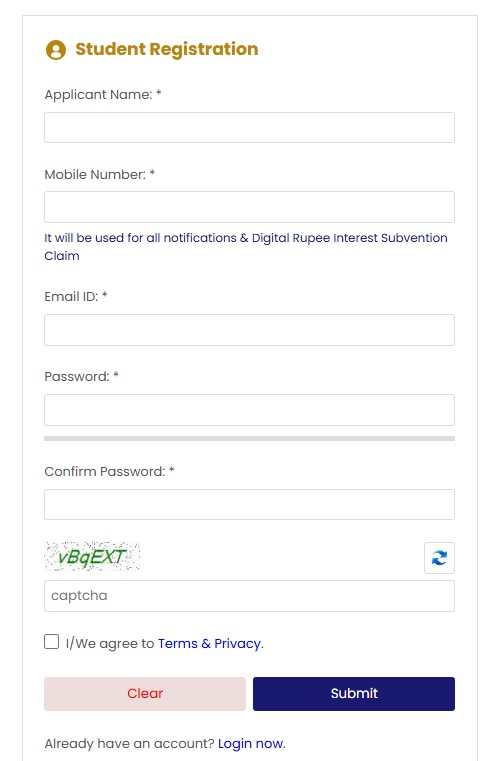
- Enter your name, mobile number and email address, create a password, and complete the registration process.
- Log in using your registered email ID and password.
- Select the 'Apply Loan' option and fill in the Common Education Loan Application Form with your personal, academic and course details.
- Upload the required documents, such as academic records, admission details, fee information and identity proofs.
- Choose your preferred bank and branch. The portal allows students to apply to up to three banks through one active application.
- Review the information carefully and submit the application to the selected bank or banks.
- Use the 'Track Loan Application' option on the portal to check the application status and respond to any additional information or document requests from the bank.
After receiving the application, the selected bank checks the student's eligibility and loan documents before taking a decision. If the loan meets the CGFSEL conditions, the bank handles the process of obtaining guarantee coverage from NCGTC. Students do not have to apply separately to NCGTC for this coverage.
Method 2: Apply Offline Through a Bank Branch
Students who prefer to apply in person can approach a participating bank branch and request an education loan under the IBA Model Educational Loan Scheme. The process generally involves these steps:
- Contact a participating bank branch and ask about an education loan of up to ₹7.5 lakh under the collateral-free provisions of CGFSEL.
- Collect the education loan application form from the bank and fill in the required details.
- Submit the completed form along with the necessary documents and details of your parent or guardian acting as the co-borrower.
- The bank will review your admission details, academic records, course fees and repayment-related information.
- If the application meets the bank's lending requirements, the bank will sanction the education loan and complete the required loan formalities.
- The bank will then apply to NCGTC for the applicable credit guarantee coverage. You do not need to submit a separate guarantee application.
Important: CGFSEL provides a guarantee to the lending institution; it does not directly transfer money to the student. Loan approval and disbursement are handled by the bank. The guarantee is subject to the scheme's conditions, and the student remains responsible for repaying the full loan amount.
Is CGFSEL a Loan Waiver or Interest Subsidy Scheme?
No. The Credit Guarantee Fund Scheme for Education Loans is neither a loan waiver scheme nor an interest subsidy scheme. It is a credit guarantee arrangement designed to protect banks against a specified portion of the eligible loan default. This makes it easier for eligible students to obtain education loans without collateral security or a third-party guarantee.
Under this arrangement, NCGTC provides guarantee coverage to the lending institution if the loan meets the scheme's claim conditions. However, the student remains responsible for repaying the entire outstanding loan, including applicable interest. Even if the bank receives payment under the guarantee, it can continue recovery proceedings against the borrower.
Students looking for interest subsidy or other forms of financial assistance should also check the Central Sector Interest Subsidy Scheme (CSIS) and PM-Vidyalaxmi Scheme, as these provide different types of support for eligible higher education borrowers.
Difference Between CGFSEL, CSIS and PM-Vidyalaxmi
The Government of India offers different forms of support to make higher education more affordable. Although CGFSEL, the Central Sector Interest Subsidy Scheme (CSIS) and PM-Vidyalaxmi are related to education loans, their benefits and eligibility conditions are different. The following table highlights the key differences:
Particulars | CGFSEL | CSIS | PM-Vidyalaxmi |
|---|---|---|---|
Full name | Credit Guarantee Fund Scheme for Education Loans | Central Sector Interest Subsidy Scheme | PM-Vidyalaxmi Scheme |
Main benefit | 75% credit guarantee to the lending institution on the eligible amount in default | Full interest subsidy during the moratorium period for eligible students | Collateral-free and guarantor-free education loans for eligible students, along with interest subvention for eligible applicants |
Loan limit for the benefit | Up to ₹7.5 lakh for guarantee coverage | Interest subsidy on education loans up to ₹10 lakh | 3% interest subvention on education loans up to ₹10 lakh for eligible students |
Family income limit | No separate family income limit under the original scheme notification | Annual family income up to ₹4.5 lakh | Annual family income up to ₹8 lakh for the 3% interest subvention benefit |
Beneficiaries | Eligible Indian students pursuing higher education in India or abroad | Eligible students pursuing approved professional or technical courses in recognised institutions in India | Students admitted to eligible Quality Higher Educational Institutions (QHEIs) |
Type of support | Credit risk protection for banks | Interest subsidy for students | Education loan support and interest subvention for eligible students |
In simple terms, CGFSEL helps banks provide education loans by reducing their lending risk, CSIS helps eligible students by paying the interest during the moratorium period, and PM-Vidyalaxmi combines education loan support with an interest subvention benefit for eligible students. These schemes have separate eligibility conditions, so students should check the applicable rules before applying.
Relevant Links
- Department of Higher Education – Ministry of Education
- National Credit Guarantee Trustee Company (NCGTC) Website
- PM-Vidyalaxmi Education Loan Portal
- Credit Guarantee Fund Scheme for Education Loans (CGFSEL) Modified Guidelines
- NCGTC – CGFEL Frequently Asked Questions
- PM-Vidyalaxmi Student Registration and Login
- PM-Vidyalaxmi Portal FAQs
Contact Information
National Credit Guarantee Trustee Company Limited (NCGTC)
Trustee and operating agency for the Credit Guarantee Fund Scheme for Education Loans (CGFSEL).
- CGFEL Helpline: 022-69035614 / 022-69035606
- Email: [email protected]
- General Enquiries: 022-69035600
- General Email: [email protected]
- Grievance Email: [email protected]
- Address: 1410, 14th Floor, Parinee Crescenzo, Plot No. C-38 & C-39, G-Block, Bandra Kurla Complex (BKC), Bandra East, Mumbai, Maharashtra – 400051.
PM-Vidyalaxmi Portal Helpdesk
- Toll-Free Number: 1800 1031
- Email: [email protected]
- Address: PM Vidyalaxmi Portal Section, Canara Bank, Head Office (Annex), Ground Floor, Scope Minar, Near Nirman Vihar Metro Station, Laxmi Nagar, New Delhi – 110092.
Note: For education loan sanction, repayment or rejection-related issues, students should first contact the concerned bank. For questions specifically related to CGFSEL guarantee coverage, they can contact NCGTC using the details above.
Frequently Asked Questions
The Credit Guarantee Fund Scheme for Education Loans (CGFSEL) is a Government of India scheme that helps eligible students obtain education loans without collateral security or a third-party guarantee.
The scheme was notified on 16 September 2015 by the Government of India under the Pradhan Mantri Uchchatar Shiksha Protsahan (PM-USP) Yojana.
Eligible education loans of up to ₹7.5 lakh can receive credit guarantee coverage under the scheme.
The scheme provides 75% guarantee coverage on the eligible amount in default, subject to the prescribed conditions.
Indian students who meet the IBA Model Educational Loan Scheme requirements and have secured admission to an eligible higher education course in India or abroad can be considered for coverage.
The original CGFSEL notification does not prescribe a separate annual family income limit. However, students must meet the applicable education loan and scheme conditions.
No. Eligible education loans covered under the scheme do not require collateral security or a third-party guarantee.
Students can apply for an education loan through a participating bank or eligible lending institution. The bank handles the application for credit guarantee coverage with NCGTC.
No. CGFSEL is a credit guarantee scheme for banks, not a loan waiver scheme. Students remain responsible for repaying the full outstanding loan amount, including applicable interest.
Yes. Eligible Indian students pursuing qualifying higher education courses in India or abroad can receive coverage, subject to the scheme's conditions.
The National Credit Guarantee Trustee Company Limited (NCGTC) acts as the trustee and manages the credit guarantee mechanism. It provides guarantee coverage to eligible lending institutions under the scheme.
No. CGFSEL provides credit guarantee coverage to lending institutions, while PM-Vidyalaxmi provides collateral-free education loan support to eligible students admitted to designated quality higher educational institutions, along with interest subvention for eligible applicants.
Do you have any question regarding schemes, submit it in scheme forum and get answers:
Feel free to click on the link and join the discussion!
This forum is a great place to:
- Ask questions: If you have any questions or need clarification on any aspect of the topic.
- Share your insights: Contribute your own knowledge and experiences.
- Connect with others: Engage with the community and learn from others.
I encourage you to actively participate in the forum and make the most of this valuable resource.


వ్యాఖ్యానించండి