


- Unique Devbhoomi Family ID for eligible families.
- Senior-most woman (18+) recognized as family head.
- Centralized database for better scheme delivery.
- Contact Details of the Scheme will be shared soon.
Summary of the Scheme | |
|---|---|
| Name of the Scheme | Uttarakhand Devbhoomi Parivar Yojana. |
| Launch Year | 2026 |
| Benefits | Eligible Families will get Unique ID. |
| Beneficiary | Eligible Families of Uttarakhand |
| Subscription | Subscribe here to get Update Regarding Scheme |
| Mode of Apply | Through the Application Form. |
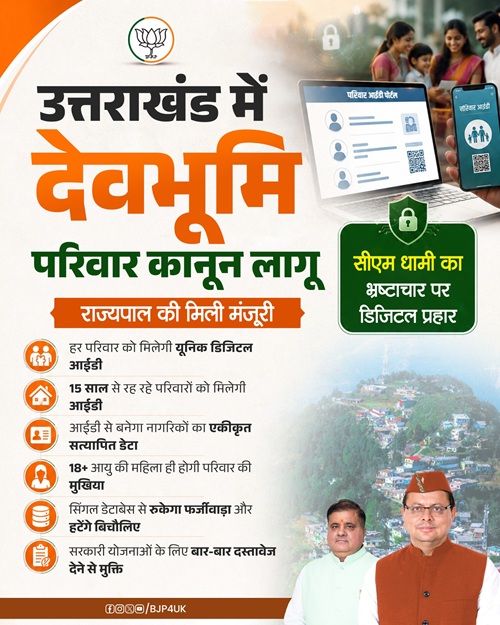
Scheme Introduction: A Brief Overview
The Uttarakhand Devbhoomi Family Act, 2026 is an important initiative of the Government of Uttarakhand aimed at creating a single and verified database of families living in the state. The Act received the approval of the Governor on 07 May 2026 and was published in the Official Gazette on 11 May 2026. Through this law, the government plans to issue a unique Devbhoomi Family ID to eligible families and connect them with various government schemes, subsidies, welfare programmes, and public services through a common platform.
Family-based identification systems are already being used in several states across India to improve the delivery of government benefits and maintain accurate beneficiary records. Uttar Pradesh operates the Family ID – Ek Parivar Ek Pehchan programme, Haryana uses the Parivar Pehchan Patra (PPP), Rajasthan has implemented the Jan Aadhaar system, and Madhya Pradesh uses Samagra ID. Following a similar approach, Uttarakhand has introduced the Devbhoomi Parivar ID system to create a centralized database of families and strengthen the state's welfare delivery mechanism.
Under the Act, every eligible family will be assigned a unique Devbhoomi Parivar ID. This ID will help the government maintain verified family records and reduce duplication in beneficiary databases. The centralized database will make it easier for government departments to identify eligible beneficiaries, verify information, and deliver benefits in a more transparent and efficient manner. The system is also expected to reduce errors in beneficiary identification and help ensure that welfare schemes reach genuine residents of the state.
One of the major objectives of the Act is to create an integrated family database that can be used by different government departments while implementing welfare schemes and citizen services. The Act also contains provisions for data verification, regular updation of family information, protection of personal data, and secure management of records. In addition, the senior-most woman aged 18 years or above in a family will ordinarily be treated as the head of the family for the purpose of maintaining family records under the Devbhoomi Family ID system.
To obtain a Devbhoomi Parivar ID, a person or family must generally be residing in Uttarakhand for at least 15 years. The Act also covers eligible state government employees, local authority employees, and their families under specified conditions. However, temporary residence, education, employment, or short-term posting in Uttarakhand alone will not make a person eligible for the Family ID. Families living in both rural and urban areas can benefit from the system if they satisfy the eligibility conditions prescribed under the Act.
It is important to note that the Uttarakhand Devbhoomi Family Act, 2026 does not provide any direct financial assistance, cash transfer, or subsidy to beneficiaries. Instead, it creates a legal framework for issuing Family IDs and maintaining a verified family database that can be used for the delivery of government schemes and services. Although the law has already been enacted, the Government of Uttarakhand has not yet announced the official registration portal, application process, or detailed enrollment guidelines. Once these details are notified, eligible families will be able to register and obtain their Devbhoomi Parivar ID.

Scheme Benefits
The Uttarakhand Devbhoomi Parivar Act, 2026 aims to create a centralised family database and provide every eligible family with a unique Devbhoomi Family ID. The Family ID will help the Government of Uttarakhand improve the delivery of welfare schemes and citizen services. Some of the key benefits are as follows:
- Every eligible family will receive a unique Devbhoomi Parivar ID.
- A centralized and integrated family database will be created for the entire state.
- Families will be able to establish their identity through a single Parivar ID for various government services and welfare schemes.
- Government departments will be able to verify beneficiary information more efficiently through the integrated database.
- The system will help eliminate duplicate and inaccurate beneficiary records.
- Eligible families can be linked with various state government schemes, subsidies, services, and benefits through a common database.
- The Family ID system will improve transparency and ensure that welfare benefits reach genuine beneficiaries.
- Family information can be updated and verified from time to time to maintain accurate records.
- The Act provides a legal framework for secure management, verification, and protection of family-related data.
- The centralized database will assist the Government in planning and implementing public welfare programmes more effectively.
Eligibility Requirement
The Uttarakhand Devbhoomi Parivar Act, 2026 lays down the broad eligibility framework for obtaining a Devbhoomi Family ID. Detailed registration guidelines, verification procedures, and operational rules are expected to be notified separately by the Government of Uttarakhand.
- The applicant must be a resident of Uttarakhand.
- A person or family that has been continuously residing within the geographical limits of Uttarakhand for 15 years or more shall be treated as a resident under the Act.
- Eligible families residing in both rural and urban areas of Uttarakhand can obtain a Devbhoomi Parivar ID.
- Permanent officers and employees of the Uttarakhand Government, Government Agencies, Local Authorities, and their families are also eligible under the provisions of the Act.
- State Government employees and their families may continue to be treated as residents even if they are residing outside Uttarakhand due to official duties or deputation.
- Mere temporary residence, employment, education, or posting in Uttarakhand shall not by itself qualify a person as a resident under the Act.
- Applicants must provide the information and details required by the Devbhoomi Family Authority for registration and verification purposes.
Required Documents
The Government of Uttarakhand has not yet notified the official list of documents required for Devbhoomi Parivar ID registration under the Uttarakhand Devbhoomi Family Act, 2026. The documents listed below are tentative in nature and are based on the likely verification requirements for family identification and residence verification. Once the Government releases the official registration guidelines or document requirements, we will update this section accordingly.
- Aadhaar Card of family members.
- Family Ration Card.
- Residence Certificate or any other proof of residence in Uttarakhand.
- Mobile Number.
- Family details and identification documents of family members.
- Any other documents required by the Devbhoomi Family Authority for verification purposes.
Steps to Apply
The Uttarakhand Devbhoomi Parivar Act, 2026 has been enacted and provides the legal framework for issuing Devbhoomi Parivar IDs to eligible families. However, the Government of Uttarakhand has not yet released the official registration portal, application form, or detailed enrollment procedure. Once the registration process is notified, this section will be updated accordingly.
- The Government of Uttarakhand will launch the official Devbhoomi Parivar ID registration process through a notified portal or designated authority.
- Eligible families will be required to provide the information and details prescribed by the Devbhoomi Family Authority.
- The submitted information will be verified through integration with government databases and records.
- If any information remains unverified, applicants may be asked to provide supporting documents for verification.
- After successful verification, a unique Devbhoomi Family ID will be issued to the eligible family.
- Families may be required to update their information from time to time to ensure that the database remains accurate and up to date.
- Detailed registration guidelines, portal links, and application procedures will be shared once officially notified by the Government of Uttarakhand.
Relevant Links
Contact Information
- Uttarakhand Government will release the Official Contact Information of Devbhoomi Parivar Yojana after its launch.
Frequently Asked Questions
The Uttarakhand Devbhoomi Family Act, 2026 is a law enacted by the Government of Uttarakhand to create a centralized family database and issue a unique Devbhoomi Family ID to eligible families in the state.
The Devbhoomi Family ID will help the Government maintain verified family records, identify genuine beneficiaries, reduce duplicate records, and improve the delivery of government schemes and services.
Generally, a person or family that has been continuously residing in Uttarakhand for 15 years or more is eligible. Certain state government employees and their families are also covered under the Act.
No. The Uttarakhand Devbhoomi Family Act, 2026 does not provide direct financial assistance. It creates a Family ID system that can be used for the delivery of various government schemes and services.
No. The Government of Uttarakhand has not yet announced the official registration portal, application form, or enrollment process for obtaining the Devbhoomi Family ID.
The Government has not yet notified the official document list. Aadhaar Card, Family Ration Card, residence proof, and family details may be required for verification purposes. The final document requirements will be announced by the Government.
Yes. Eligible families residing in both rural and urban areas of Uttarakhand can obtain a Devbhoomi Family ID if they satisfy the conditions prescribed under the Act.
Under the Act, the senior-most woman aged 18 years or above in the family will ordinarily be treated as the head of the family.
Do you have any question regarding schemes, submit it in scheme forum and get answers:
Feel free to click on the link and join the discussion!
This forum is a great place to:
- Ask questions: If you have any questions or need clarification on any aspect of the topic.
- Share your insights: Contribute your own knowledge and experiences.
- Connect with others: Engage with the community and learn from others.
I encourage you to actively participate in the forum and make the most of this valuable resource.
| Person Type | Govt |
|---|---|

Add new comment