


- Paramparagat Krishi Vikas Yojana was launched in 2015–16 to promote organic farming in India.
- The scheme provides financial assistance of ₹31,500 per hectare over three years to eligible farmers.
- Farmers receive ₹15,000 per hectare through DBT for purchasing or preparing organic farming inputs.
- The scheme promotes cluster-based organic farming and gives preference to small and marginal farmers.
- It supports farmer training, organic certification, packaging, branding, value addition and marketing of organic produce.
- Ministry of Agriculture and Farmers Welfare, Government of India
- Phone: 011-23385093
- Centre for Organic and Natural Farming (NCONF).
- Phone: 120-2764906 / 120-2764212
- Email: [email protected]
Summary of the Scheme | |
|---|---|
| Name of Scheme | Paramparagat Krishi Vikas Yojana (PKVY) |
| Launch Year | 2015–16 |
| Benefits | Financial assistance of up to ₹31,500 per hectare over 3 years, including ₹15,000 through DBT for organic inputs. |
| Beneficiary | Farmers adopting organic farming, with preference for small and marginal farmers. |
| Nodal Agency | Department of Agriculture and Farmers Welfare, Ministry of Agriculture and Farmers Welfare |
| Subscription | Subscribe here to get Update Regarding Scheme |
| Mode of Apply | Offline through State Agriculture Departments and Regional Councils; PGS group registration is available online. |
Scheme Introduction: A Brief Overview
Organic farming is becoming increasingly important as farmers look for ways to reduce cultivation costs, maintain soil fertility and produce safer agricultural products. To encourage this shift towards sustainable agriculture, the Government of India launched the Paramparagat Krishi Vikas Yojana (PKVY) in 2015-16. The scheme promotes organic farming through a cluster-based approach and provides eligible farmers with financial assistance of ₹31,500 per hectare over three years. Out of this amount, ₹15,000 is transferred directly to farmers through Direct Benefit Transfer (DBT) for purchasing or preparing organic farming inputs. The scheme also supports organic certification, farmer training, packaging, branding, value addition and marketing of organic produce.
Initially introduced as a component of the Soil Health Management programme under the National Mission for Sustainable Agriculture (NMSA), PKVY is now one of the nine components of the Pradhan Mantri Rashtriya Krishi Vikas Yojana (PM-RKVY), following the restructuring of agricultural schemes in October 2024. It is implemented by the Department of Agriculture and Farmers Welfare, under the Ministry of Agriculture and Farmers Welfare, Government of India, through State and Union Territory Governments.
The main objective of Paramparagat Krishi Vikas Yojana is to encourage farmers to adopt organic farming practices using locally available resources, organic manure, biofertilisers and other natural inputs. It aims to reduce dependence on chemical fertilisers and pesticides, improve soil health, conserve natural resources and promote environmentally sustainable agriculture. The scheme also encourages farmers to work together in clusters, share resources, receive technical training and develop better market opportunities for their agricultural produce.
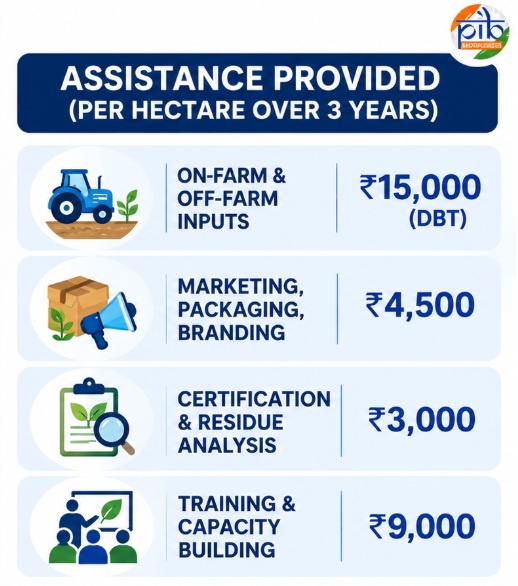
Under PKVY, financial assistance of ₹31,500 per hectare is provided over three years. This includes ₹15,000 for on-farm and off-farm organic inputs through DBT, ₹9,000 for training and capacity building, ₹4,500 for marketing, packaging, branding and value addition, and ₹3,000 for organic certification and residue analysis. Eligible farmers can receive assistance for a maximum landholding of 2 hectares, subject to the applicable scheme guidelines. Small and marginal farmers are given preference during cluster formation.
The scheme also facilitates organic certification through the Participatory Guarantee System of India (PGS-India) and the National Programme for Organic Production (NPOP). These certification systems help farmers establish the credibility of their organic produce and access suitable markets. Farmers are encouraged to participate in organic farming clusters and PGS-India Local Groups to collectively manage cultivation practices, certification and marketing activities.
For agricultural guidance and assistance with scheme-related queries, farmers can contact their nearest Agriculture Department office or call the Kisan Call Centre at 1800-180-1551. They can also approach their respective Regional Council for information about organic certification, farmer-group registration and implementation requirements.
Farmers interested in exploring other agricultural support programmes can also learn about the Pradhan Mantri Rashtriya Krishi Vikas Yojana (PM-RKVY), the umbrella programme under which PKVY is currently implemented. They can also explore the Rajasthan Govardhan Jaivik Urvarak Yojana, which promotes organic manure production.
Scheme Benefits
The Paramparagat Krishi Vikas Yojana (PKVY) provides financial and technical support to farmers who want to adopt organic farming. It helps reduce cultivation costs, improve soil fertility and create better marketing opportunities for organic agricultural produce. The major benefits of the scheme are as follows:
- Farmers receive financial assistance of ₹31,500 per hectare for three years to support organic farming activities.
- Out of the total assistance, ₹15,000 per hectare is transferred directly to farmers through DBT for purchasing or preparing organic inputs such as organic manure, biofertilisers and biopesticides.
- Farmers receive support for training and capacity building to learn organic farming techniques and prepare natural farming inputs.
- Financial assistance of ₹3,000 per hectare is provided for organic certification and residue analysis, helping farmers establish the quality of their produce.
- Farmers receive support for packaging, branding, marketing and value addition of organic agricultural products.
- The scheme promotes cluster-based farming, allowing farmers to share resources, exchange knowledge and collectively manage organic cultivation and certification.
- Farmers get access to recognised organic certification systems, including PGS-India and NPOP, which help improve the credibility and market acceptance of their produce.
- The scheme helps farmers reduce their dependence on chemical fertilisers and pesticides by encouraging the use of locally available organic inputs.
- It promotes better soil health, improves soil fertility and encourages the sustainable use of natural resources.
- Farmers get opportunities to connect with buyers through organic markets, exhibitions, buyer-seller meetings, Farmer Producer Organisations (FPOs) and digital marketing platforms.
- The scheme encourages the formation of farmer groups and FPOs, helping small and marginal farmers participate in collective production, processing and marketing activities.
- It creates opportunities for farmers to improve their income by reducing input expenses and accessing markets for certified organic products.
Eligibility Requirements
The Paramparagat Krishi Vikas Yojana (PKVY) supports farmers who want to adopt organic farming through a cluster-based approach. To receive financial assistance under the scheme, farmers must participate in an approved organic farming cluster and fulfil the applicable scheme guidelines. The key eligibility conditions are as follows:
- Farmers willing to adopt organic farming practices can participate in the scheme through the approved cluster-based implementation process.
- Financial assistance is subject to a maximum eligible land area of 2 hectares per farmer, as per the applicable scheme guidelines.
- Small and marginal farmers are given preference during the formation of organic farming clusters.
- Farmers must be part of an organic farming cluster, generally covering around 20 hectares of agricultural land.
- For community-based organic certification, farmers are required to join a PGS-India Local Group, wherever PGS-India certification is followed.
- Farmers must follow the prescribed organic farming practices and applicable certification standards.
- Participating farmers should be willing to adopt organic cultivation methods and maintain the required farm records for monitoring, certification and verification.
- Institutions involved in promoting organic agriculture may participate in eligible scheme activities, subject to the applicable guidelines and approval of the implementing authorities. Their eligibility does not automatically entitle them to individual farmer assistance.
Required Documents
Farmers interested in joining the Paramparagat Krishi Vikas Yojana (PKVY) need to complete the registration and organic certification formalities through their respective farmer groups and Regional Councils. The following documents are generally required for individual farmer and group registration under the PGS-India system:
- Aadhaar card or other valid identity proof.
- Mobile number for registration and communication.
- Land ownership or land records, such as Khasra, Khatauni, Patta or other applicable land documents.
- Bank account details, including account number and IFSC code, for receiving eligible financial assistance through DBT.
- Recent passport-size photograph.
- Completed individual farmer application form.
- Farm History Sheet containing details of previous farming practices and agricultural inputs used.
- Signed PGS-India Organic Farmer's Pledge agreeing to follow the prescribed organic farming standards.
- Local Group registration application and list of participating farmers.
- Signed group agreement and Terms of Reference (ToR) for group operations.
- Farm maps showing the location and area of agricultural plots, wherever required.
Note: The exact document requirements may vary depending on the State Government and Regional Council. Farmers should confirm the required forms and supporting documents with their concerned Agriculture Department or Regional Council before registration. The prescribed registration formats are available through the PGS-India Portal.
Steps to Apply
Farmers who want to adopt organic farming under the Paramparagat Krishi Vikas Yojana (PKVY) need to join an eligible organic farming cluster. The process is managed through State Agriculture Departments and Regional Councils. There is no single national application form for individual farmers. Follow these steps to participate in the scheme:
- Visit your nearest Block or District Agriculture Office, ATMA or Krishi Vigyan Kendra (KVK). Ask whether a PKVY organic farming cluster is available in your area.
- Join an existing cluster or discuss forming a new one with other interested farmers. A cluster generally covers around 20 hectares of agricultural land.
- Keep the required documents ready, such as identity proof, land details, bank account details and other documents requested by the implementing authorities.
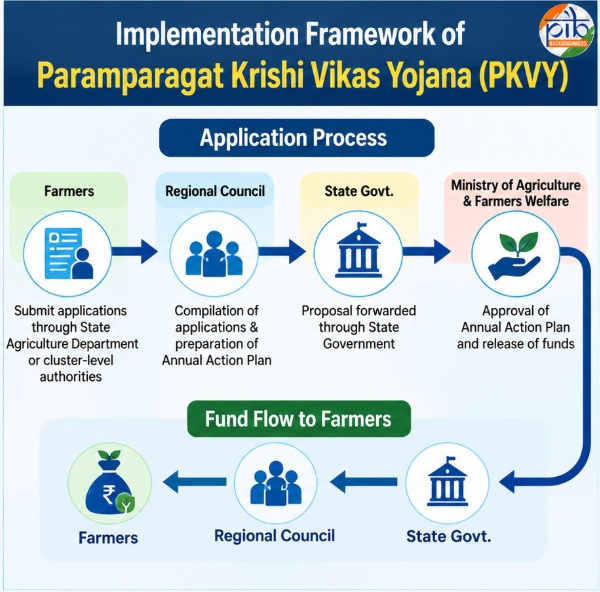
- Submit your application through the concerned Agriculture Department or cluster-level implementing authority. The authorities will guide you through the enrolment process.
- The concerned Regional Council compiles eligible farmer applications into an Annual Action Plan and submits it to the Ministry of Agriculture and Farmers Welfare for approval.
- After approval and release of funds, eligible farmers receive financial assistance according to the scheme rules. The assistance of ₹15,000 per hectare for organic farming inputs is transferred directly to eligible farmers through Direct Benefit Transfer (DBT).
Farmers should contact their District Agriculture Office to confirm whether PKVY clusters are currently available in their area and to know the application process followed by their state.
Organic Certification Under Paramparagat Krishi Vikas Yojana
Organic certification helps farmers show that they are growing crops by following approved organic farming practices without using prohibited chemical fertilisers and pesticides. It also helps buyers identify certified organic products and builds trust among consumers.
Under the Paramparagat Krishi Vikas Yojana (PKVY), organic certification is primarily carried out through the Participatory Guarantee System of India (PGS-India). Another recognised certification system, the National Programme for Organic Production (NPOP), is also used by farmers and businesses, particularly those targeting larger and international markets.
1. Participatory Guarantee System of India (PGS-India)
PGS-India is a simple and affordable organic certification system, mainly designed for small and marginal farmers. It is managed by the Ministry of Agriculture and Farmers Welfare through the National Centre for Organic and Natural Farming (NCONF). It is mainly useful for farmers who want to sell their organic produce in the domestic market.
Under this system, farmers form a group of at least five members. They visit each other's farms, check the farming methods being followed and make sure that all members follow the required organic farming standards. The concerned Regional Council (RC) supervises this process and approves the certification.
PGS-India provides two types of certification status:
- PGS-Green: This status is given to farmers whose farms are in the process of conversion to organic farming. They are following the required organic practices but have not yet completed the conversion period needed for full organic certification.
- PGS-Organic: This status is given after the required conversion period is completed and the farm meets the prescribed organic farming standards. Farmers can then market their produce as PGS-certified organic products, subject to the applicable rules.
Difference Between PGS-Green and PGS-Organic
Farmers do not receive full organic certification as soon as they start organic farming. Their farms must first go through a conversion period while they follow the required organic farming practices. The main differences between the two certification statuses are given below:
Basis | PGS-Green | PGS-Organic |
|---|---|---|
Meaning | Farm is under conversion to organic farming. | Farm has completed the required conversion period and meets organic standards. |
Certification status | Conversion stage | Full organic certification |
Conversion period | Still in progress | Required conversion period completed |
Marketing | Produce cannot be marketed as fully PGS-Organic certified. | Produce can be marketed as PGS-certified organic, subject to applicable rules. |
2. National Programme for Organic Production (NPOP)
The National Programme for Organic Production (NPOP) is another recognised organic certification system. It is particularly useful for farmers, processors and businesses that want to sell their products in larger markets, including international markets. It is managed by the Agricultural and Processed Food Products Export Development Authority (APEDA), under the Ministry of Commerce and Industry.
Unlike PGS-India, where farmers check each other's farms, NPOP certification is provided through independent inspections by accredited certification agencies. These agencies check whether farmers and businesses are following the prescribed organic production standards.
- Certification is provided through APEDA-accredited certification agencies.
- Independent inspections are conducted to check farming and production practices.
- It supports the sale and export of certified organic agricultural products.
- It helps farmers, processors and businesses build trust among buyers.
Difference Between PGS-India and NPOP Certification
Both systems help farmers obtain organic certification, but they follow different methods and serve different market needs. The main differences are given below:
Basis | PGS-India | NPOP |
|---|---|---|
Certification type | Community-based certification | Third-party certification |
Verification | Farmers check each other's farms. | Accredited agencies conduct independent inspections. |
Managed by | Ministry of Agriculture and Farmers Welfare through NCONF | APEDA, Ministry of Commerce and Industry |
Main suitability | Small and marginal farmers | Farmers, processors and exporters |
Market focus | Mainly domestic markets | Domestic and international markets |
The time required to receive full organic certification under PGS-India depends on the type of crop and the applicable certification standards. During this period, farmers must maintain records of their farming activities, take part in group inspections and follow the guidance of their Regional Council.
Relevant Links
- Department of Agriculture and Farmers Welfare – Official Website
- PGS-India Portal
- National Centre for Organic and Natural Farming – PGS-India
- PM-RKVY Guidelines (Including PKVY)
- Paramparagat Krishi Vikas Yojana Guidelines
- Paramparagat Krishi Vikas Yojana Backgrounder
- Paramparagat Krishi Vikas Yojana Official FAQs
Contact Information
Department of Agriculture and Farmers Welfare
Ministry of Agriculture and Farmers Welfare, Government of India
- Phone: 011-23385093 (Department's general contact number)
- Email: No dedicated PKVY email address could be verified in the Central Government directory.
- Address: Room No. 131, Krishi Bhawan, New Delhi, India.
National Centre for Organic and Natural Farming (NCONF)
Farmers seeking information about PGS-India certification and organic farming practices can also contact the National Centre for Organic and Natural Farming (NCONF).
- Phone: 120-2764906 / 120-2764212
- Email: [email protected]
For assistance regarding PKVY enrolment, cluster formation and organic certification, farmers can also contact their respective State Agriculture Department or concerned Regional Council. For general agricultural queries, farmers can call the Kisan Call Centre at 1800-180-1551.
Frequently Asked Questions
Paramparagat Krishi Vikas Yojana (PKVY) is a Government of India scheme launched in 2015–16 to promote organic farming through a cluster-based approach. It provides financial and technical support to farmers adopting organic cultivation practices.
The scheme was launched in 2015–16 under the National Mission for Sustainable Agriculture (NMSA). It is now one of the components of Pradhan Mantri Rashtriya Krishi Vikas Yojana (PM-RKVY).
Eligible farmers receive assistance of ₹31,500 per hectare over three years. This includes ₹15,000 through Direct Benefit Transfer (DBT) for organic farming inputs.
Farmers willing to adopt organic farming can participate through approved organic farming clusters, subject to the scheme guidelines. Small and marginal farmers are given preference during cluster formation.
Financial assistance is available for a maximum eligible land area of 2 hectares per farmer, subject to the applicable scheme guidelines.
Farmers can contact their nearest Block or District Agriculture Office, ATMA or Krishi Vigyan Kendra (KVK) to find out about available organic farming clusters and the application process in their area.
PGS-India stands for Participatory Guarantee System of India. It is a community-based organic certification system in which farmers inspect each other's farms and verify compliance with organic farming standards.
PGS-Green is given to farms that are in the process of converting to organic farming. PGS-Organic is granted after the required conversion period is completed and the farm meets the prescribed organic standards.
Yes. The scheme includes financial assistance for organic certification and residue analysis. PGS-India is the primary certification system associated with PKVY.
Farmers can call the toll-free Kisan Call Centre at 1800-180-1551 for general agricultural guidance and assistance.
Do you have any question regarding schemes, submit it in scheme forum and get answers:
Feel free to click on the link and join the discussion!
This forum is a great place to:
- Ask questions: If you have any questions or need clarification on any aspect of the topic.
- Share your insights: Contribute your own knowledge and experiences.
- Connect with others: Engage with the community and learn from others.
I encourage you to actively participate in the forum and make the most of this valuable resource.
| জাত | ব্যক্তির প্রকার | প্রকল্পের ধরন | সরকার |
|---|---|---|---|


সেক্টরের জন্য ম্যাচিং প্রকল্প: Financial Assistance
| Sno | CM | Scheme | সরকার |
|---|---|---|---|
| 1 | 
|
প্রধানমন্ত্রী কৃষাণ সম্মান নিধি (পিএম - কৃষাণ) | কেন্দ্র সরকার |
| 2 |
|
SMILE Scheme | কেন্দ্র সরকার |
| 3 |
|
পিএমএফএমই (PMFME) আঁচনি | কেন্দ্র সরকার |
| 4 |
|
Pradhan Mantri Samajik Sahayata Yojana | কেন্দ্র সরকার |
| 5 |
|
PM CARES for Children Scheme | কেন্দ্র সরকার |
| 6 |
|
Thalassemia Bal Sewa Yojana | কেন্দ্র সরকার |
| 7 |
|
Pradhan Mantri Matsya Kisan Samridhi Sah-Yojana | কেন্দ্র সরকার |
| 8 |
|
National Family Benefit Scheme | কেন্দ্র সরকার |
| 9 |
|
Pandit Deendayal Upadhyay National Welfare Program for Sportspersons | কেন্দ্র সরকার |
| 10 |
|
Scheme of Cash Incentive to Medal Winners in International Sports Events and their Coaches | কেন্দ্র সরকার |
| 11 |
|
Pradhan Mantri Parivar Labh Yojana | কেন্দ্র সরকার |
নতুন কমেন্ট যুক্ত করুন