


- Funds deep technology startups with a grant of up to Rs. 1 crore.
- The grant is equity-free and released in tranches as project milestones are met.
- Open to startups across India, with winners required to move their registered office to the state.
- Connects selected startups to government-backed incubators, mentors and market linkages.
- Startup Karnataka Helpline Number :- 080-22231007.
- Startup Karnataka Helpdesk Email :- [email protected].
Summary of the Scheme | |
|---|---|
| Name of Scheme | Karnataka ELEVATE NxT Scheme 2026-27 |
| Benefits | One-time, equity-free grant-in-aid of up to ₹1 crore. |
| Beneficiary | Eligible deep-tech startups registered anywhere in India. |
| Nodal Agency | Department of Electronics, IT, BT and S&T, Government of Karnataka. |
| Subscription | Subscribe here to get Update Regarding Scheme |
| Mode of Apply | Online through the official ELEVATE portal. |
Scheme Introduction: A Brief Overview
The Karnataka ELEVATE NxT Scheme 2026-27 is a Government of Karnataka initiative that supports deep-tech startups developing advanced technologies based on science and engineering. Eligible startups can receive a one-time, equity-free grant-in-aid of up to ₹1 crore, along with mentorship and incubation support. Applications are accepted online through the official ELEVATE portal from 13 October 2026 to 13 November 2026, with the deadline set at 5:00 PM IST on the closing date.
The scheme is run by the Department of Electronics, IT and BT, Government of Karnataka, and implemented through the Karnataka Innovation and Technology Society (KITS). Its formal name is the ELEVATE DeepTech Grant-in-Aid Scheme under the Local Economy Accelerator Programme (LEAP). The programme follows the applicable operational guidelines of the Karnataka Startup Policy 2025-2030 and provides milestone-based funding to selected startups.
The Karnataka ELEVATE NxT Scheme aims to address the funding gap that deep-tech startups often face between early research and commercialisation. These businesses may require years of research, significant investment, specialised infrastructure, and extensive testing before their technologies become commercially viable. The scheme supports startups at Technology Readiness Levels (TRL) 3 to 8, covering stages from experimental proof of concept to a complete and qualified system.
Unlike programmes restricted to businesses registered in Karnataka, ELEVATE NxT accepts applications from eligible startups across India. However, selected startups registered outside Karnataka must shift their registered office to Karnataka within 4 months of the result announcement. Beyond financial assistance, selected startups can receive mentorship, subsidised incubation, technology validation support, and market linkages through mapped K-Tech Innovation Partners. The grant is equity-free, so the government does not take an ownership stake in the startup in exchange for the grant.
ELEVATE NxT is one of two calls currently available under Karnataka's ELEVATE startup grant-in-aid programme. The other is the Karnataka ELEVATE Minorities Scheme 2026, which offers eligible startups up to ₹50 lakh in grant support. The official portal states that startups may apply to both calls if they meet the respective eligibility requirements. According to the programme figures provided, the first ELEVATE NxT edition received 983 applications and supported 33 deep-tech startups with ₹30 crore in funding, including 12 women-led startups.
Startups must meet specific requirements to qualify for ELEVATE NxT, including registration as an eligible business entity, a minimum of 2 individuals in the founding or core team, and a declared TRL between 3 and 8. Applicants must also demonstrate deep-tech capabilities, technical complexity, and intellectual property potential. Innovators exploring earlier-stage support can also read about the Karnataka Rajiv Gandhi Entrepreneurship Program, which provides a separate support route for eligible innovators developing prototypes or minimum viable products (MVPs).
Interested startups can submit their applications through the official ELEVATE portal. Applicants should review the eligibility criteria, prepare the prescribed pitch decks and notarised affidavit, and upload all required documents before submitting the application.
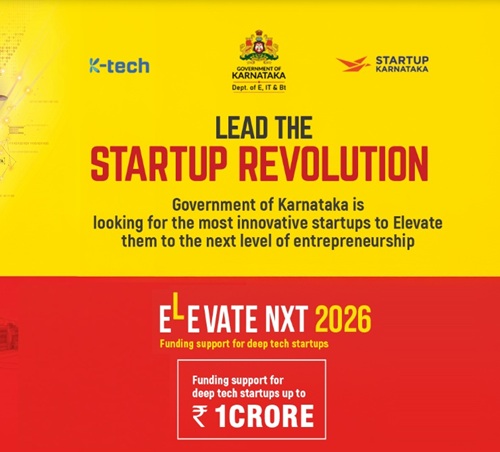
Scheme Benefits
The main benefit of ELEVATE NxT 2026-27 is a large, equity-free DeepTech startup grant from the Government of Karnataka, backed by mentoring and incubation support. Here is what a selected startup receives.
- A one-time grant-in-aid of up to Rs. 1,00,00,000 per selected startup.
- The grant is equity-free, so the government does not take any shareholding in the company.
- The grant money is released in two tranches.
- The first tranche follows completion of the required formalities.
- The second tranche follows achievement of the approved project milestones.
- Winners are mapped to K-Tech Innovation Partners for further support.
- These include government-backed incubators, accelerators and sector-specific Centres of Excellence.
- Domain-specific mentorship is provided through the programme.
- Incubation support is offered at subsidised rates.
- Technology validation support is provided to selected ventures.
- Market linkages are offered through the state's innovation ecosystem.
Eligibility Requirements
Before applying, founders should check who can apply for ELEVATE NxT 2026-27. The eligibility conditions below are set by the Department of Electronics, IT and BT, and an application failing any of them is rejected at the screening stage.
- The applicant must be registered as one of the following entity types.
- A Private Limited Company under the Companies Act, 2013.
- A Registered Partnership Firm under Section 59 of the Partnership Act, 1932.
- A Limited Liability Partnership under the LLP Act, 2008.
- A State or Multi-State Co-operative Society registered under the Multi-State Cooperative Societies Act, 2002, or under any State or Union Territory Cooperative Societies Act.
- The startup can be incorporated and based anywhere in India, as this is a pan-India call.
- The startup must be within 20 years from its date of incorporation at the time of application.
- Turnover must not have exceeded Rs. 300 crore in any financial year since incorporation or registration.
- There must be at least two individuals in the founding or core team.
- The applicant must be an independent entity, and not a subsidiary, spin-off or internal division of an existing company.
- The startup must not have received an ELEVATE Grant-in-Aid benefit in the last three years.
- These three years is counted from the date applications opened, which is 13 October 2026.
- Terms of ownership must not be altered to the founders' advantage during the project.
- The innovation must meet the DeepTech qualification, meaning it is rooted in advanced technology with high technical complexity and strong intellectual property potential.
- The innovation must address a genuine problem in industry, society or the environment, or create a new market.
- The startup must declare a Technology Readiness Level between 3 and 8 for its underlying technology.
- An entity formed by splitting up or reconstructing an existing business is not treated as a startup and cannot apply.
- A winning startup registered outside Karnataka must shift its Registered Office of the Company to Karnataka within four months from the date of the result announcement.
- Failure to comply means the application is treated as rejected.
What Qualifies as a DeepTech Startup
ELEVATE NxT applies the Deep Tech Startup definition issued by the Department for Promotion of Industry and Internal Trade (DPIIT), Government of India. This explains the call's unusual limits. An ordinary startup gets 10 years and a Rs. 200 crore turnover ceiling. A recognised Deep Tech Startup gets 20 years and Rs. 300 crore, and those are the limits ELEVATE NxT uses.
A startup qualifies as DeepTech under this call if it meets the following.
- Its solution is based on new knowledge or advances in one or more scientific or engineering disciplines, still being developed.
- It spends a high share of its revenue or funding on research and development.
- It owns or is creating significant novel intellectual property, shown through patents, proprietary algorithms or deep IP filings, and is taking steps to commercialise it.
- It faces long development timelines, high capital needs and large scientific or technical uncertainty.
- It uses advanced technologies such as AI and machine learning, IoT, blockchain, big data and analytics, AR and VR, robotics, 3D printing or drones.
- It carries high technical complexity, with the potential to redefine existing industries or create new markets.
- It solves problems at the intersection of multiple domains, requiring combined expertise.
- It has societal relevance, global competitiveness and market-creating ability.
Priority Sectors
The department has listed priority sectors for this call. The list is not restrictive, and startups from any domain may apply if they meet the DeepTech qualification above.
- Quantum Technologies.
- Energy and Climate.
- Mobility and Logistics.
- Generative AI.
- Cybersecurity and Secure Systems.
- Fintech.
- Space and Satellite.
- Aerospace and Defence.
- AgriTech and FoodTech.
- Health, Bio and Life Sciences.
- Nanotechnology.
- Semiconductors and Microelectronics.
- Industrial Automation.
- Advanced Materials and Manufacturing.
- Robotics.
- Other advanced technology domains, to be specified in the application.
Technology Readiness Level Requirement
Every applicant must declare a Technology Readiness Level, or TRL, between 3 and 8. TRL is a standard scale from 1 to 9 that measures how mature a technology is. Startups below TRL 3 or at TRL 9 do not fall within the eligible band for this call. The table below explains what each eligible level means.
| TRL | Stage | What It Means |
|---|---|---|
| TRL 3 | Experimental proof of concept | Research and development has begun, with laboratory studies and measurements validating analytical predictions. |
| TRL 4 | Technology validated in lab | The technology is validated through designed investigation, with evidence that the target performance may be achievable. |
| TRL 5 | Technology validated in relevant environment | Reliability rises sharply, with a semi-integrated system or model validated in a simulated environment. |
| TRL 6 | Technology demonstrated in relevant environment | A prototype system is produced and demonstrated in a simulated environment. |
| TRL 7 | System prototype demonstrated in operational environment | A major step up in maturity, with the prototype verified in a real operational environment. |
| TRL 8 | System complete and qualified | An actual system is manufactured and qualified in an operational environment, which in most cases marks the end of development. |
The department links applicants to a TRL reference guide published on the YUKTI portal of the Ministry of Education's Innovation Cell, Government of India. It is background reading for understanding the scale, and it does not set any ELEVATE rule by itself.
Required Documents
Applicants should keep the full ELEVATE NxT document checklist ready before starting the online form. The department has stated that missing or invalid documents result in automatic rejection.
- Valid Certificate of Incorporation of the registered entity, as applicable to the entity type.
- Memorandum of Association for a Private Limited Company, or the LLP Deed or Partnership Deed, as applicable.
- CA-certified revenue certificate for Financial Year 2025-26, confirming turnover is below Rs. 300 crore.
- Shareholding proof, showing the shareholding pattern attested by a Chartered Accountant.
- Patent filing or grant certificate, if applicable, which strengthens the IP potential assessment.
- Pitch Deck 1, the anonymised qualification deck of a maximum of two slides.
- Pitch Deck 2, the business model deck prepared on the prescribed portal template.
- Startup Affidavit, notarised on Rs. 100 e-stamp paper, naming the startup as first party and the Karnataka Innovation and Technology Society (KITS) as second party, submitted as a PDF under 10 MB.
- A certified true copy of the Board of Directors or Partners resolution authorising the signatories to swear the affidavit, which must be appended to the affidavit itself.
- Annexure A to the affidavit, listing details of any prior government funding received, or marked "NIL" if none.
Pitch Deck Guidelines
Two pitch decks are required, and the rules around them are strict. The department has stated that deviating from the prescribed format, length, or anonymity requirements can lead to disqualification.
Pitch Deck 1 - Qualification Deck
- This deck must be anonymised, with no company name, logo, founder's name, company address or patent details anywhere in it.
- The justification must fit within two slides, and exceeding this leads to disqualification.
- It must present the justification for why the applicant should be considered a DeepTech startup.
- Language must be clear and concise, with jargon avoided unless explained.
- The prescribed slide order must be followed, without rearranging or skipping required sections.
- The template provided by the department must not be altered.
- All data must be accurate and verifiable, as false claims disqualify the application.
- Visuals, charts and graphics, where used, must be relevant and easy to read.
- Formatting and design must stay consistent throughout.
- Innovation and differentiation must be highlighted clearly.
- The deck must be submitted in PDF or PPT format only.
Pitch Deck 2 - Business Model Deck
This deck is presented during the in-person pitching stage and is not anonymised. It must follow the business model template provided on the portal, covering these sections.
- Introduction to the company, including name as per incorporation, website, contact details, date of incorporation, CIN, and details of every Director or Partner with DIN number and shareholding.
- Problem statement, supported by visuals, quantifiable data and sourced references.
- Product or solution and the innovation behind it, including how it compares with existing options, R&D undertaken, and any academic or industry partnerships.
- Product readiness level, covering the current stage, the Technology Readiness Level, product images and technical details.
- Socio-economic impact of the project, including job creation in Karnataka, environmental contribution and alignment with the UN Sustainable Development Goals, with quantified figures.
- Team size, background, capability and resources, with each member's role and suitability.
- Market landscape, covering TAM, SAM and SOM, market size and competitors.
- Business model and strategy, covering target customer, value proposition, sales channels and key partners.
- Revenue model, covering pricing strategy and revenue forecast across years.
Steps to Apply
Applicants can apply for this scheme online only. The department has stated that applications are accepted solely through the official ELEVATE portal, so there is no offline route. Here is how to apply for ELEVATE NxT 2026-27 online.
- Visit the ELEVATE Official Portal of the Department of Electronics, IT and BT, Government of Karnataka.
- Click on Register and create an account using the company and personal details asked for.
- Log in to the ELEVATE portal using the registered account.
- Select the call as ELEVATE NxT, after checking eligibility for it.
- Fill in the application form with the required company and founder details.
- Write the self-justification statement of 200 words, explaining why the startup qualifies as a DeepTech venture.
- Select the Technology Readiness Level between 3 and 8 from the dropdown.
- Upload Pitch Deck 1, Pitch Deck 2, the notarised affidavit and all other supporting documents.
- Review every detail carefully, as incomplete applications are rejected.
- Submit the application before 13 November 2026, 5:00 PM.
- Note down the unique ELEVATE ID generated on submission, which is used to track the application.
Selection Process
The Karnataka ELEVATE NxT Scheme follows a 5-stage selection process to identify eligible startups with innovative deep-tech solutions. The authorities evaluate applications, technical capabilities, business plans, and final scores before selecting startups for grant-in-aid support.
| Selection Stage | Process Details |
|---|---|
| Stage 1: Application and Eligibility Check |
|
| Stage 2: Identity Masking and Jury Assignment |
|
| Stage 3: Deep-Tech Evaluation |
|
| Stage 4: First In-Person Pitch |
|
| Stage 5: Grand Finale and Final Selection |
|
Key selection factors: The scheme gives importance to innovation, technical strength, commercialisation potential, and scalability.
Evaluation Criteria
| Criterion | Marks |
|---|---|
| Depth of research and developmental efforts | 20 |
| Strength of foundation and technical evaluation | 20 |
| Clarity of commercialisation strategy and business model | 20 |
| Potential socio-economic effect | 20 |
| Experience and expertise of the founding team | 10 |
| Budgetary allocation and grant utilisation plan | 10 |
| Total | 100 |
Important Dates
| Event | Date |
|---|---|
| Announcement of the call | 12 October 2026 |
| Applications open | 13 October 2026, 9:00 AM IST |
| Last date to apply | 13 November 2026, 5:00 PM IST |
Declarations Required in the Affidavit
The notarised affidavit is a mandatory document, and it carries several conditions that are not listed elsewhere in the application form. Applicants should read these before applying.
- All founding Directors, Partners or Cooperative Society members must sign as deponents, giving full name, parentage, age, address and Aadhaar or PAN number.
- The signatories must be authorised by a resolution of the Board of Directors or Partners, and a certified true copy of that resolution must be appended.
- The complete shareholding or partnership interest must be declared, naming every shareholder with their percentage.
- The deponents must confirm they have read and accept the Operational Guidelines of the Karnataka Startup Policy 2025-2030 covering this scheme.
- They must declare that neither the company nor any promoter, director or partner received a grant under the ELEVATE Idea2PoC Grant-in-Aid Scheme in the three years before applications opened.
- All prior government funding must be declared in Annexure A, covering any grant, subsidy, tax benefit, seed funding or soft loan from any Central, State or local government body.
- If two or more applications from entities sharing a common promoter, director or partner reach the Grand Finale, only the highest-scoring entity can receive the grant, and that decision is final.
- KITS must be informed in writing within 15 days if the company receives any other government funding while the grant is being processed or utilised.
- Any material change to shareholding, directorship or control must be reported to KITS promptly.
- If any information is found false or misleading, KITS may cancel the application without notice, and the deponents and the company are jointly and severally liable to refund the entire grant.
- Disputes are governed by Indian law, with the courts in Bengaluru holding exclusive jurisdiction.
Relevant Links
- Karnataka ELEVATE Official Portal
- Karnataka ELEVATE NxT 2026-27 Online Application Registration.
- ELEVATE Portal Login.
- ELEVATE NxT Startup Affidavit Template.
- ELEVATE NxT CA Revenue Certificate Template.
- ELEVATE NxT CA Shareholding Pattern Template.
- ELEVATE Pitch Masterclass Guidelines.
- Technology Readiness Level (TRL) Reference Guide.
- Department of Electronics, IT and BT, Government of Karnataka.
Contact Information
- Startup Karnataka Helpline Number :- 080-22231007.
- Startup Karnataka Helpdesk Email :- [email protected].
Frequently Asked Questions
Yes. ELEVATE NxT is a pan-India call, so a startup incorporated anywhere in India can apply. However, if it is declared a winner, it must shift its Registered Office to Karnataka within four months of the result, failing which the application is treated as rejected.
Yes. The department allows startups to apply for both open calls, provided they meet the eligibility criteria of each one separately. Note that ELEVATE Minorities requires incorporation in Karnataka, a maximum age of 10 years, turnover below Rs. 200 crore, and at least 51% equity held by members of a recognised minority community.
Because it applies the DPIIT Deep Tech Startup definition, which extends the eligible period to 20 years and raises the turnover ceiling to Rs. 300 crore for deep technology ventures. The 10-year and Rs. 200 crore limits apply to ordinary startups, which is why ELEVATE Minorities uses those figures instead.
No. The call requires a declared Technology Readiness Level between 3 and 8. TRL 9 means the system is already proven in an operational environment and ready for full commercial deployment, which falls outside the eligible band. Startups at TRL 1 or 2 are also outside the band.
Only the entity with the highest evaluation score can receive the grant. The affidavit states that all other qualified finalist applications linked to that individual become ineligible, and this decision is final with no appeal.
No. The grant-in-aid is equity-free and non-repayable, subject to the applicant complying with the scheme terms and achieving the approved milestones.
No. The patent certificate is listed as an "if applicable" document, not a mandatory one. However, intellectual property potential is part of the DeepTech qualification assessment, so a filing or grant certificate strengthens the application.
Yes. The affidavit requires that the signatories be authorised by a resolution passed at a meeting of the Board of Directors or Partners, and a certified true copy of that resolution must be appended to the affidavit. This is easy to miss, as it is stated inside the affidavit template rather than in the main document checklist.
No. The call requires at least two individuals in the founding or core team. Note also that One Person Company Private Limited is not among the accepted entity types for ELEVATE NxT, although it is accepted under ELEVATE Minorities.
The department has not announced a result date for this edition.
Eligible deep-tech startups registered anywhere in India can apply, provided they meet the scheme's requirements regarding business registration, startup age, turnover, technology development, and other prescribed conditions.
The startup must not have exceeded ₹300 crore in turnover in any financial year since its incorporation or registration.
The last date to submit an application for the current call is 13 November 2026 at 5:00 PM IST. Applications opened on 13 October 2026 at 9:00 AM IST.
Do you have any question regarding schemes, submit it in scheme forum and get answers:
Feel free to click on the link and join the discussion!
This forum is a great place to:
- Ask questions: If you have any questions or need clarification on any aspect of the topic.
- Share your insights: Contribute your own knowledge and experiences.
- Connect with others: Engage with the community and learn from others.
I encourage you to actively participate in the forum and make the most of this valuable resource.
| Scheme Type | Govt |
|---|---|


Matching schemes for sector: Business
| Sno | CM | Scheme | Govt |
|---|---|---|---|
| 1 | 
|
Karnataka Dhanashree Scheme | Karnataka |
| 2 |
|
Karnataka Vipra Swa Udyama Nera Sala Scheme | Karnataka |
Matching schemes for sector: Fund Support
| Sno | CM | Scheme | Govt |
|---|---|---|---|
| 1 |
|
Karnataka Gruha Lakshmi Scheme | Karnataka |
| 2 |
|
Karnataka Arya Vysya Aahara Vahini Scheme | Karnataka |
Matching schemes for sector: Business
| Sno | CM | Scheme | Govt |
|---|---|---|---|
| 1 | 
|
Credit Guarantee Scheme for Startups | CENTRAL GOVT |
| 2 |
|
Prime Minister's Employment Generation Programme | CENTRAL GOVT |
| 3 |
|
Atal Vayo Abhyuday Yojana (AVYAY) | CENTRAL GOVT |
| 4 |
|
Production Linked Incentive (PLI) Scheme | CENTRAL GOVT |
Matching schemes for sector: Fund Support
| Sno | CM | Scheme | Govt |
|---|---|---|---|
| 1 |
|
Pradhan Mantri Awas Yojana(PMAY) – Housing for All | CENTRAL GOVT |
| 2 |
|
Yudh Samman Yojana | CENTRAL GOVT |
| 3 |
|
Nikshay Poshan Yojana | CENTRAL GOVT |
Add new comment