

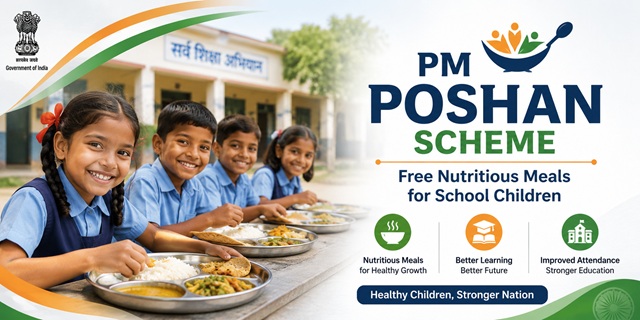
- Free hot cooked meals for students of Government and Government-aided Schools.
- Covers Primary (Classes I-V) and Upper Primary (Classes VI-VIII) students.
- Helps improve child nutrition, health, and learning outcomes.
- PM POSHAN Division Department of School Education & Literacy, New Delhi, India
- Poshan Helpline: 1515
- Email ID: [email protected]
Summary of the Scheme | |
|---|---|
| Name of Scheme | Pradhan Mantri Poshan Shakti Nirman (PM POSHAN) Scheme |
| Launch Year | 1995 |
| Benefits | Free hot cooked meals providing 450 kcal and 12 g protein for primary classes, and 700 kcal and 20 g protein for upper-primary classes per school day. |
| Beneficiary | Children in Balvatika and Classes I–VIII in eligible government and government-aided schools. |
| Nodal Agency | Department of School Education & Literacy, Ministry of Education |
| Subscription | Subscribe here to get Update Regarding Scheme |
| Mode of Apply | No separate application is required. Eligible children receive meals through their school. |
Scheme Introduction: A Brief Overview
A nutritious meal at school can help children grow, stay active, and concentrate better on their studies. To address classroom hunger and improve children's nutrition, the Government of India runs the Pradhan Mantri Poshan Shakti Nirman (PM POSHAN) Scheme, formerly known as the Mid-Day Meal Scheme. Launched on 15 August 1995 as the National Programme of Nutritional Support to Primary Education, the scheme provides free hot cooked meals to eligible children studying in Balvatika and Classes I to VIII in government and government-aided schools. The prescribed meal provides 450 calories and 12 grams of protein to primary-level children and 700 calories and 20 grams of protein to upper-primary students per school day.
Earlier known as the National Programme of Mid-Day Meal in Schools, the scheme was renamed PM POSHAN on 29 September 2021. It has played an important role in addressing classroom hunger and encouraging children to attend school regularly. Meals are prepared according to prescribed nutritional standards, including specific quantities of food grains, pulses, vegetables, and oil. The scheme also promotes equality by encouraging children from different social and economic backgrounds to eat together.
The main objective of the PM POSHAN Scheme is to improve children's nutritional status while encouraging school enrolment, regular attendance, and retention. It also aims to create a more inclusive learning environment and support children's healthy growth and development.
The scheme is implemented by the Department of School Education and Literacy under the Ministry of Education, Government of India, in partnership with State Governments and Union Territory Administrations. Its implementation follows the National Food Security Act, 2013, and the Mid-Day Meal Rules, 2015. Eligible children generally do not need to submit a separate application, as meals are provided through their schools on school working days. Parents can contact the school head, School Management Committee, or relevant district education authority for help with meal availability or quality.
Parents looking for other child nutrition and education-related welfare programmes can also explore the Integrated Child Development Scheme, which supports eligible young children, pregnant women, and lactating mothers through nutrition and early childhood services.
Scheme Benefits
The PM POSHAN Scheme provides nutritional support to schoolchildren while helping them attend school regularly and focus on their studies. Its main benefits are as follows:
- Eligible children receive free hot cooked meals on school working days.
- Primary-level children receive meals providing 450 calories and 12 grams of protein per day.
- Upper-primary students receive meals providing 700 calories and 20 grams of protein per day.
- The scheme helps reduce classroom hunger and supports children's healthy growth and development.
- It encourages school enrolment, regular attendance, and retention, particularly among children from disadvantaged backgrounds.
- Children from different social and economic backgrounds eat together, promoting equality and social inclusion.
- Meals are prepared using prescribed quantities of food grains, pulses, vegetables, oil, and other ingredients to meet nutritional standards.
- School Nutrition Gardens encourage children to learn about growing vegetables and healthy eating habits.
- Through Tithi Bhojan, community members can provide additional food to children on special occasions, along with their regular school meals.
- If a school fails to provide a meal on a school day, eligible children are entitled to a Food Security Allowance under the applicable rules.
Nutritional Standards and Food Norms
Under the PM POSHAN Scheme, children receive meals prepared according to prescribed nutritional standards. The quantity of food and the required calories and protein differ between primary and upper-primary classes to meet children's nutritional needs.
The following table shows the prescribed nutritional and food norms per child per school day:
Food and Nutritional Requirements | Primary Classes (Balvatika and I–V) | Upper-Primary Classes (VI–VIII) |
|---|---|---|
Energy | 450 kcal | 700 kcal |
Protein | 12 g | 20 g |
Food Grains | 100 g | 150 g |
Pulses | 20 g | 30 g |
Vegetables | 50 g | 75 g |
Oil and Fat | 5 g | 7.5 g |
Salt and Condiments | As required | As required |
The exact menu may differ from one State or Union Territory to another, depending on local food habits and the availability of ingredients. However, schools must follow the prescribed nutritional standards. The scheme also encourages the use of locally available foods, seasonal vegetables and millets where appropriate.
Health-related services, such as deworming and iron and folic acid supplementation, may also be provided through coordination with the relevant health authorities.
Financial Assistance and Cost Sharing
The government provides financial support to schools to prepare meals for eligible children under the PM POSHAN Scheme. The minimum material cost per child per school day, revised from 1 May 2025, is given below.
School Level | Material Cost per Day |
|---|---|
Balvatika and Primary Classes | ₹6.78 |
Upper-Primary Classes | ₹10.17 |
This amount covers ingredients such as pulses, vegetables, oil, condiments and fuel. It is separate from the cost of food grains and other scheme expenses.
The Central and State Governments share the costs as follows:
- Most States: 60% Central Government and 40% State Government.
- North-Eastern and specified Himalayan States, including Uttarakhand: 90% Central Government and 10% State Government.
- Union Territories without a legislature: 100% Central Government funding for the applicable shared components.
The Central Government also covers the cost of food grains, transportation and management, monitoring and evaluation as prescribed under the scheme guidelines. States may provide additional funds to support school meals.
Eligibility Requirements
The PM POSHAN Scheme is available to children studying in eligible schools across India. Children must meet the following conditions to receive meals under the scheme:
- The child must be enrolled in Balvatika (pre-primary class before Class I) or Classes I to VIII in an eligible school.
- The school must be a government or government-aided school covered under the scheme.
- Children attending eligible Special Training Centres and supported Madarsas or Maktabs are also covered under the applicable rules.
- Children are eligible regardless of their family income, gender, caste, or social background.
- The child must be enrolled in and attending the school to receive the regular meal on school working days.
- No separate application or income certificate is generally required. Meals are provided through the eligible school.
Required Documents
The PM POSHAN Scheme does not generally require parents to submit a separate application or specific documents to receive meals. Children receive meals through their eligible schools. For school admission and enrolment, parents may need to provide the following documents as required by the school:
- Aadhaar card or another identity document, if required for school records.
- Proof of age or date of birth, if required for admission.
- Address proof, if required by the school.
- Previous school records or a transfer certificate, if applicable.
These documents are for school admission or record-keeping purposes and are not separate PM POSHAN Scheme application requirements. Parents should confirm the applicable admission requirements with the school.
Steps to Apply
Children do not need to fill out a separate application form to receive meals under the PM POSHAN Scheme. The benefit is provided through eligible schools, so parents can follow these simple steps to ensure their child receives the meal.
- First, enrol your child in a government or government-aided school covered under the PM POSHAN Scheme.
- Confirm with the school head or class teacher that your child's class is covered under the scheme.
- Ask the school about the daily meal schedule and menu so you know when meals are served.
- Once your child is enrolled and attending school, the meal is provided on school working days without a separate online registration or application.
- If your child is not receiving the meal or you have concerns about its quality, contact the school head or School Management Committee for assistance.
- For further information about the scheme's rules and implementation, read the official PM POSHAN guidelines. You can also check the PM POSHAN monitoring portal for scheme-related information.
If the issue remains unresolved, contact the relevant district education office or your State/UT's PM POSHAN authority for further help.
How to File a Complaint Under PM POSHAN
If a child does not receive the prescribed meal, or if there is a concern about food quality, hygiene or the way the scheme is being implemented, parents can raise the issue with the school and the relevant education authorities. The following steps can help them seek a resolution:
- First, contact the school head or principal and explain the issue, such as a missed meal, poor food quality, unhygienic preparation or irregular meal service.
- If the issue is not resolved, raise it with the School Management Committee (SMC), which helps monitor the school's meal arrangements.
- You can then contact the Block Education Officer, District Education Officer or the district authority responsible for PM POSHAN in your area.
- If the complaint remains unresolved, use the grievance helpline or complaint portal provided by your State or Union Territory's PM POSHAN authorities.
- For grievances concerning a Central Government department or service, you may also submit a complaint through the Centralised Public Grievance Redress and Monitoring System (CPGRAMS), where applicable.
When submitting a complaint, provide the school's name and location, the date of the incident, and a clear description of the problem. You may also include supporting details or evidence, if available, to help the authorities examine the matter.
Under the Mid-Day Meal Rules, 2015, if a meal is not provided to an eligible child on a school day, the applicable provisions for a Food Security Allowance may apply. This allowance covers the prescribed food-grain entitlement and cooking cost, subject to the rules. The relevant authorities should be contacted to report the missed meal and determine the applicable remedy.
Relevant Links
- Nodal Department – Department of School Education & Literacy
- Official PM POSHAN Scheme Portal
- PM POSHAN Scheme Guidelines
- PM POSHAN Guidelines and Operational Framework.
- Food Grain Allocation Details
- POSHAN Abhiyaan Portal
- Right to Information and Designated Officers
Contact Information
Department of School Education & Literacy, Ministry of Education, Government of India
- Poshan Helpline: 1515
- Email ID; [email protected]
- Phone: 011-24014954 (listed on the current PM POSHAN contact page)
- Email: [email protected]
- Address: Ministry of Education, Department of School Education & Literacy, Kartavya Bhavan 2, New Delhi – 110001
Frequently Asked Questions
PM POSHAN is a Government of India scheme that provides free hot cooked meals to eligible students studying in Government and Government-aided schools.
The scheme was previously known as the Mid-Day Meal Scheme (MDM).
Students studying in Government and Government-aided Schools from Classes I to VIII are eligible to receive benefits under the scheme.
No. Eligible students are automatically covered through their schools.
The scheme covers Primary Classes (I to V) and Upper Primary Classes (VI to VIII).
Eligible students receive free hot cooked meals on school working days.
The scheme aims to improve child nutrition, school attendance, and learning outcomes.
The scheme primarily covers students enrolled in Government and Government-aided schools.
The scheme helps reduce classroom hunger, improves nutrition, and supports better concentration and academic performance among students.
The scheme is implemented by the Government of India in coordination with State Governments and participating schools.
Do you have any question regarding schemes, submit it in scheme forum and get answers:
Feel free to click on the link and join the discussion!
This forum is a great place to:
- Ask questions: If you have any questions or need clarification on any aspect of the topic.
- Share your insights: Contribute your own knowledge and experiences.
- Connect with others: Engage with the community and learn from others.
I encourage you to actively participate in the forum and make the most of this valuable resource.
| Person Type | Govt |
|---|---|

Add new comment