



- Indian fellows receive up to US$2,000 per month to pursue a PhD abroad.
- Overseas fellows receive ₹40,000 per month to pursue a PhD in India.
- Fellows receive an annual contingency grant of US$1,000 or ₹25,000, depending on their category.
- ICAR provides economy-class international return airfare by the shortest route.
- The fellowship supports three years of advanced research in agriculture and allied sciences.
- Agricultural Education Division, Indian Council of Agricultural Research (ICAR)
- Phone: +91-11-25843635 (Dr. Seema Jaggi, Assistant Director General, Human Resource Development)
- Email: [email protected](Fellowship application queries)/[email protected] (HRD-related queries)
- General Email: [email protected] (Agricultural Education Division)
Summary of the Scheme | |
|---|---|
| Name of Scheme | Netaji Subhas-ICAR International Fellowship (NS-ICAR IF) |
| Benefits | Up to US$2,000 per month for Indian fellows pursuing a PhD abroad and ₹40,000 per month for foreign fellows pursuing a PhD in India. |
| Beneficiary | Indian and overseas nationals pursuing a PhD in agriculture and allied sciences. |
| Nodal Agency | Indian Council of Agricultural Research (ICAR) |
| Subscription | Subscribe here to get Update Regarding Scheme |
| Mode of Apply | Prescribed application form submitted by email to ICAR |
Scheme Introduction: A Brief Overview
Pursuing a PhD in agriculture and allied sciences can give researchers the opportunity to work on advanced technologies, learn from experienced scientists and contribute to agricultural development. However, studying at a reputed university in another country can involve considerable expenses and access to specialised research facilities. The Netaji Subhas-ICAR International Fellowship (NS-ICAR IF) supports this kind of advanced research through a three-year fellowship. It provides Indian candidates with up to US$2,000 per month to pursue a PhD at selected overseas institutions, while overseas candidates receive up to ₹40,000 per month to pursue doctoral studies at Indian agricultural universities. The scheme offers around 30 fellowships each year, with the number of Indian and overseas awards depending on the availability of suitable candidates.
The fellowship is administered by the Agricultural Education Division (Human Resource Development section) of the Indian Council of Agricultural Research (ICAR), under the Department of Agricultural Research and Education (DARE), Ministry of Agriculture and Farmers Welfare. It has two main objectives: to help Indian researchers gain expertise in advanced agricultural technologies at leading international laboratories and to promote the Indian agricultural education and research system among overseas scholars. Through this two-way exchange, the scheme aims to strengthen research capacity and encourage international academic collaboration in agriculture and allied sciences.
The fellowship is open to both Indian and overseas nationals who wish to pursue a PhD in an ICAR-identified priority area. Applicants must generally hold a Master's degree in agriculture or an allied science with at least 6.60 OGPA on a 10-point scale or 65% marks. The maximum age is 35 years for fresh candidates and 40 years for in-service candidates, calculated on the last date of application. In-service Indian applicants must be employed in the ICAR-Agricultural University system and obtain the required deputation approval. Candidates must also meet the other academic, research and conduct requirements specified in the fellowship guidelines.
Along with the monthly stipend, the fellowship provides annual contingency assistance and eligible air-travel support. Indian fellows studying abroad can receive US$1,000 per year towards contingency and preparatory expenses, along with an economy-class return air ticket by the shortest route. Overseas fellows studying in India can receive ₹25,000 per year as contingency assistance and reimbursement of eligible economy-class travel between the Indian port of arrival and their university. The fellowship covers a maximum period of three years and cannot be extended.
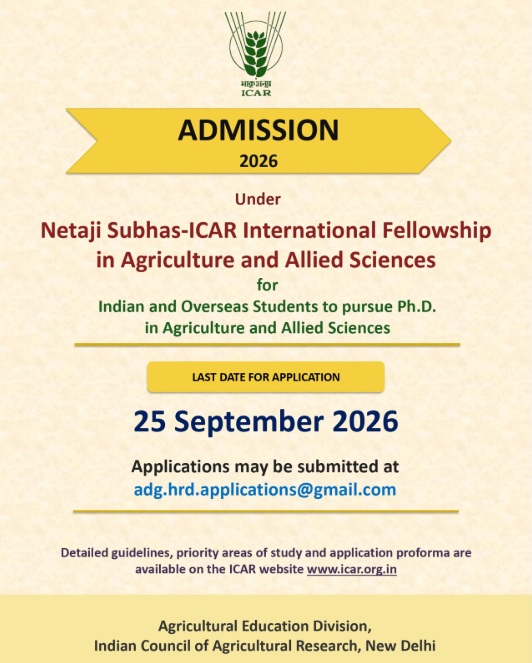
Eligible candidates must apply using the prescribed application form and submit the required documents, including their academic records, research plan and details of referees. Applications for the 2026 fellowship cycle were accepted by email at [email protected], addressed to the Assistant Director General (HRD), ICAR. The last date for the 2026 cycle was 25 September 2026, and the application window is now closed. Applicants can refer to the official fellowship guidelines for detailed conditions and application requirements.
For assistance, candidates can contact the Agricultural Education Division, ICAR, at Krishi Anusandhan Bhavan-II, Pusa, New Delhi – 110012. The general contact number for the ICAR Education Division is 011-25841760, and its email address is [email protected]. No separate helpline number for this fellowship has been published.
Scheme Benefits
The Netaji Subhas-ICAR International Fellowship provides financial support to Indian and overseas researchers pursuing a PhD in agriculture and allied sciences. It also gives fellows an opportunity to gain research experience at reputed universities and institutions in India and abroad. The major benefits include:
- Indian fellows pursuing a PhD abroad receive a monthly stipend of up to US$2,000 for three years.
- Overseas fellows pursuing a PhD at Indian agricultural universities receive a monthly stipend of up to ₹40,000 for three years.
- Indian fellows receive US$1,000 per year towards contingency and preparatory expenses.
- Overseas fellows receive ₹25,000 per year towards contingency expenses.
- Indian fellows are provided an economy-class return air ticket by the shortest route between India and the host country.
- Overseas fellows can claim reimbursement of eligible economy-class travel expenses between their Indian port of arrival and the host university, and back.
- Indian fellows may spend up to 1.5 years conducting research at an Indian agricultural university or institute, subject to the prescribed conditions. During this period, they receive ₹40,000 per month and ₹25,000 per year as contingency assistance.
- Fellows get an opportunity to work with experienced researchers, access advanced research facilities and develop expertise in priority areas of agriculture and allied sciences.
- The fellowship encourages international research collaboration and exchange of scientific knowledge between Indian and overseas institutions.
- Both Indian and overseas fellows are provided with economy-class return airfare by the shortest route. Overseas fellows are also eligible for reimbursement of eligible domestic travel expenses between their arrival airport in India and the destination university, and back.
The fellowship covers a maximum period of three years and cannot be extended. Tuition fees, medical insurance and other personal expenses are not separately covered and must be met by the fellow from the fellowship amount or their own resources.
Financial Assistance and Funding Conditions
The fellowship provides monthly financial assistance and an annual contingency grant to selected candidates. The amount depends on whether the fellow is an Indian national pursuing a PhD abroad or an overseas national pursuing a PhD in India.
Financial Assistance | Indian Fellows (PhD Abroad) | Overseas Fellows (PhD in India) |
|---|---|---|
Monthly Fellowship | Up to US$2,000 | ₹40,000 |
Annual Contingency Grant | US$1,000 | ₹25,000 |
International Airfare | Economy-class return airfare by the shortest route, provided by ICAR. | Economy-class return airfare by the shortest route, provided by ICAR. |
Domestic Travel | Travel from the fellow's residence or workplace to the departure airport in India, and from the arrival airport abroad to the destination university, must be paid by the fellow or the host organisation. | Eligible economy-class travel expenses between the Indian airport of arrival and the destination university, and back, are reimbursed. |
The fellowship does not separately provide financial assistance for tuition fees, university charges or medical insurance. Fellows must meet these expenses from their fellowship amount or their own resources, as applicable.
Bank Guarantee and Security Deposit
Selected fellows must meet certain financial security requirements before receiving the fellowship. The conditions are different for Indian and overseas candidates:
- Indian Fellows: Selected Indian candidates must submit an irrevocable bank guarantee of US$10,000 or its equivalent in Indian rupees in favour of the Secretary, ICAR. The guarantee must remain valid throughout the fellowship period and until successful completion of the programme.
- Overseas Fellows: ICAR withholds a total of ₹2 lakh from the fellowship amount as a security deposit. ₹1 lakh is deducted from each of the first two instalments. This amount is refunded with the final fellowship release after the fellow successfully completes the PhD programme.
Financial Support During Research Visits to India
Indian fellows pursuing their PhD abroad may conduct research or collect data at an Indian State Agricultural University or ICAR institute for up to 1.5 years, provided the visit is part of their approved research plan. The visit requires the advisor's consent and prior approval from ICAR.
During the approved stay in India, fellows receive:
- ₹40,000 per month as a fellowship amount.
- ₹25,000 per year as a contingency grant.
Travel expenses for the research visit must be borne by the fellow. ICAR does not provide separate travel assistance for this purpose.
Expenses Not Separately Covered
The fellowship does not provide separate financial assistance for all expenses. Fellows must arrange the following costs from their fellowship amount or their own resources, as applicable:
- Tuition fees and other university charges.
- Medical insurance and related expenses.
- Medical fitness test expenses.
- Domestic travel from the fellow's residence or workplace to the departure airport in India. These expenses may be borne by the fellow or the host organisation.
All financial assistance is subject to the conditions specified in the ICAR fellowship guidelines.
Eligibility Requirements
The Netaji Subhas-ICAR International Fellowship is open to Indian and overseas candidates who wish to pursue a PhD in agriculture and allied sciences. Applicants must meet the following academic, age and other requirements to be considered for the fellowship:
- The applicant must be an Indian national or an overseas national.
- The applicant must hold a Master's degree in agriculture or an allied science with at least 6.60 OGPA on a 10-point scale, 65% marks or an equivalent grade.
- Fresh applicants must not be more than 35 years old on the last date of application.
- In-service applicants must not be more than 40 years old on the last date of application.
- Fresh applicants must have completed their Master's degree no more than two years before the specified date in the year of admission.
- Indian in-service applicants must be employed in the ICAR-Agricultural University (ICAR-AU) system.
- In-service applicants from India must obtain deputation approval from the Director of the concerned ICAR institute or the Vice-Chancellor of the Agricultural University.
- The proposed PhD research must fall under the priority areas identified by ICAR. Other suitable frontier research areas may also be considered.
- Applicants must have a good conduct record, certified by their last university or current employer.
- Candidates must secure an admission acceptance letter from the proposed host university. It is preferable to submit this letter with the application, but it must be produced at the interview.
The fellowship supports doctoral studies only. It is not meant for Master's degree programmes, short-term training or short research visits. Applicants should also check the official ICAR fellowship guidelines for the complete eligibility conditions.
Required Documents
Applicants need to submit the prescribed application form along with supporting documents to verify their academic qualifications, research experience and eligibility for the Netaji Subhas-ICAR International Fellowship. Keep the following documents ready before applying:
- Completed ICAR application form with a recent passport-size photograph.
- Aadhaar number, which is mandatory for Indian candidates to receive the fellowship.
- Passport details, including passport number, date and place of issue, and expiry date.
- Degree certificates and mark sheets from graduation onwards, showing marks or OGPA.
- Certificates or documents supporting academic awards, honours, scholarships, NET or ARS qualifications, and research or teaching experience, wherever applicable.
- Copies of published research papers, particularly publications with a NAAS rating above 4.0.
- Admission acceptance letter from the proposed host university, if available at the time of application. It must be produced at the interview.
- A research plan describing the proposed PhD research work.
- Deputation permission from the parent organisation for in-service Indian applicants.
- Good conduct certificate issued by the last university attended or the present employer.
- Physical fitness certificate issued by an authorised medical doctor.
- Contact details of two referees who can provide comments on the applicant's academic background and research work.
- For overseas applicants, a certificate from an Indian diplomatic representative and proof of English language proficiency.
Applicants should use the prescribed ICAR application form and official fellowship documents to check the required format and supporting details before submitting their application.
Selection Process
Submitting an application does not guarantee selection for the Netaji Subhas-ICAR International Fellowship. ICAR evaluates applications based on the candidate's academic background, research proposal and suitability for the chosen area of study. The selection process generally involves the following stages:
- Initial screening: ICAR screens the applications and assesses the relevance of the proposed research area, the quality of the research plan, academic record, achievements and previous work experience.
- Evaluation by the selection committee: Eligible applications are considered by the ICAR Selection Committee using a weighted evaluation process based on the prescribed criteria.
- Interview: Shortlisted candidates are called for an interview. It may be conducted in person, by telephone or through teleconference. Overseas candidates may also be interviewed by experts in their home country.
- Admission confirmation: Candidates must produce an admission acceptance letter from the proposed host university at the interview. Therefore, applicants should make arrangements for admission well before the selection stage.
- Final selection: The fellowship is awarded to candidates selected by ICAR after considering the prescribed evaluation criteria and interview.
The selection process considers both academic performance and the proposed research work. Applicants should therefore prepare a clear research plan that explains the subject, objectives and relevance of their proposed PhD study.
Participating Universities and Research Areas
The Netaji Subhas-ICAR International Fellowship supports doctoral research at selected overseas universities and Indian agricultural institutions. The choice of institution depends on the applicant's nationality and the direction of study under the fellowship.
Universities for Indian Fellows
Indian candidates can pursue their PhD at identified overseas universities and research institutions. The 2026 fellowship notification provides a list of approximately 83 suggested institutions. Some examples include:
- Cornell University, USA
- Purdue University, USA
- Texas A&M University, USA
- Wageningen University, Netherlands
- University of Guelph, Canada
- University of Queensland, Australia
- Australian National University, Australia
- University of Tokyo, Japan
- Hebrew University of Jerusalem, Israel
- Swedish University of Agricultural Sciences, Sweden
Indian candidates can also explore other reputed and recognised universities, subject to ICAR's prescribed conditions. Applicants should refer to the list of overseas universities for the fellowship before selecting their preferred host institution.
Universities for Overseas Fellows
Overseas candidates can pursue their PhD at eligible Indian Agricultural Universities and institutions in the ICAR-AU system. The list covers around 79 institutions, including:
- State Agricultural Universities (SAUs).
- Three Central Agricultural Universities located at Imphal, Jhansi and Pusa.
- Four ICAR Deemed-to-be Universities: ICAR-Indian Agricultural Research Institute (IARI), New Delhi; ICAR-Central Institute of Fisheries Education (CIFE), Mumbai; ICAR-Indian Veterinary Research Institute (IVRI), Bareilly; and ICAR-National Dairy Research Institute (NDRI), Karnal.
- Central universities with agricultural faculties, including Aligarh Muslim University, Banaras Hindu University, Nagaland University and Visva-Bharati.
Priority Research Areas
The fellowship focuses on advanced and emerging research topics in agriculture and allied sciences. The 2026 notification identifies seven broad priority areas:
Research Area | Examples of Priority Topics |
|---|---|
Crop Sciences | Genome editing, crop improvement, pest and disease management, high-throughput phenomics and seed quality research. |
Horticulture | Date palm research, modern orchard management, mechanisation, GIS and remote sensing. |
Biotechnology and Nanotechnology | Transgenic technologies, genome-wide association studies, nano-biosensors, metagenomics and cryopreservation. |
Animal Sciences | Molecular diagnostics, recombinant vaccines, biosecurity, dairy processing and next-generation sequencing. |
Natural Resource Management | Climate change, soil carbon sequestration, artificial intelligence and machine learning in natural resource management, and precision nutrient management. |
Agricultural Engineering | Robotics, drones, precision farm machinery, post-harvest technology, smart packaging and drip irrigation. |
Fisheries | Cage culture, fish health, feed technology, stock assessment and fish processing. |
ICAR may also consider other suitable frontier research areas under the prescribed conditions. Applicants should refer to the list of approved research subjects and priority areas to identify topics eligible for the fellowship before preparing their research proposal.
Steps to Apply
Applying for the Netaji Subhas-ICAR International Fellowship involves selecting a suitable research institution, preparing a PhD research plan and submitting the prescribed application form with supporting documents. ICAR accepts applications through email as specified in its fellowship notification. Follow these steps to complete the application:
- First, open the ICAR fellowship notification page. Download the latest fellowship guidelines, priority areas of study, application form and list of eligible universities.
- Go through the priority areas and identify the research subject that matches your academic background. Indian applicants should select a suitable overseas university or institution from the list, while overseas applicants should choose an eligible Indian Agricultural University under the ICAR-AU system.
- Contact your preferred university and check its PhD admission requirements, course details and application deadlines. Obtain an admission acceptance letter from the proposed host institution. ICAR prefers applicants to attach this letter with the fellowship application, and it is compulsory to produce it at the interview.
- Prepare a research plan explaining the proposed PhD topic and the work you intend to undertake. Also, arrange the contact details of two referees who can comment on your academic background and research experience.
- Fill in the prescribed application form carefully and attach the required documents, including degree certificates, mark sheets, research papers, experience details and other supporting certificates. In-service Indian candidates must also include the required deputation approval.
- Send the completed application and supporting documents by email to [email protected], addressed to the Assistant Director General (HRD), ICAR.
- Use the following subject line in your email: Application for NSIF: Name of Applicant and contact number. Make sure the application reaches ICAR before the deadline mentioned in the latest notification.
- After submission, shortlisted candidates are screened and called for an interview by the ICAR Selection Committee. The interview may be conducted by telephone or teleconference. Overseas candidates may also be interviewed by experts in their home country.
- If selected, complete PhD registration within one year from the date of the fellowship award letter. Failure to register within this period will result in automatic termination of the fellowship offer.
The application period for the 2026 fellowship cycle ended on 25 September 2026. Candidates interested in the next cycle should check the ICAR notification page for the new application form, deadline and instructions. The 2027 application schedule has not yet been announced officially.
Fellowship Duration and Important Conditions
The Netaji Subhas-ICAR International Fellowship is awarded for a maximum period of three years. Fellows must follow the academic, reporting and service conditions prescribed by ICAR throughout the fellowship period. Important conditions include:
- The fellowship is granted for three years and cannot be extended under any circumstances.
- Selected candidates must complete their PhD registration within one year from the date of the fellowship award letter. Otherwise, the fellowship offer automatically terminates.
- Fellows must submit academic progress reports every six months. The reports must be certified by the research advisor, supervisor or head of the institution, as applicable.
- Fellows must pursue full-time doctoral studies and cannot change their place of work or make changes to the broad approved research area without following the prescribed conditions.
- ICAR may terminate the fellowship immediately if a fellow's academic progress or conduct is found unsatisfactory.
- If the PhD is not completed within the prescribed three-year period, the fellow must arrange the remaining study expenses from their own resources.
- If the PhD remains incomplete even two years after the prescribed fellowship period, ICAR may recover the fellowship amount already paid.
- Fellows must submit a copy of their PhD thesis and a brief report to ICAR within 15 days of completing the programme.
- Indian fellows must return to India after completing their studies and serve in the ICAR-Agricultural University system if a suitable post is offered. Failure to fulfil this obligation may lead to recovery of the full fellowship amount along with 10% overhead charges.
Indian in-service candidates must also sign a bond agreeing to serve their deputing university or institute for at least three years after completing the degree. Applicants should carefully read the fellowship guidelines to understand the applicable bond, security and recovery conditions before accepting the award.
Relevant Links
- Agricultural Education Division, ICAR – Nodal Department
- Netaji Subhas-ICAR International Fellowship 2026 – Official Notification
- ICAR Fellowship Notification and Application Form
- Netaji Subhas-ICAR International Fellowship – Guidelines
- ICAR – Fellowships
Contact Information
Agricultural Education Division, Indian Council of Agricultural Research (ICAR)
- Phone: +91-11-25843635 (Dr. Seema Jaggi, Assistant Director General, Human Resource Development)
- Email: [email protected](Fellowship application queries)/[email protected] (HRD-related queries)
- General Email: [email protected] (Agricultural Education Division)
- Address: Room No. 217, Division of Agricultural Education, Krishi Anusandhan Bhawan-II, New Delhi – 110012, India.
Frequently Asked Questions
The Netaji Subhas-ICAR International Fellowship is a doctoral fellowship offered by ICAR to promote advanced research in agriculture and allied sciences. It allows Indian students to pursue a PhD at selected overseas institutions and overseas students to study at Indian Agricultural Universities.
Indian and overseas nationals with a Master's degree in agriculture or allied sciences can apply. They must meet the prescribed academic requirements, age limit and other conditions mentioned in the ICAR guidelines.
Fresh candidates must not be older than 35 years, while in-service candidates must not be older than 40 years on the last date of application submission.
ICAR offers 30 fellowships each year. The distribution between Indian and overseas candidates depends on the availability of suitable applicants in the priority research areas.
Indian fellows pursuing a PhD abroad receive up to US$2,000 per month. Overseas fellows pursuing a PhD in India receive ₹40,000 per month.
Indian fellows receive US$1,000 per year as a contingency grant, while overseas fellows receive ₹25,000 per year. Both categories are also eligible for economy-class international return airfare by the shortest route, subject to the fellowship guidelines.
The fellowship is provided for three years. The duration cannot be extended. If a fellow does not complete the PhD within this period, they must arrange the expenses for the remaining period themselves.
Yes. Indian fellows may conduct research or collect data at an Indian State Agricultural University or ICAR institute for up to 1.5 years. The visit must be part of the approved research plan and requires prior ICAR approval.
The application must be submitted using the prescribed form and the method specified in the relevant ICAR notification. For the 2026 cycle, candidates were instructed to email their applications to the address mentioned in the notification.
No. The application deadline for the 2026 cycle was 25 September 2026. As of 5 November 2026, the application window has closed, and ICAR has not announced the 2027 application cycle.
Do you have any question regarding schemes, submit it in scheme forum and get answers:
Feel free to click on the link and join the discussion!
This forum is a great place to:
- Ask questions: If you have any questions or need clarification on any aspect of the topic.
- Share your insights: Contribute your own knowledge and experiences.
- Connect with others: Engage with the community and learn from others.
I encourage you to actively participate in the forum and make the most of this valuable resource.
| Caste | Person Type | Scheme Type | Govt |
|---|---|---|---|


Add new comment