



- CGSMFI-2.0 was introduced on 20 March 2026 to improve funding access for MFIs and NBFC-MFIs.
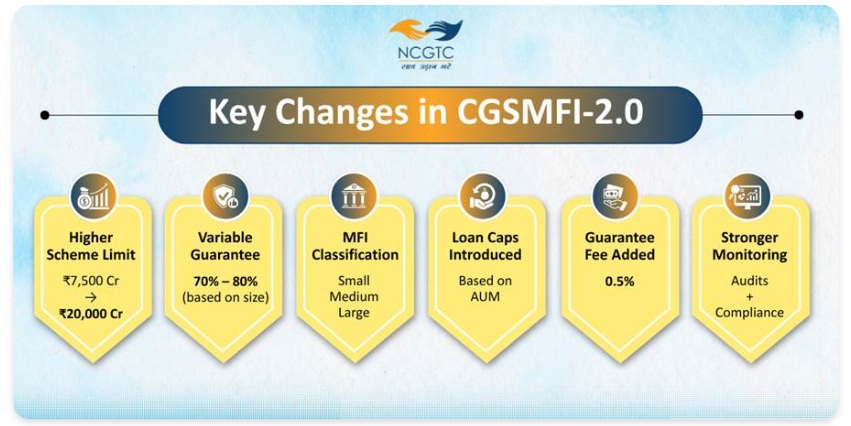
- The scheme aimed to facilitate credit flow of up to ₹20,000 crore.
- Guarantee coverage ranges from 70% to 80%, depending on the MFI's AUM.
- Department of Financial Services, Ministry of Finance, Government of India
- Phone: 022-69035624 / 022-69035607
- Email: [email protected]
Summary of the Scheme | |
|---|---|
| Name of Scheme | Credit Guarantee Scheme for Microfinance Institutions-2.0 (CGSMFI-2.0) |
| Launch Year | 2026 |
| Benefits | 70–80% guarantee cover; up to ₹20,000 crore credit for MFIs. |
| Beneficiary | Eligible MFIs, NBFC-MFIs and small microfinance borrowers. |
| Nodal Agency | National Credit Guarantee Trustee Company Ltd. (NCGTC) |
| Subscription | Subscribe here to get Update Regarding Scheme |
| Mode of Apply | Apply only through banks/FIs (MLIs). No direct application to NCGTC. |
Scheme Introduction: A Brief Overview
Small businesses, self-employed people and low-income families often depend on microfinance institutions for loans to meet their financial needs. However, these institutions sometimes struggle to get enough funds from banks and other financial institutions. To address this problem, the Government of India introduced the Credit Guarantee Scheme for Microfinance Institutions (CGSMFI). Its revised version, known as the Credit Guarantee Scheme for Microfinance Institutions-2.0 (CGSMFI-2.0), was launched on 20 March 2026 to improve the availability of funds for the microfinance sector. Under this scheme, eligible banks and financial institutions receive 70% to 80% guarantee coverage on the amount in default when they provide loans to eligible MFIs and NBFC-MFIs. The scheme aimed to support credit flow of up to ₹20,000 crore and benefit around 36 lakh small borrowers through these institutions.
The scheme is managed by the National Credit Guarantee Trustee Company Limited (NCGTC) under the Department of Financial Services, Ministry of Finance, Government of India. NCGTC provides guarantee support to eligible banks and financial institutions, encouraging them to lend to microfinance institutions. The guarantee coverage depends on the size of the MFI. Small MFIs with Assets Under Management (AUM) below ₹500 crore receive 80% coverage, medium MFIs with AUM between ₹500 crore and below ₹2,000 crore receive 75%, and large MFIs with AUM of ₹2,000 crore or above receive 70% coverage.
The main purpose of CGSMFI-2.0 is to help microfinance institutions get funding so they can continue providing loans to small borrowers. Eligible banks, All-India Financial Institutions and other approved lending institutions can provide financial assistance to MFIs and NBFC-MFIs under the scheme. These institutions must use the funds to provide loans to existing or new small borrowers who meet the Reserve Bank of India's (RBI) definition of microfinance. The maximum financial assistance is generally limited to 20% of an MFI's AUM, subject to the prescribed limits of ₹100 crore for small MFIs, ₹200 crore for medium MFIs and ₹1,000 crore for large MFIs. The scheme also carries a guarantee fee of 0.50% per year, payable by the lending institution, along with specified interest rate conditions.
It is important to understand that this scheme does not provide direct loans, subsidies or loan waivers to individuals. Instead, it provides a guarantee to banks and financial institutions when they lend money to eligible MFIs and NBFC-MFIs. These institutions then use the funds to provide microfinance loans to eligible borrowers. Therefore, individuals cannot apply directly to NCGTC under this scheme. They need to approach an eligible MFI or NBFC-MFI for a loan, while microfinance institutions seeking funds must contact a participating bank or financial institution.
CGSMFI-2.0 was initially valid until 30 June 2026 and was later extended until 31 August 2026 or until guarantees worth ₹20,000 crore were issued, whichever occurred earlier. According to the Department of Financial Services, 139 guarantees amounting to ₹8,463.9 crore had been issued under the scheme as of 31 August 2026. Its published validity period has now ended. Therefore, fresh applications should not be considered open unless the Government announces a further extension or a new notification.
For questions about guarantee coverage and scheme conditions, banks and microfinance institutions can contact the National Credit Guarantee Trustee Company Limited (NCGTC). Individual borrowers should contact their respective MFI or NBFC-MFI for information about loan applications, repayment and other lending conditions.
Readers interested in other government-supported credit schemes can also explore the Credit Guarantee Scheme for Micro and Small Enterprises (CGTMSE), which helps eligible small businesses access institutional loans. The Pradhan Mantri MUDRA Yojana (PMMY) offers business loans to eligible micro enterprises, while the Credit Guarantee Fund for Micro Units (CGFMU) provides guarantee support for eligible MUDRA loans. These schemes have different eligibility conditions and benefits.
Scheme Benefits
The Credit Guarantee Scheme for Microfinance Institutions-2.0 (CGSMFI-2.0) aims to make it easier for microfinance institutions to obtain funds from banks and other financial institutions. By reducing the lending risk through government-backed guarantee coverage, the scheme helps MFIs continue providing financial support to small borrowers. Its major benefits include:
- Provides guarantee coverage of 70% to 80% of the amount in default on eligible loans given to MFIs and NBFC-MFIs.
- Facilitates credit flow of up to ₹20,000 crore to strengthen the microfinance sector.
- Was expected to benefit approximately 36 lakh small borrowers through onward lending by MFIs.
- Helps small and medium-sized MFIs access institutional funding more easily.
- Allows eligible MFIs to receive financial assistance of up to 20% of their Assets Under Management (AUM), subject to the prescribed limits.
- Provides maximum financial assistance limits of ₹100 crore for small MFIs, ₹200 crore for medium MFIs and ₹1,000 crore for large MFIs.
- Encourages banks and financial institutions to lend to MFIs by reducing their potential credit losses.
- Supports both existing and new small borrowers who meet the RBI's regulatory definition of microfinance.
- Promotes access to formal credit for low-income households, self-employed individuals and small business owners.
- Includes interest rate restrictions to help ensure that supported loans are provided to MFIs and small borrowers at reasonable rates.
Note: The above benefits describe the provisions and objectives of CGSMFI-2.0 during its validity period, which ended on 31 August 2026, subject to the scheme's earlier closure condition.
How Does the Credit Guarantee Scheme for MFIs Work?
The Credit Guarantee Scheme for Microfinance Institutions-2.0 (CGSMFI-2.0) works through a partnership between banks, financial institutions, microfinance institutions and the National Credit Guarantee Trustee Company Limited (NCGTC). The scheme reduces the lending risk for banks and encourages them to provide funds to eligible MFIs and NBFC-MFIs, which then offer loans to small borrowers.
The scheme follows a simple lending and guarantee process:
- An eligible bank or financial institution (Member Lending Institution) identifies an eligible MFI or NBFC-MFI seeking financial assistance.
- The bank or financial institution assesses the MFI's financial position, Assets Under Management (AUM) and eligibility before sanctioning the loan.
- The lending institution obtains the applicable credit guarantee coverage from NCGTC according to the MFI's size and the scheme guidelines.
- The MFI or NBFC-MFI uses the sanctioned funds to create fresh loan assets by providing loans to eligible existing or new small borrowers.
- If the MFI or NBFC-MFI defaults on its loan, the lending institution can invoke the guarantee and claim the eligible portion of the amount in default, subject to the scheme's terms and conditions.
- The MFI remains responsible for recovering loans from its borrowers, and individual borrowers must repay their loans according to the agreed repayment terms.
In this way, NCGTC shares a portion of the credit risk with the lending institution, helping maintain the flow of institutional finance to the microfinance sector.
Credit Guarantee Scheme for MFIs-2.0 at a Glance:-
Bank or Financial Institution Approves Loan to MFI → Applies for Guarantee Cover from NCGTC → NCGTC Provides 70%, 75% or 80% Guarantee Coverage → MFI Uses Funds to Provide Loans to Eligible Small Borrowers → Bank Can Claim Eligible Guarantee Amount in Case of MFI Default
Eligibility Requirements
- Scheduled Commercial Banks (SCBs), All India Financial Institutions (AIFIs), MUDRA Ltd. and other institutions approved by NCGTC can participate as Member Lending Institutions (MLIs).
- MFIs and NBFC-MFIs applying for financial assistance must be registered with an RBI-recognised Self-Regulatory Organisation (SRO), such as MFIN or Sa-Dhan.
- MFIs and NBFC-MFIs are divided into three categories based on their Assets Under Management (AUM):
- Small institutions: AUM below ₹500 crore.
- Medium institutions: AUM of ₹500 crore to below ₹2,000 crore.
- Large institutions: AUM of ₹2,000 crore or above.
- The maximum loan assistance is limited to 20% of the institution's AUM, subject to the following category-wise limits:
- Small institutions: Up to ₹100 crore.
- Medium institutions: Up to ₹200 crore.
- Large institutions: Up to ₹1,000 crore.
- The funds must be used to provide fresh loans to eligible small borrowers. They cannot be used to repay existing loans or for other purposes.
- Both existing and new borrowers can receive loans through participating MFIs and NBFC-MFIs, provided they meet the RBI's definition of microfinance borrowers and the scheme conditions.
- MFIs and NBFC-MFIs must follow the prescribed interest rate rules, maintain separate loan accounts for borrowers covered under the scheme and comply with applicable RBI guidelines.
- Participating institutions must submit the required undertakings, financial details and statutory auditor certificates to confirm that they meet the scheme conditions.
Eligible Member Lending Institutions (MLIs)
Under CGSMFI-2.0, the following types of banks and financial institutions can participate as Member Lending Institutions (MLIs), subject to registration with NCGTC:
- Scheduled Commercial Banks (SCBs), including public and private sector banks.
- All India Financial Institutions (AIFIs), such as the Small Industries Development Bank of India (SIDBI).
- MUDRA Ltd.
- Other banks and financial institutions approved by NCGTC under the scheme.
The lending institution must complete the prescribed registration formalities and submit an undertaking to NCGTC before participating as an MLI. MFIs and NBFC-MFIs seeking financial assistance must approach a registered MLI for funding.
The list of registered institutions is available on the NCGTC official scheme page.
Required Documents
To obtain financial assistance under the Credit Guarantee Scheme for Microfinance Institutions-2.0 (CGSMFI-2.0), eligible MFIs and NBFC-MFIs must submit the necessary documents to the participating bank or financial institution. The documents help the lender verify the institution's registration, financial position and eligibility under the scheme. These may include:
- Certificate of Incorporation and registration documents of the MFI or NBFC-MFI.
- RBI registration certificate, wherever applicable.
- Proof of registration or membership with an RBI-recognised Self-Regulatory Organisation (SRO), wherever required.
- Audited financial statements and latest annual reports.
- Details of Assets Under Management (AUM) for determining the institution's category.
- Details of existing borrowings, outstanding loans and repayment history.
- Board resolution or authorisation letter approving the borrowing.
- Business plan explaining how the funds will be used for fresh lending to eligible small borrowers.
- Bank account details and other KYC documents of the institution.
- Required declarations, undertakings and certificates from the statutory auditor, as prescribed under the scheme.
The exact document list may vary depending on the participating lending institution and the applicable scheme guidelines. MFIs and NBFC-MFIs should confirm the requirements with their selected bank or financial institution before submitting an application.
Steps to Apply
The application process under the Credit Guarantee Scheme for Microfinance Institutions-2.0 (CGSMFI-2.0) is different from that of a regular individual loan scheme. MFIs and NBFC-MFIs cannot directly claim the government guarantee. They must approach a registered Member Lending Institution (MLI), such as an eligible bank or financial institution, for funding. The process generally involves the following steps:
- Identify an eligible lending institution: First, the MFI or NBFC-MFI should check the NCGTC CGSMFI-2.0 scheme page and review the list of registered Member Lending Institutions (MLIs). It can then approach a participating bank or financial institution for financial assistance.
- Submit a loan application to the MLI: The MFI or NBFC-MFI must contact the selected lender and submit its funding request along with the required registration documents, financial statements, AUM details and other documents requested by the bank.
- Complete the lender's assessment: The bank or financial institution examines the institution's financial position, eligibility, borrowing requirements and repayment capacity before deciding whether to sanction the loan.
- Obtain guarantee coverage from NCGTC: After sanctioning an eligible loan, the registered MLI submits the required guarantee application and details through the NCGTC system in accordance with the scheme guidelines.
- Complete the required formalities and receive funds: Once the lender completes the necessary documentation and disbursement formalities, the MFI or NBFC-MFI receives the sanctioned financial assistance.
- Provide loans to eligible small borrowers: The MFI must use the funds for the prescribed purpose, including creating fresh loan assets by providing microfinance loans to eligible existing or new small borrowers within the RBI's regulatory definition of microfinance.
Individual borrowers cannot apply directly through the NCGTC website for this guarantee. Those looking for a microfinance loan should contact an eligible MFI or NBFC-MFI and follow its normal loan application and verification process.
Loan Amount and Guarantee Coverage Under CGSMFI
Under CGSMFI-2.0, the maximum financial assistance available to an eligible MFI or NBFC-MFI depends on its Assets Under Management (AUM). The loan assistance is generally limited to 20% of the institution's AUM, subject to the maximum amount prescribed for each category.
The guarantee coverage also varies according to the size of the institution, as shown below:
MFI Category | Assets Under Management (AUM) | Maximum Loan Assistance | Guarantee Coverage |
|---|---|---|---|
Small MFI | Below ₹500 crore | Up to 20% of AUM, maximum ₹100 crore | 80% |
Medium MFI | ₹500 crore to below ₹2,000 crore | Up to 20% of AUM, maximum ₹200 crore | 75% |
Large MFI | ₹2,000 crore or above | Up to 20% of AUM, maximum ₹1,000 crore | 70% |
For example, if a small MFI has an AUM of ₹400 crore, its maximum eligible financial assistance would be ₹80 crore, subject to the scheme conditions. The applicable guarantee coverage would be 80% of the eligible amount in default, not 80% of the entire sanctioned loan.
The maximum financial assistance limit and guarantee coverage are two different things. The first determines how much funding an MFI can receive, while the second determines the portion of the eligible default amount covered by NCGTC.
Interest Rate and Guarantee Fee Under CGSMFI
CGSMFI-2.0 includes specific interest rate conditions and a guarantee fee to regulate the cost of institutional borrowing and encourage affordable onward lending to small borrowers.
The main financial conditions are as follows:
- Interest rate charged by the MLI: The interest rate on financial assistance provided by the bank or lending institution to an MFI is capped at the applicable External Benchmark Lending Rate (EBLR) or one-year Marginal Cost of Funds Based Lending Rate (MCLR), plus 2% per annum.
- Interest rate charged by the MFI: The interest rate charged to eligible small borrowers must be at least 1 percentage point below the MFI's average lending rate during the preceding six months.
- Guarantee fee: The annual guarantee fee is 0.50% and is payable by the Member Lending Institution (MLI) to NCGTC.
- First-year fee calculation: The guarantee fee is calculated on the sanctioned amount during the first year.
- Subsequent-year fee calculation: From the second year onwards, the fee is calculated on the outstanding loan amount.
These conditions are intended to make institutional funding more accessible while ensuring that the financial benefits of the guarantee mechanism also support reasonable lending rates for small borrowers.
Relevant Links
- Department of Financial Services (DFS) Official Website
- National Credit Guarantee Trustee Company (NCGTC) Official Website
- CGSMFI-2.0 Scheme Portal
- CGSMFI-2.0 Operational Guidelines and FAQs
- SPOC FORM for Credit Guarantee Scheme for Microfinance Institutions-2.0
- CGSMFI-2.0 Launch Notification
Contact Information
National Credit Guarantee Trustee Company Limited (NCGTC)
Department of Financial Services, Ministry of Finance, Government of India
- Phone: 022-69035624 / 022-69035607
- Email: [email protected]
- General Email: [email protected]
- Address: 1410, 14th Floor, Parinee Crescenzo, Plot No. C-38 & C-39, G-Block, Bandra Kurla Complex (BKC), Bandra East, Mumbai, Maharashtra – 400051.
- NCGTC Contact and Grievance Portal
Frequently Asked Questions
CGSMFI-2.0 is a Government of India credit guarantee scheme designed to improve access to institutional funding for eligible Microfinance Institutions (MFIs) and NBFC-MFIs. It provides guarantee coverage to eligible lenders against a portion of the amount in default.
CGSMFI-2.0 was introduced on 20 March 2026 to support credit flow to the microfinance sector.
The scheme aimed to facilitate credit flow of up to ₹20,000 crore to eligible MFIs and NBFC-MFIs.
Eligible MFIs and NBFC-MFIs can receive funding from participating Member Lending Institutions (MLIs). Small borrowers benefit indirectly when these institutions use the funds to provide microfinance loans.
No. Individual borrowers cannot directly apply for this scheme. They can approach an eligible MFI or NBFC-MFI for a microfinance loan.
Eligible Member Lending Institutions include Scheduled Commercial Banks, All India Financial Institutions such as SIDBI, MUDRA Ltd. and other institutions approved by NCGTC.
The maximum financial assistance is generally limited to 20% of the MFI's Assets Under Management (AUM), subject to these category-wise caps:
- Small MFIs: Up to ₹100 crore.
- Medium MFIs: Up to ₹200 crore.
- Large MFIs: Up to ₹1,000 crore.
The guarantee coverage depends on the size of the MFI:
- Small MFIs: 80%.
- Medium MFIs: 75%.
- Large MFIs: 70%.
This coverage applies to the eligible amount in default, not the entire sanctioned loan.
The annual guarantee fee is 0.50%. The fee is calculated on the sanctioned loan amount during the first year and on the outstanding loan amount in subsequent years. It is payable by the Member Lending Institution.
The published validity of CGSMFI-2.0 was extended until 31 August 2026 or until guarantees of ₹20,000 crore were issued, whichever was earlier. Since this validity period has ended, fresh applications should not be assumed to be open unless NCGTC announces a further extension.
Do you have any question regarding schemes, submit it in scheme forum and get answers:
Feel free to click on the link and join the discussion!
This forum is a great place to:
- Ask questions: If you have any questions or need clarification on any aspect of the topic.
- Share your insights: Contribute your own knowledge and experiences.
- Connect with others: Engage with the community and learn from others.
I encourage you to actively participate in the forum and make the most of this valuable resource.


Add new comment